A few years back I was sitting in a post-mortem after a run that came in light. Not a disaster. Noticeably below where it should have been. The room had an experienced grower, years in the industry, the kind of person you’d trust with any cultivar. We walked through the timeline, talked through the phases, and his analysis was: “I don’t know. They just locked out.”
Everyone in the room nodded. Conversation over.
I remember sitting there thinking: if I shipped software and the post-mortem was “I don’t know, the servers just crashed,” I’d be out of a job by Friday. In engineering, “I don’t know” is where the investigation starts. In cannabis cultivation, it’s where it ends.
Not because growers are lazy or incompetent. Because the tools to actually dig deeper don’t exist in most facilities. And so the room nods, the next run goes in, and the same pattern shows up eight weeks later.
That cycle is worth understanding. Because until you understand why it happens, it doesn’t stop.
“Locked Out” Is a Symptom, Not a Cause
Think about how emergency medicine works. A patient walks into the ER and says “I can’t breathe.” The doctor doesn’t write “couldn’t breathe” on the chart and send them home. That’s the presenting symptom. The diagnosis is pneumonia, or a collapsed lung, or a panic attack. The treatment is completely different for each one.
“They locked out” is “I can’t breathe.” It describes what you observed from the outside. It says nothing about why.
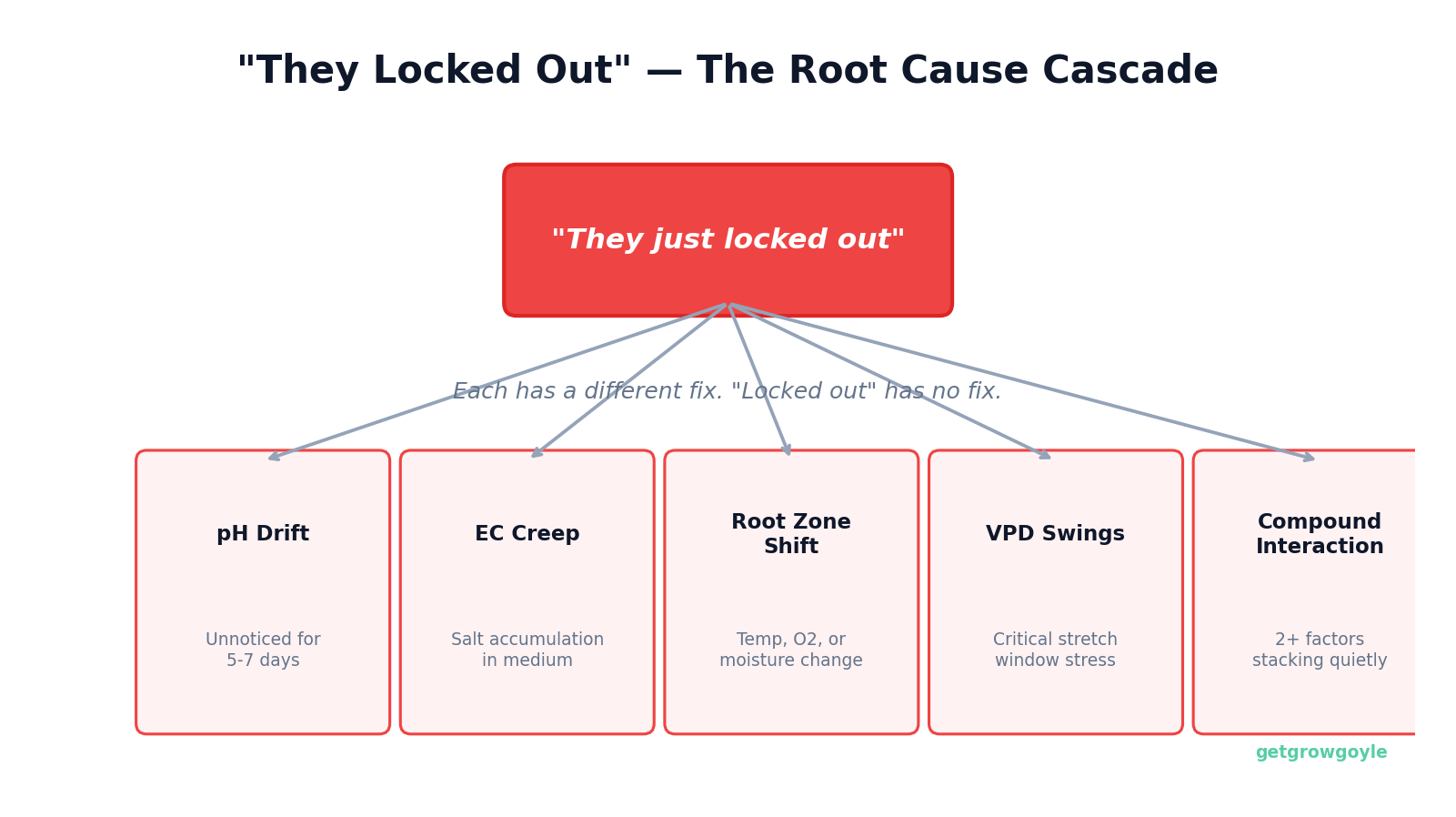
Nutrient lockout is real. Cannabis plants genuinely lose the ability to absorb available nutrients when conditions go wrong. But “locked out” is a description of what the plants looked like, not a root cause. What’s actually driving it is usually one of these:
- pH drift that went unnoticed for five to seven days
- EC creep from salt accumulation in the medium
- Root zone conditions that shifted (temperature, oxygen, or moisture content)
- VPD swings during a critical stretch window that stressed uptake
- An interaction between two of the above that compounded quietly over time
Each of those has a different fix. “They locked out” has no fix, because it’s not actually a problem. It’s a description of what the problem looked like at the surface level.
Saying “they locked out” is like saying “the car stopped.” Sure. But was it the fuel pump, the alternator, or did you run out of gas? The repair is completely different depending on the answer. And you can’t start the car again until you know which one it is.
Why the Post-Mortem Always Ends Here
The “I don’t know” isn’t a character flaw. It’s the completely rational outcome of the systems most commercial cannabis facilities actually run on. There are three reasons the post-mortem reliably stops here, and all three are worth naming clearly.
Reason 1: There’s no data to go deeper with
You cannot do root cause analysis on memory. What was the pH in Week 4? What was the runoff EC trending between Days 20 and 28? Was VPD consistent during lights-on in the back half of flower? If nobody was recording it systematically, or if it was tracked somewhere but never pulled into one view, the post-mortem hits a wall.
“I don’t know” isn’t a cop-out in that situation. It’s literally true. Without data, even the best grower in the room cannot reconstruct what happened. The information doesn’t exist anymore. It lived in someone’s head during the run, and the run is over.
Reason 2: The language protects the grower
This is the part nobody talks about openly. Listen to the grammar of the phrase: “They locked out.” The subject of that sentence is the plant. The plant did something. The grower is absent from the sentence entirely.
Compare that to: “I let the pH drift.” Now the grower is the subject. That sentence carries professional risk.
In an industry where your reputation is your resume (where “master grower” is a literal job title and your next opportunity depends on your track record), saying “I don’t know what happened” feels safer than saying “I think I caused this.” And “they locked out” is the safest version of all, because it implies the plants did something unpredictable. Nobody can argue with it. Nobody can prove otherwise. The post-mortem ends, everyone moves on, and the same thing happens two runs later.
This isn’t a character flaw. It’s rational behavior in a system where:
- There’s no data to support a deeper answer even if you wanted to give one
- Admitting fault carries real professional consequences
- The culture accepts vague explanations because everyone uses them
The problem isn’t the people. The problem is that the system makes honest analysis risky and vague analysis free.
Reason 3: Nobody actually remembers Week 4
Even when a grower genuinely wants to figure out what happened, human memory is terrible at reconstructing a ten-week timeline. You remember the big moments: the day the temps spiked, the week you first noticed the discoloration. But the slow drift? The gradual EC creep? The VPD that ran 0.2 kPa off for eight straight days? Nobody flags that in real time because it never felt like an event. It was background noise that compounded quietly into a problem nobody saw coming until it was already there.
By the time the run finishes light and the post-mortem begins, the window for figuring out what actually happened has already closed. And the conversation is working from fog.
The Uncomfortable Math
Here’s what makes the “locked out” post-mortem expensive in concrete terms.
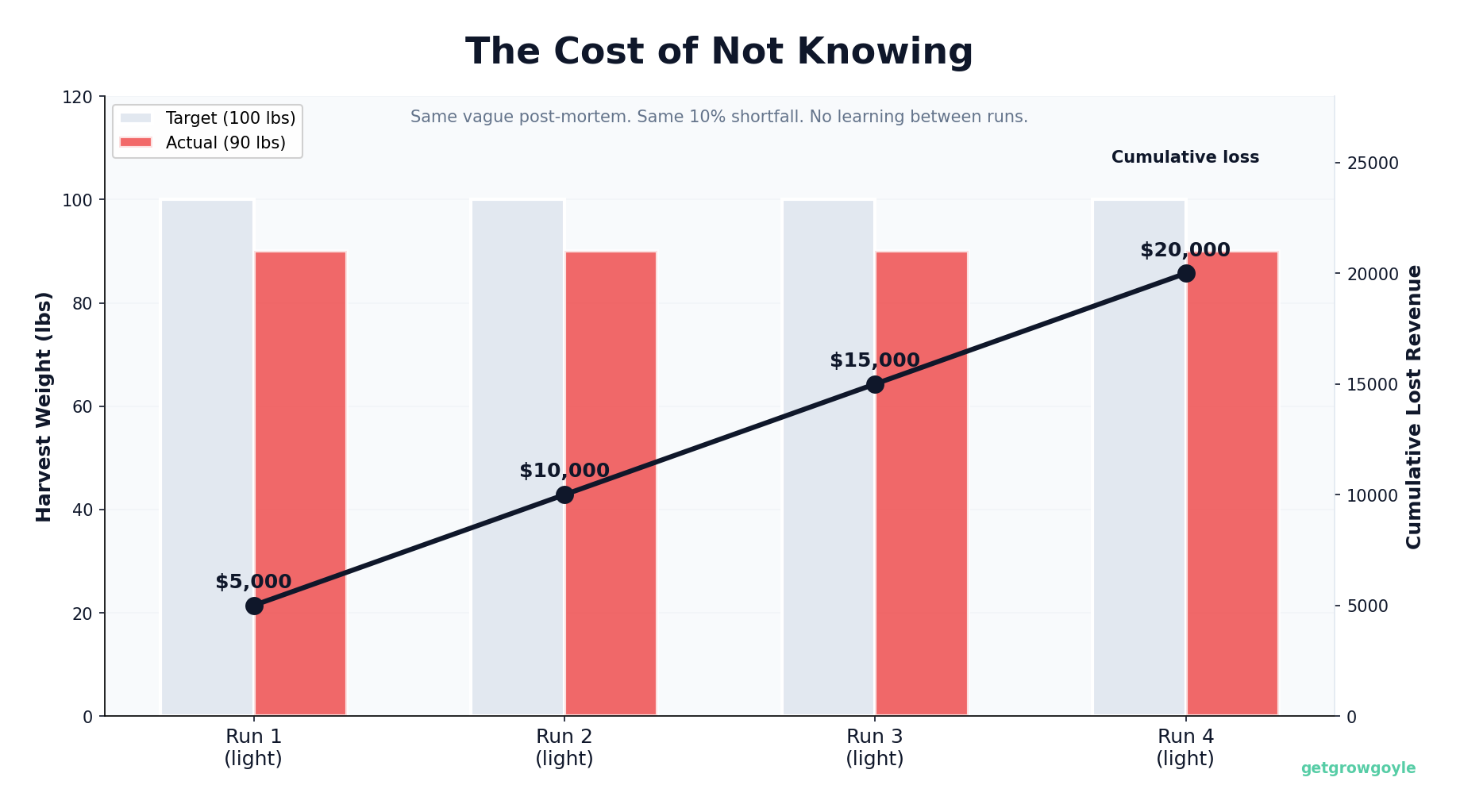
If wholesale is sitting around $500-600/lb and your facility runs 20 or more cycles per year, a run that comes in 10% light on a 100-lb target costs $5,000-6,000 in lost revenue. One run. If the post-mortem is “they locked out” and nothing actually changes, and the same pattern appears two runs later, that’s $10,000-12,000 gone with no learning attached to either of them.
The compounding problem is that the market isn’t pausing while you sort it out. The real cost per pound math gets harder every year. Wholesale was higher two years ago. It’ll be lower two years from now. Every run where the post-mortem ends at “I don’t know” is a run where the improvement rate fell behind the compression rate. And at some point, the math stops working.
The cannabis operations that are pulling ahead in this market aren’t the ones that never have bad runs. Every facility has bad runs. What separates the ones that survive is that they actually figure out what happened and don’t watch the same pattern repeat. Their rate of learning outpaces the market compression. That gap widens every single quarter.
The most expensive sentence in commercial cannabis cultivation isn’t a number. It’s “I don’t know, they just locked out.” Because it means the next run starts from the same position as this one did. Nothing carried forward. Nothing improved. Same inputs, same uncertainty, same risk.
What a Real Post-Mortem Looks Like
A real cannabis post-mortem needs three things. Most facilities have none of them, and that’s not an accusation. It’s just the honest reality of how cultivation operations are typically structured.
1. A timeline, not a snapshot
Not “the pH was off” but “pH held at 6.1 through Week 3, drifted to 5.6 between Days 22 and 28, and the first visible symptoms appeared Day 31.” That tells you exactly when the problem started and how fast it progressed. It also tells you where in the phase the plant was most vulnerable, which directly shapes what changes on the next run.
A snapshot is what your eyes saw on one inspection. A timeline is what actually happened. Those are not the same thing, and post-mortems built on snapshots stay vague by design.
2. Comparison to a run that worked
“They locked out” exists in a vacuum. There’s nothing to compare against. But if you can pull up the run before (the one that hit target) and see that pH held steady through the same window, or EC ran 0.3 lower during Week 4, or VPD stayed tighter during stretch, now you have signal. Comparing runs side by side turns a theory about what might have happened into data showing what was actually different.
The difference between the good run and the bad run is the diagnosis. You don’t need to guess. You need the comparison.
3. Pattern recognition across multiple runs
One bad run is an incident. The same problem appearing in the same phase across three separate runs is a system issue. Maybe it’s the cultivar’s sensitivity at that growth stage. Maybe it’s a seasonal HVAC pattern nobody connected to yield. Maybe it’s a workflow gap where runoff EC stops getting checked after stretch because everyone is focused on something else.
You cannot see a pattern without data from multiple runs sitting side by side. Inconsistent yields have structure. They’re rarely random. But the structure only becomes visible when you have enough runs to look across.
The honest admission: almost no commercial cannabis facility does this manually. Not because they don’t want to. Because pulling three runs of environmental and feed data into a format you can actually compare takes hours of work that nobody has when the next batch is already in the room and the team needs direction today.
Why I Built Around This Problem
I come from software engineering, where post-mortems are a discipline. When a system goes down, you don’t write “servers crashed” on a ticket and move on. You pull logs, trace the timeline, find the root cause, and document it so the same failure can’t repeat. The whole point is for the system to get smarter every time something goes wrong. Blame is beside the point. Learning is the point.
When I started applying that thinking to cannabis cultivation, the gap was obvious. The will to learn is there. Growers are genuinely curious about what happened and most of them want real answers. But without the data infrastructure to support a real investigation, even the most skilled grower in the room ends up saying “I don’t know, they locked out.” Because it’s true. The information that would support a better answer isn’t there.
That’s the gap I built Growgoyle around. AI batch analysis runs after every completed run and assembles what the data shows: what changed between runs, what held steady, what looked different from a run that performed well. It doesn’t point at anyone. It points at data. “pH drifted during Week 4” doesn’t threaten anyone’s professional standing. It’s just information. And information is what turns “I don’t know” from the end of the conversation into the start of one.
The goal isn’t to catch anyone doing something wrong. It’s to give the post-mortem something to actually work with. To make the data the subject of the sentence instead of putting the grower there.
The cannabis operations that are going to be profitable two years from now aren’t the ones with the fewest problems. Every facility has problems. The ones that survive are the ones whose rate of improvement is faster than the rate the market is compressing. Every run you can actually analyze is a run you learned from. Every run that ends at “I don’t know” resets to zero.
Every operation has bad runs. The question is whether the next one starts from the same place, or from somewhere better.
Growgoyle keeps the crop records, completed work, and run comparisons together so a post-mortem has something real to work with. Put the follow-up on the schedule, give it an owner, and check what happened on the next run.