I’ve onboarded a lot of cannabis growers at this point. And there’s a moment that keeps repeating. I’ll ask something simple: “When did you flip this room?” And there’s a pause. Then they open METRC.
Two separate commercial operators did this in the same week. Both running real facilities with real teams, both experienced, both passing every compliance audit. One of them was a full week off on his flip date and had to back-calculate it from his harvest date in METRC. These are not sloppy growers. These are professionals running multi-room cannabis cultivation facilities, hitting deadlines, managing staff. They just didn’t have anywhere to write it down except the system the state gave them.
And that’s the problem. Not METRC. The problem is that METRC became these growers’ default grow journal, even though keeping the regulatory record and running the room are different jobs.
METRC Does Its Job. That’s the Point.
METRC is a compliance system. It tracks plant counts, harvest weights, package IDs, transfers, lab results, and waste manifests. It does this well. It gives the state what the state needs: a chain of custody from seed to sale. Every licensed cannabis cultivation operation in a METRC state uses it because they’re required to. And that’s fine.
For the current jurisdiction list, use our verified 2026 METRC directory. Operators dealing with a different state platform can also review BioTrack vs METRC, including migration and reconciliation issues.
The issue is the context a state traceability record does not capture. METRC can hold growth-stage events and harvest dates. That is different from your planned flip date, your VPD targets during week 5, the reason you adjusted feed EC on day 21, or the observations that might help explain why January hit 2.8 lb/light and March hit 2.3.
METRC can tell you that you harvested 47 pounds. It cannot tell you why it wasn’t 52.
What METRC Tracks vs. What You Actually Need
Here’s the gap, laid out plainly.
On the METRC side: plant counts, harvest weights, package IDs, transfer manifests, lab test status, waste disposal records. That’s the compliance picture. It’s complete for its purpose.
On the cultivation side, you need the operating context: planned and actual flip dates, environment targets, feed changes, canopy observations, strain performance across runs, and what the crew did between them. A state record may contain some of the dates and weights. It is not the complete history you need to run the next crop.
If you’re relying on METRC as your batch-over-batch improvement system, you’re trying to use a compliance ledger as a grow journal. It’s like doing your taxes with a recipe book. Both are useful documents. Neither can do the other’s job.
The Invisible Cost of No Cannabis Cultivation Records
Here’s what this looks like in practice. You had a great run in October. Frosty, dense, 2.9 lb/light. Your team was hyped. Fast forward four months. You’re running the same strain in the same room. And it comes back at 2.4.
What changed? You think it might have been the environment. Maybe the VPD was off during stretch. Maybe you pushed the dry too fast. But you can’t look it up because nobody wrote it down. METRC says you harvested. Your memory says “I think we did something different with the lights.” That’s not cannabis grow tracking. That’s guessing.
The data gap compounds over time. One forgotten detail per run is manageable. But across 4 rooms, 6 strains, 3 runs per room per year, you’re looking at dozens of lost data points. Each one represents a question you can’t answer later. What feed schedule produced your best terpene profile? What was your dry room humidity when that batch came out perfect? The answers existed. They just weren’t captured anywhere that persists.
This is the real cost per pound problem that nobody talks about. Not just inputs and labor. It’s the yield left on the table because you can’t reliably repeat what works.
What a Cannabis Batch Actually Needs Recorded
Think about the lifecycle of a single batch. From flip to cure, there are dozens of inflection points where decisions get made and conditions shift.
At flip, you need the date, the strain, the plant count, the room, and your target environment parameters. During stretch (weeks 1 through 3 of flower), you’re watching canopy development, adjusting light height, maybe defoliating. Mid-flower (weeks 4 through 6), you’re monitoring trichome development, adjusting VPD, watching for deficiencies. Late flower (weeks 7 through 9+), you’re deciding when to flush, when to chop, tracking fade.
Then harvest. Wet weight. Trim. Dry room conditions. Final dry weight. Cure parameters. Lab results. Yield per light.
METRC records required events through the crop and product lifecycle, including growth-stage changes and harvests. What it does not provide on its own is the full operating context between those events. Without a separate habit of recording conditions, work, observations, and decisions, that context stays in somebody’s head, on a whiteboard, or in a text thread nobody can find.
That’s not a character flaw. That’s a systems problem. And it’s universal. Every cannabis cultivation facility I’ve talked to has some version of this gap.
When Your Best Grower Leaves
There’s a version of this problem that keeps operators up at night. Your lead grower, the one who dialed in your environment, who knows exactly when to push the DLI, who can eyeball a canopy and call the yield within 10%. What happens when they leave?
All that institutional knowledge walks out the door. METRC can’t tell you what they did differently. Neither can your spreadsheet from 6 months ago. The new person comes in and starts from scratch, making the same adjustments your last grower already figured out. You’re paying for lessons your facility already learned.
This is why cultivation intelligence matters. Not as a buzzword. As a practical concept: your facility should accumulate knowledge over time, independent of any single person. When the data from every run is captured, structured, and analyzed, your operation gets smarter whether or not the same person is running it.
You Need Two Systems
The answer isn’t to replace METRC. You can’t, and you shouldn’t try. METRC does its job. The answer is to stop expecting it to do a job it was never designed for.
You need one system for the state and one system for you.
Your state system tracks compliance: did you account for every plant, every gram, every transfer? Your cultivation system tracks what actually happened during the run: environment data, feed changes, canopy observations, and what your best runs had in common.
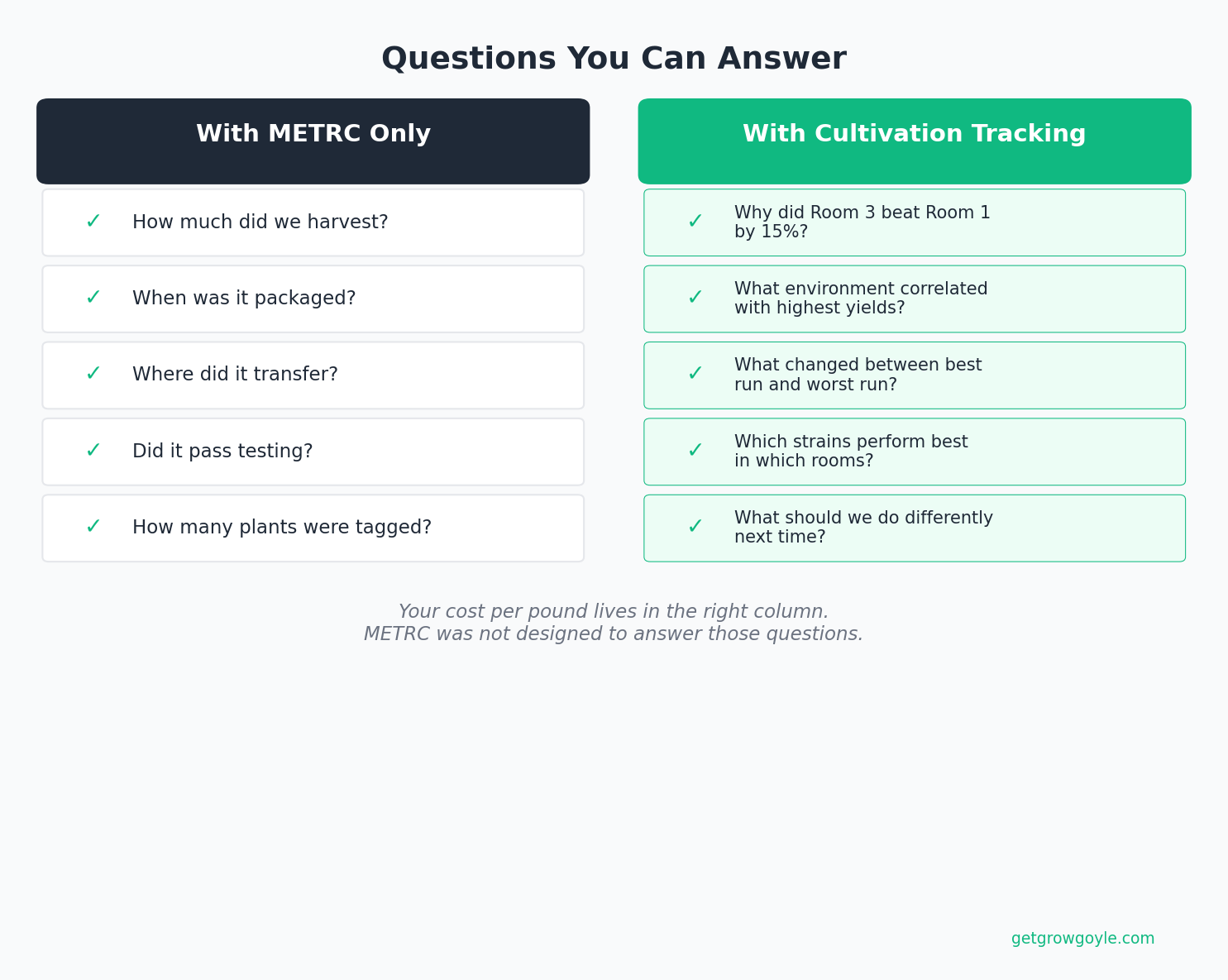
Two systems, two purposes. METRC answers the state’s questions. Cultivation tracking answers yours.
With METRC alone, you can answer: How much did we harvest? When was it packaged? Where did it transfer? Did it pass testing?
With real cannabis batch tracking, you can answer: Why did Room 3 outperform Room 1 by 15% on the same strain? What environment conditions correlated with your highest yields? What changed between your best run and the one that fell short? Which strains perform best in which rooms? What should you do differently next time?
That second set of questions is where your cost per pound actually lives. And right now, for most operations, those questions go unanswered.
Compliance Tracking vs. Cultivation Intelligence
Compliance tracking is backward-looking by design. It answers: what happened? It’s regulatory. It satisfies an external requirement. It records outcomes.
Cultivation intelligence is forward-looking. It answers: what should we do next? It’s operational. It satisfies an internal need. It records the process that created those outcomes, then helps you refine that process run after run.
Both are necessary. But if you only have the first one, you’re running your cannabis facility with one eye closed. You can prove what you grew. You just can’t prove why, or how to grow more of it next time.
This is a useful job for AI batch analysis: assemble the recorded conditions and work, compare runs, and highlight things worth investigating. If an analysis includes a pound estimate, treat it as a modeled opportunity with assumptions, not proof of what a past event cost. You still decide what to check and what to change.
And when you want to understand why one run outperformed another, batch comparison puts them side by side. Here’s what your best run had in common. Here’s what was different about the mediocre one. No guessing. No trying to reconstruct it from memory four months later.
Your Compliance System Tracks Your Grow for the State. You Need Something That Tracks Your Grow for You.
METRC isn’t the problem. The gap is the problem. When the required state record becomes the only record a team maintains, flip plans, feed changes, canopy observations, and follow-up work get carried in someone’s head, scribbled on a whiteboard, or lost in a group text.
Your operation’s rate of improvement depends on how much you retain from your last run. And right now, most of what you retain is whatever you can hold in your head. That’s not a failure of discipline. That’s a failure of systems. Your facility deserves consistent yields, and consistency requires a record that’s actually built for growing, not for compliance.
METRC is for the state to track your grow. Growgoyle is for you to track your grow and repeat what works, run after run.
Growgoyle doesn’t replace METRC. It fills the gap METRC was never designed to fill. See the full system built by a grower who got tired of losing lessons between runs. See how it works.
Leave a Reply