You check your controller. It reads 78°F. Everything looks fine.
But that 78°F is a snapshot. Over the last 24 hours, your room told a different story. Your AC cycled on and off hundreds of times. Each cycle pushed the room through a 4-8°F swing. Your lights cut at midnight and the temperature crashed 10°F in 10 minutes. Your dehumidifier spent 20 minutes catching up while relative humidity spiked into the danger zone. And then the whole thing repeated the next night.
None of this shows up when you glance at a controller screen. But your plants felt every minute of it.
Most commercial growers have their setpoints dialed. The real question is whether their equipment can actually hold those setpoints. The gap between what you set and what your room actually does is where yield, potency, and terpenes quietly disappear.
What’s Actually Happening in Your Room
There are three mechanical realities in almost every commercial flower room that create temperature instability. None of them are operator errors. They’re equipment limitations.
1. AC Deadband Swings During the Day
Every air conditioning system has a deadband: the temperature range around your setpoint where the compressor doesn’t engage. A standard controller might have a 4°F (2.2°C) deadband. That means your “78°F room” is actually cycling between 74°F and 82°F (23.3-27.8°C) all day long. The compressor kicks on at 82, drives the room down to 74, shuts off, and the room drifts back up.
That’s not a setpoint. It’s an average. And the plants don’t experience an average. They experience the swings.
2. The Lights-Off Crash
This is the single biggest environmental event in your room every 24 hours, and most facilities handle it poorly. When LEDs cut (or dim to off), the room loses its primary heat source instantly. Temperature drops 8-12°F (4.4-6.7°C) in minutes.
Here’s the cascade that follows:
- Cooler air holds less moisture. Relative humidity spikes 15-20% almost immediately.
- VPD drops toward zero. Transpiration slows dramatically.
- The dehumidifier, which was sized for steady-state conditions, takes 15-20 minutes to bring humidity back in range.
- During that window, leaf surfaces cool faster than the surrounding air. Condensation forms on flowers. This is the #1 infection window for powdery mildew and botrytis in commercial flower rooms.
Every night. Every room. Unless you’ve specifically engineered the transition.
3. Dehumidifier Heat Rejection
Refrigerant-based dehumidifiers work by cooling air below its dew point, condensing water out, and then reheating the air before returning it to the room. That reheat cycle dumps heat back into the space. In a sealed flower room with high transpiration rates, the dehu is running hard, and that heat adds up.
The result: your night temperature slowly creeps up over the dark period as dehu heat rejection accumulates. Your intended 70°F (21°C) night temp might settle at 74-75°F (23.3-23.9°C) by the end of the dark period. Your DIF (day-night temperature differential) shrinks without you realizing it.
Why This Matters: What Temperature Instability Does to Your Plants
This isn’t theoretical. Peer-reviewed research has measured the effects of temperature swings on cannabis flower production.
DIF and Cannabinoid Production
DIF is the intentional temperature difference between day and night. It’s one of the most important environmental variables in flower, and most growers don’t manage it precisely because their equipment doesn’t let them.
A 2023 study by Bok et al., published in Agronomy, tested five different day/night temperature combinations in indoor cannabis, all averaging 24°C (75°F):
| DIF | Day Temp | Night Temp | Flower Biomass | Cannabinoid Yield |
|---|---|---|---|---|
| -12°C / -22°F | 18°C / 64°F | 30°C / 86°F | Worst (4.7x less) | Lowest |
| -6°C / -11°F | 21°C / 70°F | 27°C / 81°F | Poor | Low |
| 0°C / 0°F | 24°C / 75°F | 24°C / 75°F | Good | Good |
| +6°C / +11°F | 27°C / 81°F | 21°C / 70°F | Good | Highest |
| +12°C / +22°F | 30°C / 86°F | 18°C / 64°F | Moderate | Moderate |
The sweet spot was a +6°C (+11°F) positive DIF: 27°C (81°F) days and 21°C (70°F) nights. Negative DIF (warmer nights than days) produced 4.7 times less flower biomass at its worst.
This is critical because uncontrolled equipment behavior actively undermines your DIF strategy. If your AC deadband swings the room 8°F during the day, you’re cycling through multiple effective DIF states every few hours. If your lights-off crash overshoots the target night temp and then dehu heat rejection pushes it back up, your actual DIF is never what you set it to be.
DIF is your friend. Uncontrolled swings are not. The goal isn’t a flat-line temperature. It’s a controlled step-down from day to night, held steady at each setpoint.
High Temperature Spikes and Cannabinoids
A 2025 study by Holweg et al. in Environmental and Experimental Botany compared cannabis grown at 25/21°C (77/70°F) versus 31/27°C (88/81°F). The higher temperature treatment reduced total cannabinoid concentrations and caused abnormal inflorescence clusters that disrupted normal flower maturation. The cannabinoid reduction was consistent across both cultivars tested.
Every time an AC deadband lets your room spike to 84-86°F (29-30°C), you’re temporarily entering the zone where cannabinoid production gets suppressed. One spike doesn’t kill a crop. But hundreds of spikes across an 8-week flower cycle add up.
Terpene Volatilization
Terpenes are volatile organic compounds. “Volatile” means they evaporate. They evaporate faster at higher temperatures. A 2024 study in the Journal of Fluid Flow, Heat and Mass Transfer measured significant increases in terpene evaporation rates between 30-50°C (86-122°F).
This means temperature spikes don’t just stress the plant. They’re actively boiling off terpenes that are already in the flower. Every swing above your target is a small terpene loss event. Over 56 days of flower, those losses accumulate into measurably lower terp profiles at harvest.
VPD Chaos and Stomatal Disruption
Temperature and humidity are mathematically linked through VPD (vapor pressure deficit), the metric that drives plant transpiration and nutrient uptake. When temperature swings, VPD swings with it.
An 8°F (4.4°C) temperature oscillation means your “1.3 kPa VPD” is actually bouncing between roughly 1.0 and 1.6 kPa throughout the day. Stomata respond to these changes within minutes (Nievola et al., 2017, Temperature). They’re opening and closing repeatedly instead of holding a steady transpiration rate.
The downstream effects: nutrient uptake becomes inconsistent, calcium and magnesium delivery fluctuates, and the plant diverts energy to managing water stress instead of building flowers. None of this shows up as a dramatic problem. It shows up as slightly lower yields, slightly less density, slightly more tip burn. The kind of results that get chalked up to genetics or a “weird run.”
Oxidative Stress from Rapid Changes
Temperature fluctuations trigger reactive oxygen species (ROS) production in chloroplasts and mitochondria. The plant responds by building antioxidant defense compounds. That biosynthetic energy has to come from somewhere. It comes from growth and flower production.
A steady 78°F is metabolically cheap for the plant. A room that cycles between 74°F and 82°F six times a day is metabolically expensive, even though the average is the same 78°F. The plant is spending resources managing stress that could have gone into bud weight.
Solutions: Tightening the Hold
The good news: every one of these problems has a practical fix. Some cost nothing. Others require equipment upgrades. All of them pay for themselves in yield.
Smooth the Lights-Off Transition
Add supplemental heat at lights-off. A simple radiant or convection heater on a timer, set to run for 20-30 minutes after lights cut, stretches the temperature drop from a 10-minute crash to a 30-minute glide. This gives your HVAC and dehumidifier time to adjust to the new load profile instead of scrambling to catch up. The humidity spike gets smaller because the air stays warmer longer, and VPD transitions smoothly instead of crashing.
Dim LEDs to off instead of cutting them. If your fixtures support dimming (most commercial LEDs do), program a 15-30 minute ramp-down at the end of the light cycle. The thermal load reduces gradually, which means no sudden temperature cliff for the HVAC to chase. This is free if your lights support it. Check your controller manual.
Upgrade Your Controller
The single biggest improvement most commercial rooms can make is moving from a basic thermostat or timer-based controller to one with adjustable deadbands and separate day/night programs.
| Controller | Deadband Control | Day/Night Programs | Price Range |
|---|---|---|---|
| TrolMaster HCS-2 Hydro-X Pro | Adjustable per parameter | Yes | $500-700 |
| TrolMaster HCS-3 Hydro-X Plus | Adjustable + setpoint offset | Yes | $700-900 |
| Agrowtek GC-Pro | Fully customizable logic | Yes, multi-zone | $1,000-2,500 |
| Link4 iPonic 624 | Dual-zone independent | Yes | $1,500+ |
The TrolMaster HCS-2 is probably the most common upgrade path for mid-size commercial rooms. It lets you set deadband per device module, program completely different control profiles for day and night, and coordinate HVAC with dehumidification so they’re not fighting each other.
The key feature to look for in any controller: separate day/night control programs with independent deadbands and response speeds. The lights-off transition is a fundamentally different HVAC load than steady-state daytime. Your controller should treat them as two different jobs.
Right-Size Your Dehumidification
Size for the spike, not the average. Most facilities size their dehumidifiers based on steady-state transpiration during lights-on. But the moment that costs you product quality is the 15-20 minute humidity spike after lights-off. If your dehu capacity is sized for that peak demand, the recovery window shrinks from 20 minutes to 5. That’s the difference between a condensation event on every flower surface and a smooth transition.
Decouple dehumidification from cooling. If your mini-split is doing double duty as your dehumidifier (overcooling the air to condense moisture), every humidity spike drives temperature below your target. You end up with unstable temperature AND unstable humidity because one system is trying to manage both. Standalone dehumidification units let temperature and humidity be controlled independently.
Consider Variable Speed Compressors
An on/off air conditioner with a 4°F deadband produces a 4°F swing. That’s not a flaw. That’s how on/off control works. A variable speed (inverter-driven) compressor modulates its output continuously, holding the room within 1-2°F (0.5-1°C) of the setpoint. The deadband problem goes away because there is no deadband.
Variable speed systems cost more upfront. They also use less energy at partial load because they’re not constantly cycling a compressor on and off. For a commercial flower room where environmental consistency directly affects revenue, the payback period is usually measured in harvests, not years.
Stagger Lights-Off Across Rooms
If you’re running multiple flower rooms, don’t schedule lights-off at the same time in every room. When all rooms dump their heat load simultaneously, the facility’s HVAC system is suddenly managing multiple transition events at once. Staggering lights-off by 30-60 minutes per room spreads the load and lets each room’s transition settle before the next one starts.
Measure It or You’re Guessing
You can implement every solution on this list and still not know if it’s working unless you’re measuring the actual hold over time. A controller shows you a setpoint. Your plants experience the variance.
This is exactly what Growgoyle’s zone consistency scoring is built to surface. Here’s what it looks like in practice:
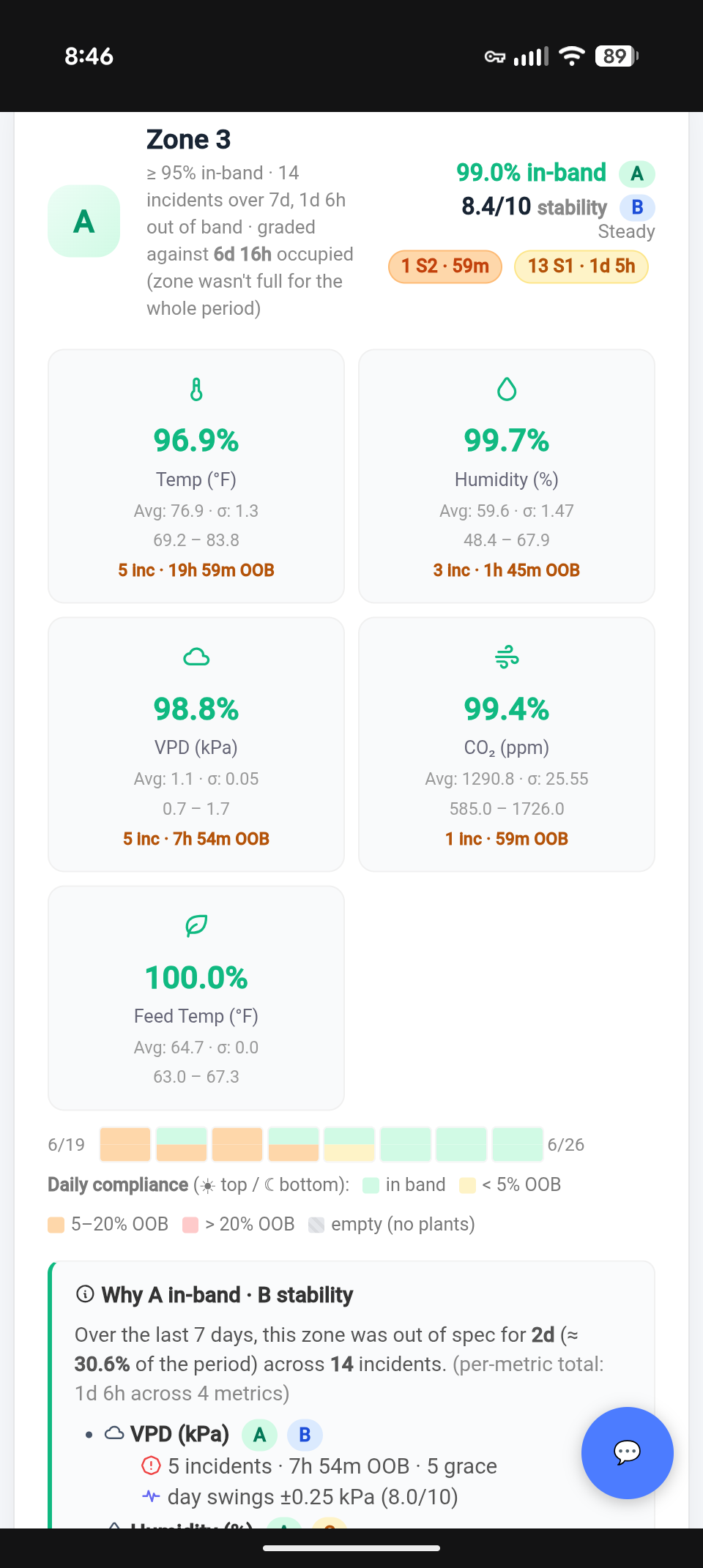
Each zone gets two scores:
- In-band percentage measures how much time your readings stayed within your target range. An “A” grade means 95%+ of readings were in-band.
- Stability score (1-10) measures how much your readings moved around within those bands. A room can be 99% in-band but still swinging 14°F from min to max. The stability score catches that.
The system tracks temperature, humidity, VPD, CO2, and feed temperature independently. Each metric shows its average, standard deviation, full range, number of out-of-band incidents, and total time spent outside your targets. A daily compliance heatmap breaks down performance by day and night phases, because a room that’s perfect during the day and chaotic at night will look fine on a 24-hour average but terrible when you split it out.
The consistency score answers the question this entire article is about: is your equipment actually holding the environment you think it’s holding?
Because here’s the reality. You can set perfect targets. You can run the right DIF strategy. You can have the right VPD and CO2 levels programmed in. But if your AC has a 6°F deadband, your lights crash the room every night, and your dehu can’t keep up with the transition, then your plants are living in a different environment than the one you think you’re providing.
The growers who are consistently pulling top yields and quality aren’t running secret genetics or exotic nutrients. They’re running tight rooms. Their equipment does what the controller says. Their transitions are smooth. Their DIF is intentional and held. That’s the difference.
Leave a Reply