In a regulated commercial facility, the required plant and inventory records are part of the job. But the team also needs to know who did the work, what changed and where the supporting records live.
A useful batch record keeps those operating details connected. It gives the next shift something better than a text thread and gives a later review something better than memory. Better records can support better decisions; they do not guarantee a lower cost per pound.
Cannabis Batch Tracking Methods Compared
| Method | Useful for | What to check |
|---|---|---|
| Paper records | A simple, legible record at the point of work | Ownership, retention and finding entries later |
| Spreadsheets | Flexible structured records, validation, charts and manual analysis | Shared definitions, access, attachments and who maintains the formulas |
| State traceability system | Required inventory and activity reporting | Which operating records still need a separate home |
| Commercial seed-to-sale software | Inventory, compliance and additional business workflows | Its actual cultivation, work-record and cost features |
| Sensor platform | Connected measurements and history | Device support, access, exports and links to batch context |
| Growgoyle | Plans, daily work, maintenance and connected batch records | Whether the team can enter and retrieve its own work during a normal shift |
Most facilities use more than one of these systems. Start by deciding where each record belongs and who maintains it. The operating record should make a handoff easier today, even before there are several completed batches to compare.
Compliance Tracking vs. Performance Tracking in Cannabis
METRC serves required traceability and reporting. Those records can still be useful to your business. They are not a substitute for the full context of an assignment, an equipment service visit or a manager’s decision. Commercial seed-to-sale products may add cultivation tools, so evaluate the actual product rather than the category label.
The compliance mindset says: “Tracking is something I do because I have to.” You fill in the required fields, you generate the reports, you pass your audit. Done.
The operating question is: “Can the team find what happened and use it in the next review?” Keep the work history and supporting records consistent enough to answer that question. Recording more fields is only useful when those fields support a real handoff or decision.
If the team cannot find the notes behind a completed batch, the next review starts with a reconstruction job. That is the gap an operating record needs to close.
What a Performance Batch Record Actually Looks Like
A real cannabis production record goes well beyond what compliance requires. Here’s the minimum viable batch record for a commercial flower operation:
- Strain, clone date, flip date, chop date, dry weight (the basic timeline)
- Lights and canopy square footage (so you can calculate real yield metrics)
- Plant count (density matters more than most growers think)
- Environment summary (any VPD swings, temperature deviations, humidity spikes?)
- Nutrition changes (anything different from the last run?)
- Pest and disease events (what happened, when, what you did about it)
- Lab results (THC, terpenes, microbials, water activity)
- Final yield metrics: lb/light, g/sqft, g/watt
- Notes: what went well, what you’d change next time
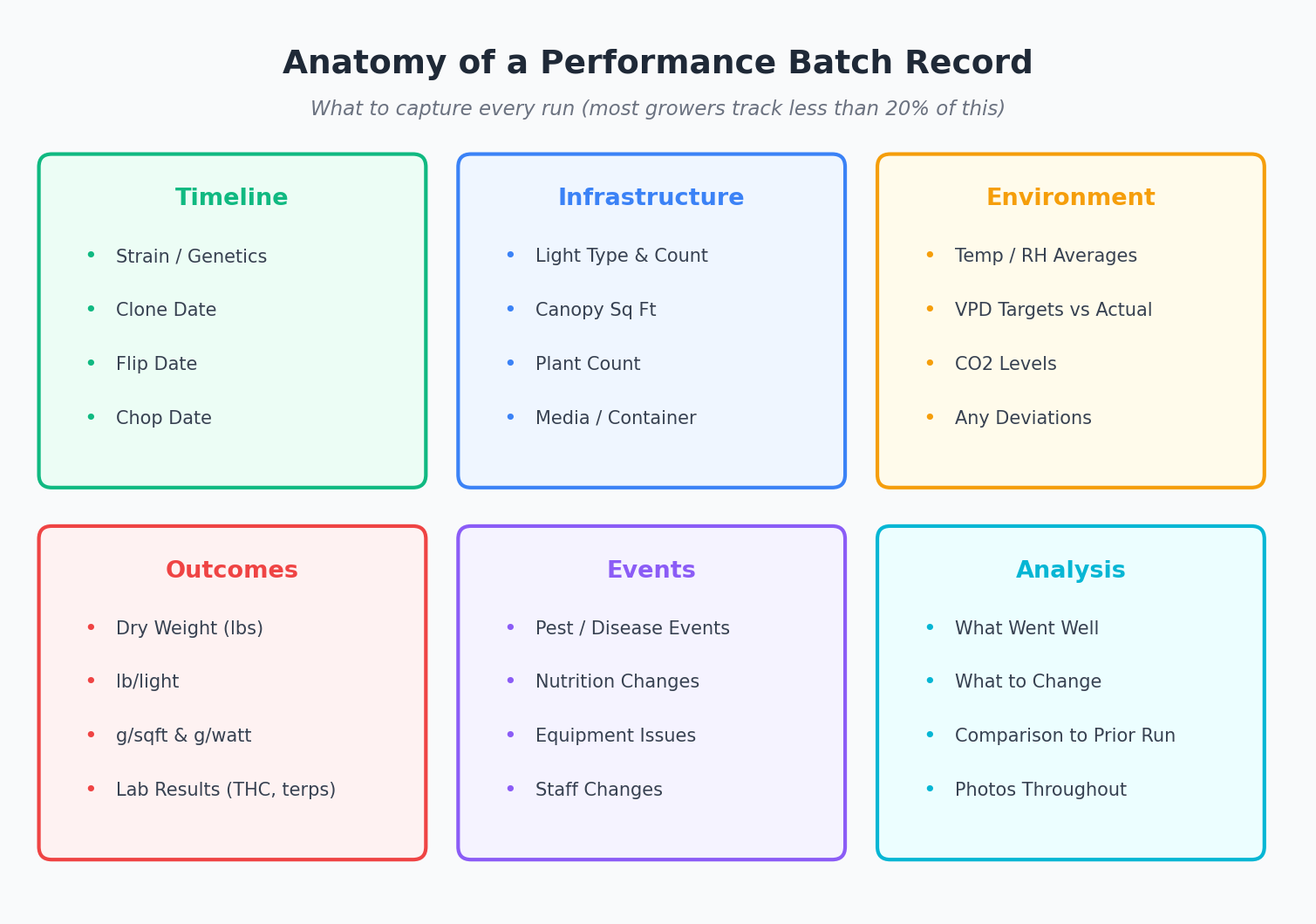
A complete performance batch record captures far more than compliance requires.
Some of this information is probably already being recorded. The question is whether it is tied to the right batch, dated and easy for the next person to find. Keep the original lab report or service record available when you summarize it.
What a Complete Batch Record Includes
Pre-Run
- Strain and genetics source
- Clone/seed date
- Target plant count
- Room assignment
- Light configuration
- Growing medium
Vegetative Phase
- Transplant dates
- Topping/training dates
- Environment averages (temp, RH, VPD)
- Feed recipe and EC targets
- Photo documentation
Flower Phase
- Flip date
- Stretch measurements
- Weekly photo documentation
- Environment data by week
- Feed adjustments and EC/pH runoff
- Defoliation dates and method
- Pest/disease observations
- Any interventions (foliar sprays, beneficial insects)
Harvest
- Wet weight
- Dry weight
- Yield per light (or per plant/sqft)
- Trim weight
- Waste weight
- Hang dry conditions and duration
Post-Harvest
- Lab results (THC, terpenes, moisture)
- Final yield calculations
- Cost inputs for the run
- AI analysis results
- Comparison notes vs. previous runs
The Power of Cannabis Batch Comparison
Batch comparison is useful when the records are comparable. Check the batch identity, dates, measurement units and source documents before reading a difference as a finding.
One practical test is to choose two completed batches and ask the team to find the work history, notes and attachments for both. Can you distinguish a missing record from a recorded zero? Can you trace a summary back to the original entry? Those are software questions you can test.
A difference between batches is a reason to investigate. It is not proof that one recorded condition caused the result. Keep competing explanations and missing information in the review.
Why Spreadsheets Break Down
Let’s give spreadsheets their due. Excel or Google Sheets is a perfectly fine cannabis grow journal for your first few batches. You set up some columns, you fill them in after harvest, you scroll back to compare. It works.
It breaks when reality scales up. Multiple rooms running simultaneously with staggered flip dates. Team members entering data in different formats (did they use grams or pounds? wet or dry?). You want to compare across 10+ runs and the spreadsheet is 40 columns wide. Photos and lab result PDFs don’t fit in cells. Somebody accidentally deletes a row.
But the real cost isn’t that spreadsheets are technically bad. It’s that the friction means you stop doing it. One busy week during harvest, the batch record doesn’t get filled in. Then the next one slips too. Then you’re back to running on memory, and your yield consistency suffers because the system for improvement quietly disappeared.
This is a human behavior problem, not a technology problem. The habit of tracking has to be easier than not doing it. If entering a batch record takes 30 minutes of copying data between systems, it won’t survive contact with a busy harvest week. Period.
What AI Does to Cannabis Batch Tracking
Reviewing scattered notes and exports takes time. AI can help organize that review, but the underlying records still need to be complete enough to support the question being asked.
AI can reduce the time spent reading across batch records and looking for patterns. You still capture the yields, readings, photos, lab results, tasks, and notes. The review can then surface differences and questions to investigate, with the recorded evidence close at hand.
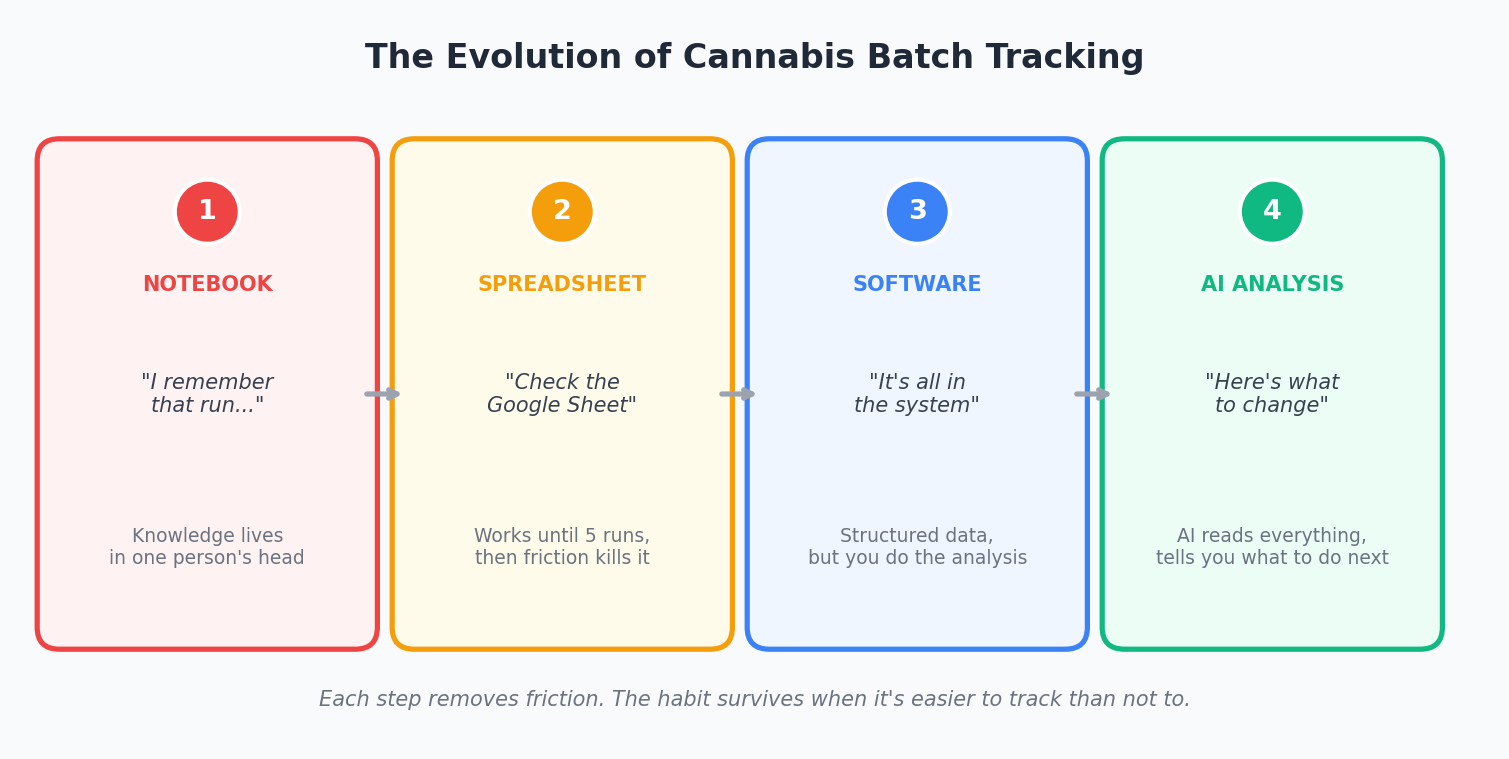
The evolution of cannabis batch tracking: each step reduces friction and adds intelligence.
Here’s what that looks like in practice with a system like Growgoyle:
Photo-based plant health assessment: Upload canopy photos during the run and review visible symptoms, possible causes, and suggested checks. The assessment becomes part of the crop record. It can miss problems or misread a photo, so use it alongside the walkthrough, measurements, and testing the situation calls for.
Post-run analysis: Review the available readings, work records, photos, lab results, and harvest metrics together. The Goyle Score combines personal-history yield scoring with defined criteria in other dimensions. AI can suggest improvement opportunities, including modeled pound estimates where supported; those are investigation leads, not proved losses or promised gains.
Batch comparison: Put two runs side by side and inspect the recorded differences. A change in environment, feed, timing, or completed work may help explain a gap between a 3.2 lb/light run and a 2.8. Check competing explanations before making it the new SOP.
The grower still chooses the question, checks the source records and decides what to do with the answer. A useful analysis makes that work easier to inspect; it does not make the decision for you.
Starting the Cannabis Batch Tracking Habit
If you’re doing nothing right now: Start with a Google Sheet. Strain, dates, yield, notes. Four columns. It’s better than nothing by a wide margin. The goal is to build the habit of recording something after every harvest.
If you’re already using spreadsheets: You’ve proven the habit exists. That’s the hard part. Now the question is whether you’re actually reviewing the data and getting value from it. If your spreadsheet is 20 runs deep and you haven’t compared the last 5 side by side, the tracking is happening but the improvement loop isn’t. Time to move to a system that does the analysis for you.
If you’re looking for dedicated cannabis grow journal software: Evaluate based on what matters. Does it make data entry fast enough that you’ll actually do it during a busy week? Does it handle photos and lab results, not just numbers? And most importantly, does it do something with the data beyond storing it? Storage is easy. Analysis is where the value lives.
Judge the system by the work it saves and the records your team can actually retrieve. If the next shift can see what happened without calling the last shift, the record is already doing a useful job.
Frequently Asked Questions: Cannabis Batch Tracking
Q: What is the difference between compliance batch tracking and cultivation batch tracking?
Compliance records support required state reporting. An operating batch record also preserves assignments, maintenance, observations and supporting documents for the team. Some commercial seed-to-sale products provide both kinds of workflow; compare the actual records and reporting you need.
Q: Can spreadsheets work for cannabis batch tracking?
Spreadsheets can work when ownership, data definitions and access are managed well. They support validation, formulas and linked files. Dedicated software earns its place when it reduces maintenance and makes records easier for the team to enter, find and review.
Q: What data should a cannabis batch record include?
A complete batch record captures six categories: genetics (strain, source, clone/seed date), environment (daily temp, humidity, VPD, light intensity, CO2 levels), nutrition (feed recipes, EC targets, pH, runoff data), cultivation practices (topping, defoliation, training dates), harvest metrics (wet weight, dry weight, yield per light, trim ratio), and post-harvest data (lab results, dry room conditions, final quality grade). The more data you capture during the run, the more useful your post-run analysis becomes.
Q: How does AI cannabis batch analysis work?
AI batch analysis reviews the available records from a completed crop and can compare them with relevant prior runs. It highlights differences, possible contributors, and follow-up questions. More complete, comparable records can improve the review, but there is no fixed number of batches after which the AI knows a facility, and modeled yield opportunities are not guaranteed results.
Q: Do I still need batch tracking if I already use METRC?
Keep your required state reporting in place. Then check whether your existing software also keeps the assignments, maintenance, notes and source records your team needs. Add another system only where it solves a real gap.
Right now, your batch data lives on a whiteboard, in a spreadsheet you haven’t updated since last harvest, or in your head. That works until it doesn’t. Every day you’re not logging what’s happening in your rooms is a day of data gone forever. You can’t go back and reconstruct what week 4 looked like when you’re standing in the dry room wondering why this run came up short.
Growgoyle connects batch records to the work of running the crop: plans, assigned tasks, maintenance, observations, and harvest review. Start with the room you have in flower now. Recorded labor and attributed overhead also support run comparison, while accounting remains the source for actual production costs.
See two batch photo records together
This 28-second recording shows a current photo beside an earlier batch’s photo at the same stage. It demonstrates finding and comparing records, not proof of why either batch performed differently.
Recorded in a demonstration account. Watch on YouTube.
Leave a Reply