You probably have sensors. You probably have a dashboard. You can check your temp and RH from the couch at 11pm without putting your shoes on. Congratulations. So can every other cannabis grower in your state.
The question isn’t whether you can see your data. The question is whether your data is actually making your grows better, batch after batch. Are you pulling more pounds per light than you were six months ago? Is your trim ratio tightening? Are your lab results trending the direction you want?
Seeing data and using it to run a better crop are different jobs. A static sensor chart handles the first. A review that connects readings with work, observations, and harvests helps with the second. One product can do both, so judge the workflow you actually get rather than the category on the sales page.
Here’s how to think about the difference, and why it matters more than most facility owners recognize.
What a Sensor Dashboard Actually Does
A basic sensor dashboard collects environmental readings and displays them: temperature, relative humidity, CO2, VPD, light, or substrate moisture, depending on the equipment. It logs the numbers, draws the charts, and may alert on a threshold. Some platforms go further, so check the actual feature set.
That’s genuinely useful. Real-time monitoring catches equipment failures before they kill a room. An HVAC going down at 2am is a disaster you want to know about at 2am, not at 9am when you walk in. If your sensor system has tight alerting on mission-critical equipment, keep it running. That infrastructure matters.
The limit of a chart on its own is that somebody still has to interpret it. A platform with crop records and analysis may already help with that job. Growlink, for example, now describes Nova AI for comparing rooms, spotting drift, and reviewing what changed between cycles.
A chart can show 84°F and 62% RH on Day 18. By itself, it cannot establish that those readings caused a 0.4 lb/light yield difference. To investigate, you also need relevant crop history: what the plants looked like, what changed in feed and irrigation, what work happened, and how the run finished.
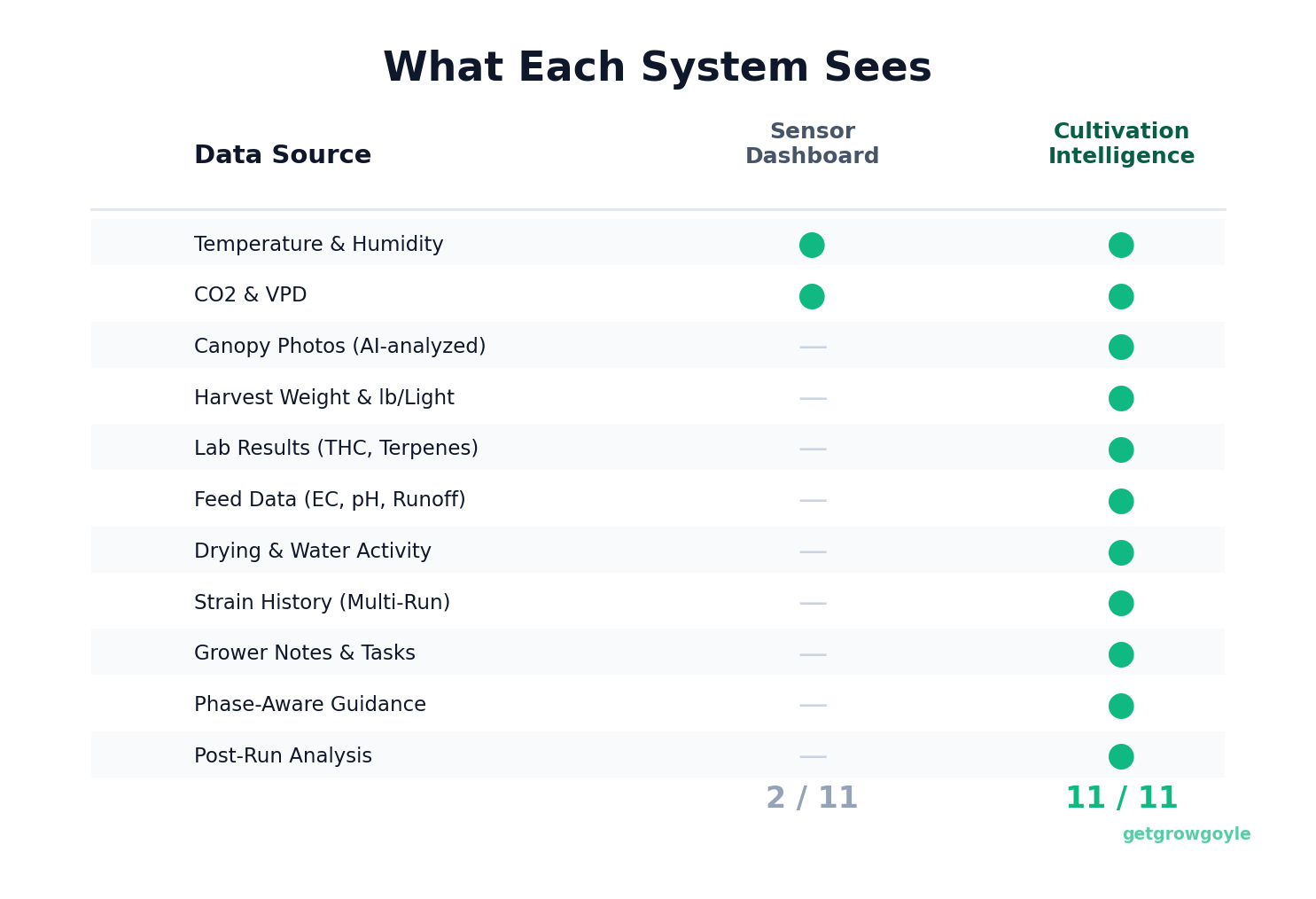
That is the scope question to ask: does your tool keep harvest weights, lab results, strain history, feed records, drying outcomes, and completed work with the readings? If those records live elsewhere, the team needs a practical way to bring them into the review.
Think of it like a fitness tracker that counts your steps. Useful data. But it doesn’t design your training program, and it doesn’t tell you why you’re not getting faster.
What Cultivation Intelligence Actually Does
Cultivation analysis brings the available crop records together so a grower can review the run in context. The useful output is a set of findings tied to evidence and a manageable list of follow-up questions.
The key distinctions aren’t subtle.
Breadth of records. Canopy photos, harvest weights, trim ratios, water activity, lab results, feed records, completed tasks, notes, and strain history add context a sensor reading cannot supply. The analysis only has that context when the records exist and are available to it.
Retrospective analysis. After harvest, review the readings and crop records alongside the result. Written analysis can help organize differences and possible improvement opportunities. A pound estimate is a model with assumptions, not a diagnosis of exactly what cost the crop weight.
History across batches. A useful comparison lets you inspect this run beside a relevant earlier run of the same strain. Look for a system that preserves the records behind the comparison so you can check what changed rather than rely on a summary alone.
Phase awareness. Week 1 and Week 7 of flower have different priorities. Check whether targets, alerts, and task schedules can follow the crop stage, and who sets those targets. This is a workflow to verify in a demo, not a capability you can infer from the word “AI.”
A grower reviewing a room does more than read a thermometer. They check the plants, the recent work, and what changed. The software is useful when it brings those records together without pretending the interpretation is certain.
You can read more about what AI batch analysis actually produces after a run completes, and why retrospective analysis is where most of the yield gains live.
The Data Pipeline Gap (This Is the Real Divide)
Here’s the structural difference between these two categories, stated plainly.
A basic environmental chart starts with sensor readings. The wider review needs the other records as well, whether they come from the same product or a separate system.
Cultivation intelligence has 10 or more inputs feeding a single analytical engine:
- Environmental sensor data (temp, RH, CO2, VPD, light, soil moisture)
- Canopy photos analyzed by AI for health, stress, and deficiency
- Harvest metrics (dry weight, wet weight, lb/light, plant count)
- Lab results (THC, terpenes, water activity, microbials)
- Feed data (nutrients, EC, pH, runoff)
- Drying data (duration, weight loss, final moisture content)
- Strain history across every prior run of the same genetics
- Grower notes and journal entries
- Task completion records
- Schedule and phase context (what day of flower, what activities are due)
The useful part is the connection among the records. A grower can do that review manually, and many do. Software can reduce the time spent collecting the evidence and make it easier to revisit the reasoning later.
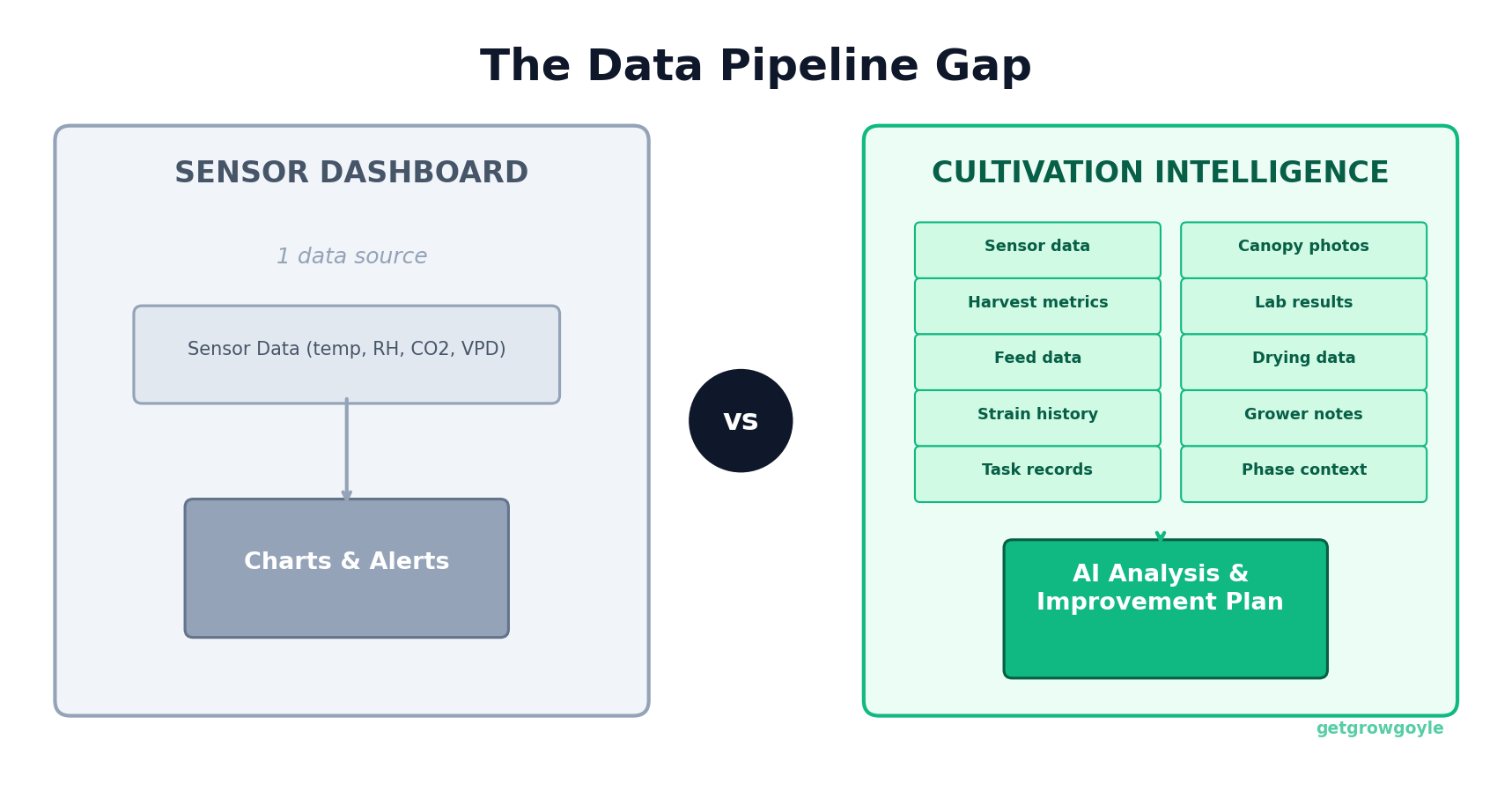
A grower could theoretically do this themselves. Pull the sensor data, look at the canopy photos, compare to last run’s spreadsheet, check lab results, review notes, estimate what the differences cost you in pounds. Some very disciplined growers actually do a version of this. It takes hours. It happens once per run if they’re disciplined. Usually it doesn’t happen at all because harvest week is not when you have time to sit down and do data analysis.
Growgoyle can assemble a post-run review from the data recorded with the batch. The team still has to capture observations, check the findings, and decide what work follows. The benefit is less time reconstructing the run, not zero work.
Understanding how that analysis directly affects your bottom line is worth reading more about: how AI batch analysis lowers cost per pound gets into the specifics of where those gains actually come from.
Where Sensor Dashboards Still Matter
To be clear: don’t trash your sensors. Sensors are essential. Environmental data is a critical input to everything cultivation intelligence does. You can’t do retrospective analysis on your VPD curve if you weren’t logging VPD in the first place.
Think of it this way. Sensors are the ears. Cultivation intelligence is the brain. You need both.
Where sensors shine is real-time equipment monitoring. If your chiller goes down at 3am, you want a text message, not an insight delivered at the end of your next harvest. Mission-critical alerts belong close to the hardware, on systems designed for that purpose. Cultivation intelligence is not trying to replace your environmental alerting infrastructure.
Good cannabis grow room environment control starts with knowing what’s happening in real time. Sensor systems do that job well. The question is what you do with that data afterward, and whether it ever connects to the rest of what you know about your facility.
The point isn’t that sensor dashboards are bad. The point is that they’re incomplete. Watching your environment in real time is step one. Understanding what all your data means across batches, strains, and seasons is step two. Most cannabis growers are stuck on step one and think they’re done because the charts look good.
The Question to Ask Yourself
Think about your last harvest. What did you actually do with the data afterward?
Did you look at the environmental data, the yield numbers, the lab results, the canopy photos, the feed records, and the drying data all together? Did you compare that picture to the previous run of the same strain? Did you identify what changed, quantify the impact, and write down specific things to do differently next cycle?
If you did, you already have the review habit. Software earns its place when it makes that habit easier to keep across rooms and busy weeks.
If you did not, start with one completed run and one question. You do not know what the records will show until you look. The first useful outcome may be a better note-taking or maintenance task, not a new yield claim.
The growers consistently pulling the best numbers out of the same square footage aren’t doing it because they have fancier sensors than everyone else. They’re doing it because they’re actually learning from every run. That’s the whole game. Batch over batch improvement doesn’t happen by accident.
For a deeper look at the mechanics of that improvement cycle, the article on what cultivation intelligence actually is covers the category in full, including what makes it different from standard grow management software.
Putting It Together
If you’re evaluating tools for your cannabis cultivation operation, here’s a clean way to sort them out.
Sensor dashboards answer: “What is happening right now?” That’s a monitoring question. The tools designed for it do it well. Real-time visibility, threshold alerts, historical charts.
Cultivation analysis asks: “What changed, what might explain it, and what should we check next?” Bringing the crop records together helps answer that question. Acting on the answer still belongs to the grower.
Most commercial grows need both current visibility and a usable crop history. One product may cover both jobs, or separate tools may need a clear handoff. Check what is already covered before adding another subscription.
The next problem may be missing data, a weak review process, or work that never gets assigned. Find that gap first. Better software only helps if it makes that particular job easier to do.
Growgoyle doesn’t replace your sensors. It makes sense of everything your sensors, your eyes, your scale, and your lab reports are telling you. See it in action. Try it free on your own plants.