Your genetics don’t change between runs. Your nutrients don’t change between runs. Your lights don’t change between runs. But your yields do. The variable almost every time? Environment.
Climate control isn’t a checkbox on a facility build-out list. It’s the single biggest factor separating a 2.5 lb/light average from a 3.5 lb/light average. And the gap between those two numbers, multiplied across a commercial facility, is the difference between surviving wholesale compression and getting squeezed out.
This guide breaks down what actually matters in grow room climate management, what the research shows, and where most operations lose yield without realizing it.
The Four Pillars of Grow Room Climate
Every grow room environment comes down to four things working together:
- Temperature controls metabolic rate and terpene preservation
- Humidity (and its relationship to temperature via VPD) drives transpiration and nutrient uptake
- CO2 fuels photosynthesis when light levels justify it
- Airflow distributes everything evenly and prevents microclimates
Miss one and the other three can’t compensate. A room running perfect VPD with dead spots in airflow will still produce uneven canopies and inconsistent harvests.
Temperature Targets by Growth Phase
Temperature requirements shift as plants move through their lifecycle. Running the same setpoint from clone to harvest is one of the most common mistakes in commercial cultivation.
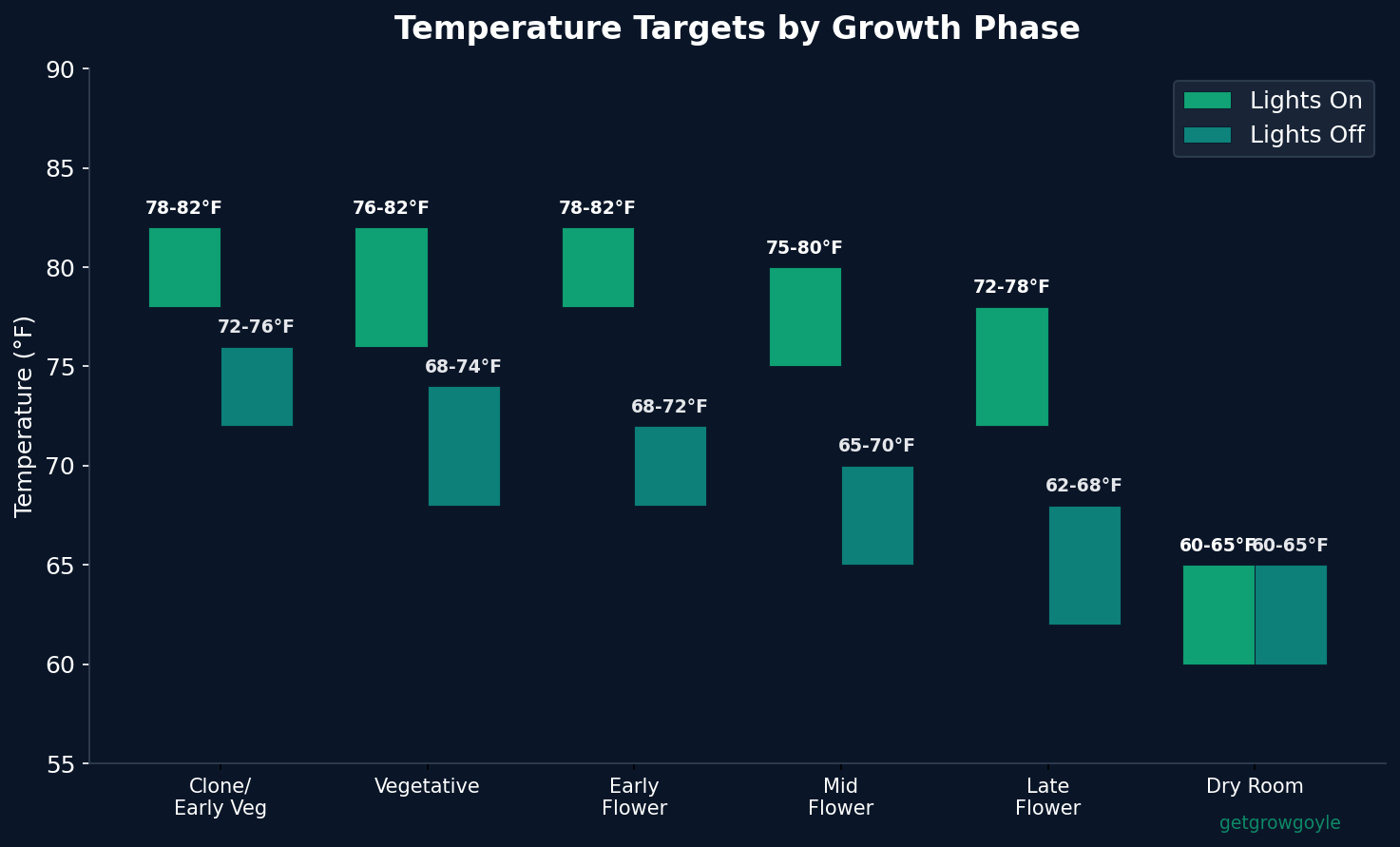
| Phase | Lights On | Lights Off | Key Notes |
|---|---|---|---|
| Clone/Early Veg | 78-82°F | 72-76°F | Higher temps promote root development. Domes help maintain humidity. |
| Vegetative | 76-82°F | 68-74°F | Warmer temps drive faster growth. Don’t exceed 85°F even with CO2. |
| Early Flower (Wk 1-3) | 78-82°F | 68-72°F | Stretch period. Slightly warmer supports internode development. |
| Mid Flower (Wk 4-6) | 75-80°F | 65-70°F | Begin stepping temps down. Resin production increases at cooler temps. |
| Late Flower (Wk 7+) | 72-78°F | 62-68°F | Coolest phase. Enhances anthocyanin expression and terpene preservation. |
| Dry Room | 60-65°F | 60-65°F | Constant. No light cycle. Target 55-65% RH. |
The DIF principle: The difference between day and night temperatures (called DIF) directly influences plant morphology. A 10-15°F DIF promotes compact growth and stronger stems. Research published in the Journal of the American Society for Horticultural Science demonstrated that negative DIF (cooler days, warmer nights) reduces stem elongation, though this is more applicable in vegetable production than cannabis flowering.
For cannabis, maintaining a positive DIF of 8-12°F during flower is the practical sweet spot. It preserves terpene profiles (many terpenes are volatile above 80°F) while keeping metabolic processes active during the day.
Humidity and VPD: Why RH Alone Misleads You
Relative humidity is what most growers monitor. But RH is relative to temperature, which means the same RH percentage at two different temperatures creates completely different transpiration conditions for the plant.
This is where Vapor Pressure Deficit (VPD) matters. VPD measures the actual drying power of the air independent of temperature. It tells you how hard the plant has to work to move water through its vascular system.
| Growth Phase | Target VPD (kPa) | Equivalent Conditions (example) |
|---|---|---|
| Clones | 0.4-0.8 | 78°F / 80% RH |
| Veg | 0.8-1.2 | 80°F / 65% RH |
| Early Flower | 1.0-1.4 | 80°F / 58% RH |
| Late Flower | 1.2-1.6 | 76°F / 50% RH |
When VPD is too low (humid, stagnant air), transpiration slows. Nutrient uptake drops. Stomata close. Botrytis and powdery mildew thrive.
When VPD is too high (dry, aggressive air), plants transpire faster than roots can deliver water. Leaf edges curl. Stomata close defensively. Growth stalls.
The critical insight: you can hit the same VPD target by adjusting temperature OR humidity. Most growers reach for the dehumidifier first, but sometimes raising the temperature 2°F achieves the same VPD shift with less energy cost.
For a deeper breakdown of VPD calculation and optimization, see our complete VPD guide for cannabis cultivation. Or plug in your own numbers with the free VPD calculator.
CO2 Supplementation: When It Helps and When It Doesn’t
CO2 enrichment is one of the most oversold and under-understood inputs in commercial cannabis.
The baseline: Ambient air contains approximately 420 ppm CO2. Plants can use more, up to a point. Research from Plant Physiology journals consistently shows photosynthetic rates in C3 plants (which includes cannabis) increase with CO2 concentration up to approximately 1,200-1,500 ppm, after which returns plateau.
But CO2 only helps when light is the limiting factor it removes. At low light levels (below 600 PPFD), plants can’t use the extra CO2. You’re just venting money.
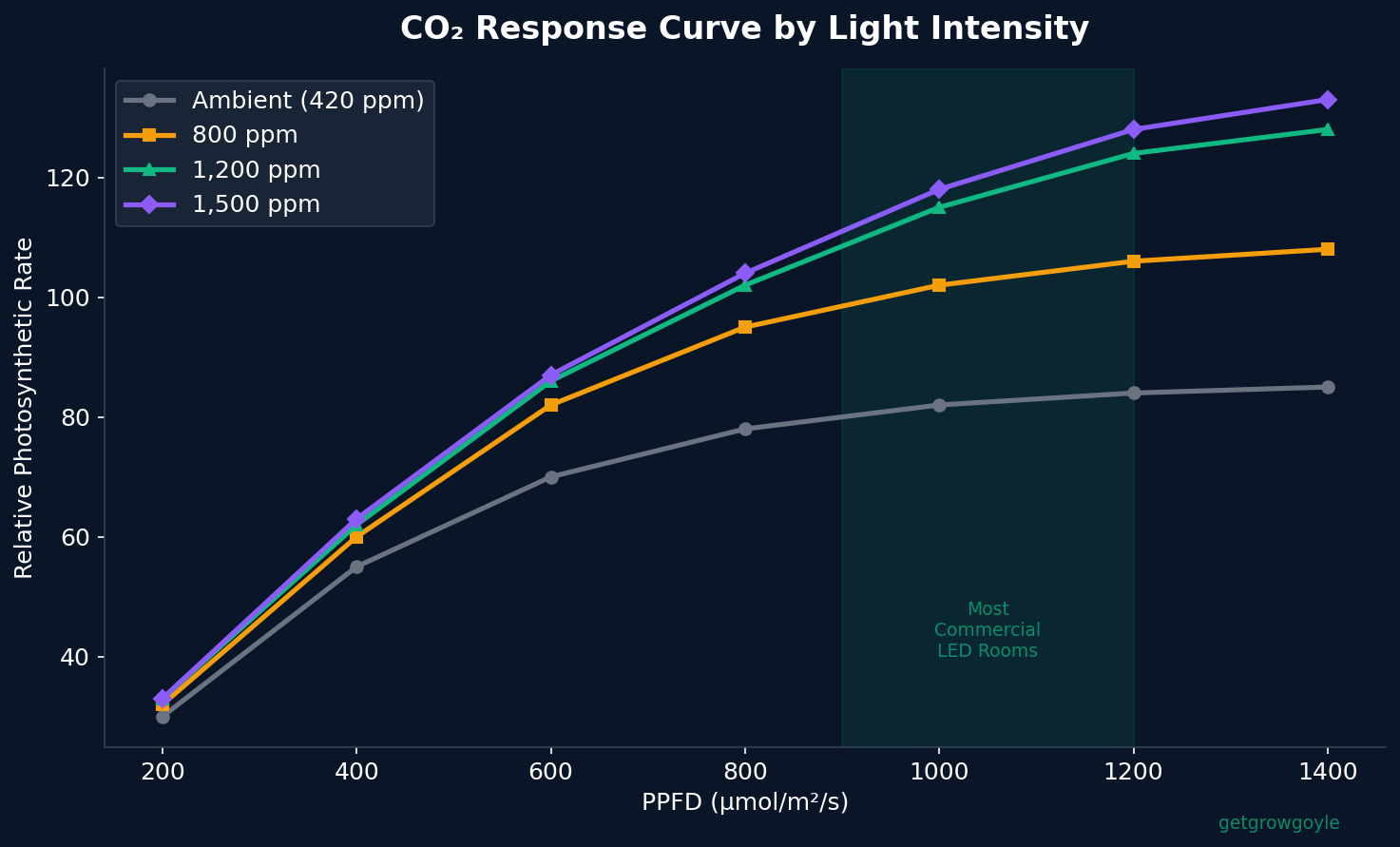
A study by Chandra et al. (2008) in Physiology and Molecular Biology of Plants found that cannabis photosynthesis increased 50% when CO2 was raised from 250 to 750 ppm at saturating light levels. But the delta from 750 to 1,500 ppm was much smaller. The biggest bang for your CO2 dollar comes from getting to 800 ppm, not from pushing to 1,500.
The timing mistake: CO2 should only run during lights-on. During lights-off, plants respire (consume O2, release CO2). Supplementing CO2 at night is pure waste, and can create dangerously high concentrations in sealed rooms.
The temperature relationship: Higher CO2 levels allow plants to tolerate (and benefit from) slightly higher temperatures. At 1,200+ ppm, running 82-85°F during lights-on is acceptable and can increase photosynthetic efficiency. At ambient CO2, those temperatures cause stress.
Airflow Design: The Invisible Yield Killer
You can have perfect temperature, perfect humidity, and perfect CO2 levels at your sensor. And still have problems. Because your sensor measures one point in the room. The canopy doesn’t care about the average. It cares about what’s happening at leaf level.
Canopy-level microclimates are responsible for more mold, more uneven ripening, and more inconsistent yields than most growers realize. The center of a dense canopy can be 5-8°F warmer and 15-20% higher RH than the data your controller sees.
Common Airflow Mistakes
- Oscillating fans pointed at the canopy create hot spots and cold spots on a timer. Constant, directional airflow from multiple angles is better.
- Fans too strong cause wind stress, thickened stems (which sounds good but actually diverts energy from flower production), and localized drying.
- Fans too weak or too few leave dead zones. The center of the room, directly under lights, is always the worst spot.
- No vertical air exchange allows heat to stratify at ceiling level. Ceiling fans or ducted air returns prevent this.
The benchmark: A well-designed commercial room moves enough air to achieve 0.5-1.0 air exchanges per minute at canopy level. This isn’t the same as HVAC air changes per hour (ACH) for the whole room. It specifically means the air touching the leaves is being replaced constantly.
The Night Climate Problem
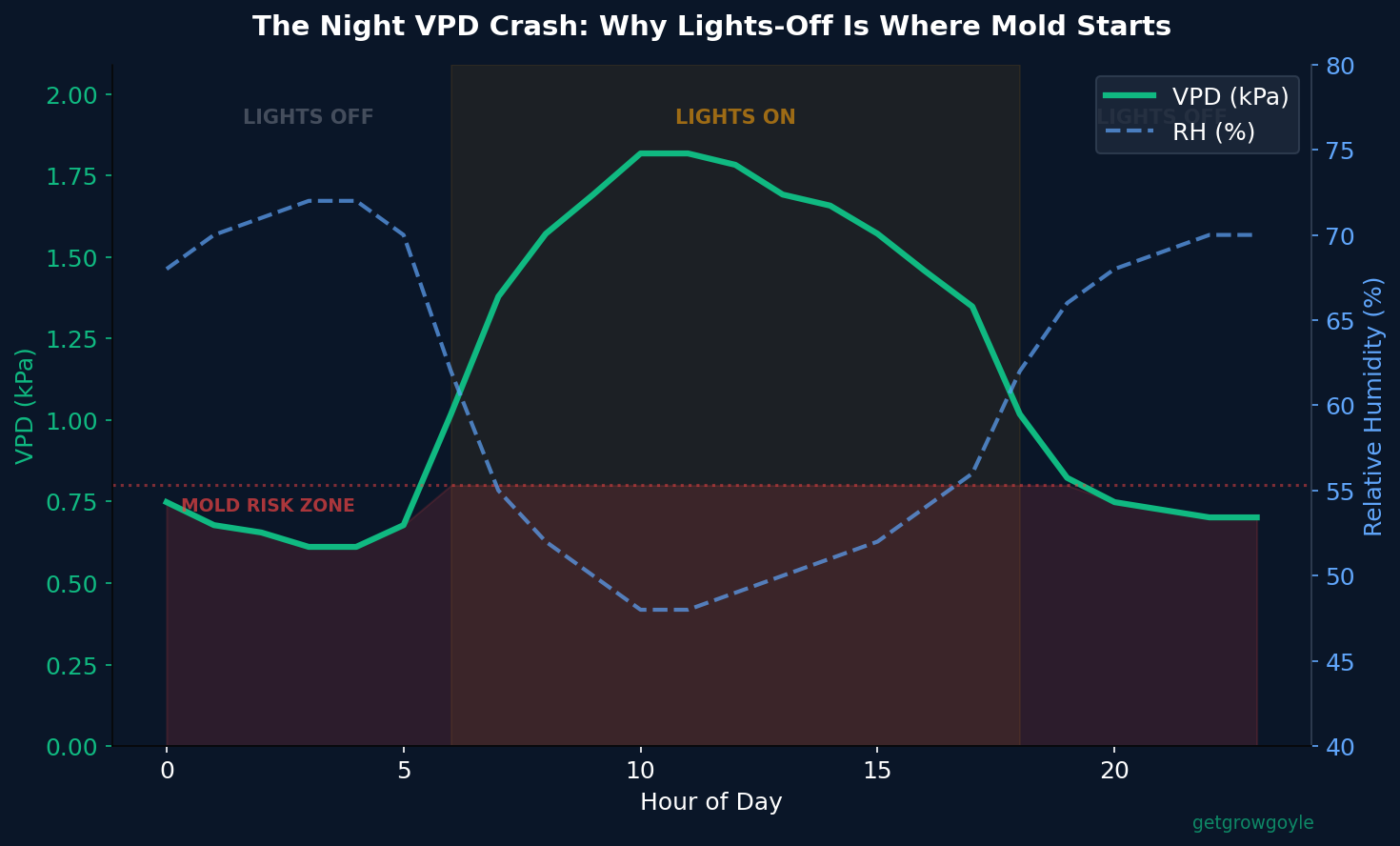
Most climate discussions focus on daytime parameters. But the lights-off period is where climate control breaks down in the majority of commercial operations.
During lights-off:
- Temperature drops 8-15°F
- Relative humidity spikes (same moisture content, cooler air)
- VPD plummets into the danger zone for mold and mildew
- CO2 from plant respiration accumulates in sealed rooms
Night VPD management is arguably more important than daytime VPD for crop health. A room that runs 1.2 kPa VPD during the day but drops to 0.4 kPa at night is creating the exact conditions Botrytis cinerea needs to establish.
The fix: Dehumidification ramps UP when lights go off, not down. Some operations add a small amount of supplemental heat during lights-off to keep the day/night VPD gap manageable. The target is keeping lights-off VPD above 0.8 kPa through the entire dark period.
Sealed Rooms vs. Open Rooms
Most commercial facilities run sealed rooms with dedicated HVAC and dehumidification. This is the right approach for flower rooms because:
- Full environmental control (no outside air variables)
- CO2 retention (supplemented CO2 doesn’t escape)
- Pest pressure reduction (no intake from outdoors)
- Humidity control (no ambient moisture entering)
HVAC sizing rule of thumb: Plan for 4-5 tons of cooling per 1,000 square feet of canopy in a sealed room with modern LED fixtures. HPS rooms need more (6-7 tons) due to higher radiant heat.
HVAC System Types for Commercial Grows
Not all cooling is created equal, and the system you choose shapes how well you can manage climate long-term. Here is what each option actually looks like in a commercial flower room.
| System Type | Best For | Upfront Cost | Operating Cost | Dehumidification |
|---|---|---|---|---|
| Ductless Mini-Splits | Small rooms (1-4 lights) | Low ($2-5K/room) | Moderate | Minimal. Needs standalone dehumidifier. |
| Ducted Split Systems | Mid-size rooms (5-20 lights) | Moderate ($5-15K/room) | Moderate | Partial. Still needs supplemental dehumidification in flower. |
| Chilled Water Systems | Multi-room facilities | High ($30-80K+ for chiller plant) | Lowest at scale | Excellent with proper air handlers. Best overall control. |
| Purpose-Built Grow HVAC (Desert Aire, Surna, Quest IQ) | Single rooms, 10-40 lights | Moderate-High ($8-25K/unit) | Low-Moderate | Integrated. Designed for high-transpiration crops. |
Mini-splits are the entry point. They cool well but remove almost no moisture. In a flower room with 50+ plants transpiring gallons per day, a mini-split alone will leave you chasing humidity every night. They work for veg rooms and small personal grows. For commercial flower, plan on adding standalone dehumidification.
Ducted split systems are the standard for rooms in the 5-20 light range. Better air distribution than wall-mounted heads, and some passive dehumidification during cooling cycles. The limitation is that cooling and dehumidification are still partially coupled. When the thermostat is satisfied, the compressor cycles off and humidity creeps back up.
Chilled water systems are the commercial standard for multi-room facilities. A central chiller produces cold water, which circulates to air handlers in each room. The advantage: you size the chiller for the entire building’s load, and each room gets precisely the cooling it needs through its own air handler. Operating costs are significantly lower at scale, and the central plant can run at partial load during lights-off rather than cycling compressors on and off.
Purpose-built grow room HVAC units from companies like Desert Aire, Surna, and Quest integrate cooling and dehumidification into a single system designed for the specific conditions cannabis creates. They handle the high latent loads (moisture removal) that general HVAC systems struggle with. The tradeoff is higher per-unit cost, but for a single large flower room, they often outperform a split system plus standalone dehumidifier at a similar total price point.
Niu et al. (2020) published research in Energy and Buildings showing that LED fixtures reduce HVAC cooling requirements by 30-40% compared to HPS at equivalent light output. If you recently switched from HPS to LED, your existing HVAC may be significantly oversized, which sounds like a benefit but actually causes short-cycling: the compressor reaches setpoint too quickly, shuts off, humidity climbs, compressor kicks back on. Short-cycling wears equipment faster and creates the temperature and humidity swings that hurt consistency.
Seasonal Climate Challenges
Most climate control discussions assume a static outdoor environment. Reality is different. The hardest weeks to manage are not peak summer or deep winter. They are the transition seasons, when outdoor conditions swing 30-40°F in a single day and your controllers spend the whole time chasing setpoints.
Summer
The primary challenge is heat load stacking. Your lights produce heat. Your dehumidifiers produce heat (they are essentially refrigeration units, and all the energy they consume becomes heat in the room). Your HVAC fights both. On a 95°F day with high outdoor humidity, cooling capacity that was comfortable in April starts falling short in July.
The secondary summer challenge is nighttime outdoor conditions. In many climates, summer nights stay warm and humid enough that there is no free cooling available from outside air. Sealed rooms handle this fine, but operations that rely on any nighttime air exchange lose their usual assist.
Winter
Winter flips the problem. Indoor air becomes extremely dry, especially in northern climates where outdoor air at 10°F holds almost no moisture. Humidification suddenly becomes necessary in veg rooms and clone areas. Flower rooms usually have enough transpiration to maintain humidity, but veg rooms with fewer plants per square foot can drop to 30% RH without supplementation.
The other winter risk is cold surfaces. Exterior walls, poorly insulated ceiling corners, and any surface touching the outside can drop below the dew point of room air. Condensation forms. Mold follows. Insulation and vapor barriers on exterior walls are not optional in cold climates.
Transitions (Spring and Fall)
This is where the data shows the most climate failures. A day that starts at 45°F and ends at 78°F creates a moving target for HVAC. The room that was slightly over-cooled at 8 AM is under-cooled by 2 PM. Controllers that work fine in steady-state conditions lag behind rapid outdoor changes.
The practical fix is slightly more aggressive setpoints during transition months: tighter deadbands, faster response times, and closer monitoring. Operations that track environment data across entire runs will see yield inconsistency cluster in the spring and fall harvests. That pattern is a direct signal to tighten climate control during those months. Scoring your operational efficiency across seasons helps identify whether climate is the weak link.
The Dehumidification Challenge
Cannabis plants transpire heavily, especially in flower. A room of 50 plants in mid-flower can release 50+ gallons of water per day into the air. If your dehumidification can’t remove it as fast as the plants release it, humidity climbs every evening and your VPD falls apart during lights-off.
This is where most operations fail at climate control. Not during the day, when HVAC cooling provides some passive dehumidification. At night, when lights go off, temperature drops, and relative humidity spikes because cooler air holds less moisture.
The solution is dedicated dehumidification sized for the lights-off period, not the lights-on period. Quest, Anden, and similar commercial units designed for grow rooms are built for continuous operation at the temperature and humidity ranges cannabis requires.
Sizing rule of thumb: In flower, budget 2-3 pints of moisture removal capacity per plant per day. A 50-plant flower room needs 100-150 pints/day of dehumidification capacity. Size for the lights-off peak, not the average. The hours after lights turn off are when transpiration continues (plants don’t stop immediately) while temperature drops and RH spikes. That two-hour window after lights-off is the highest-demand period for your dehumidifier.
Monitoring: What to Measure and Where
A single temperature/humidity sensor on the wall tells you almost nothing about what the canopy is experiencing.
Minimum monitoring for a commercial room:
- Temperature and RH at canopy level (not wall-mounted, not ceiling-mounted)
- Temperature and RH at multiple points if the room exceeds 500 sq ft
- CO2 concentration at canopy level
- Substrate metrics (VWC, EC, temperature) if running automated irrigation
What sensors miss: Even good sensor placement captures a point in time at a point in space. It doesn’t capture microclimates, gradual drift within a day, or the cumulative impact of small environment deviations across an entire run.
Reviewing environmental records alongside yield, quality, photos, and completed work can reveal patterns worth investigating. An AI-assisted review might show that a similar humidity pattern preceded weaker results in several harvests. That is a lead to check against equipment, plant, and crop records, not proof that humidity caused the difference.
Automation: What to Automate First
Full environmental automation is expensive. But not all automation is equal. Some investments pay for themselves immediately, others are nice-to-have. Here is the priority order based on where manual control fails most often.
Tier 1: Automate immediately.
- Temperature and dehumidification. No human can maintain consistent VPD through an 8-12 hour dark period. The transition from lights-on to lights-off requires dehumidification to ramp up within minutes, not whenever someone checks the room. This is the single highest-value automation in any grow.
- CO2 injection tied to light schedule. A simple relay that kills CO2 at lights-off prevents waste and dangerous nighttime buildup. Timer-based works. Sensor-based is better but not mandatory for most operations.
Tier 2: High value, moderate cost.
- Integrated environmental controllers that manage HVAC, dehumidification, and CO2 from a single brain. TrolMaster, Agrowtek, and IntelliClimate are the most common in commercial cannabis. The reason these matter: without coordination, your HVAC and dehumidifier fight each other. The HVAC cools the room (which raises RH). The dehumidifier removes moisture (which adds heat). They cycle back and forth, wasting energy and creating unstable conditions. An integrated controller manages both simultaneously to reach the combined temperature and humidity target.
Tier 3: Nice to have.
- Automated irrigation tied to substrate sensors. VWC-based irrigation removes the guesswork from watering frequency and helps maintain consistent rootzone conditions. Valuable, but environment automation pays off first.
- Light dimming schedules. Stepping PPFD up gradually during early flower and dimming during the last week of flower can optimize DLI without manual adjustment. Most modern LED controllers support this natively.
The common mistake is automating irrigation before automating climate. A perfectly watered plant in a room where VPD swings from 0.6 to 1.8 kPa every night is still going to produce inconsistent results.
Common Climate Control Mistakes
| Symptom | Likely Cause | The Fix |
|---|---|---|
| Same temp clone to harvest | Late-flower terpene loss, early-flower slow growth | Phase-specific programs with weekly adjustments |
| Watching RH instead of VPD | False confidence at different temps | Monitor VPD directly. Use a free VPD calculator to find targets. |
| CO2 running lights-off | Wasted gas, dangerous concentration buildup | Timer or controller kills CO2 at lights-off |
| Undersized dehumidification | Nightly humidity spikes, mold establishment | Size for lights-off peak (2-3 pints/plant/day), not daytime |
| Single sensor placement | False readings that mask canopy-level problems | Sensors at canopy level, 2+ points over 500 sq ft |
| No DIF management | Excessive stretch, flat terpene expression | 8-12°F day/night difference in flower |
| Ignoring night VPD | Mold establishment during lights-off | Ramp dehumidification at lights-off, target > 0.8 kPa |
| Temp swings > 5°F during lights-on | Undersized HVAC or short-cycling compressor | Right-size cooling capacity; check refrigerant charge |
| Condensation on walls or ceiling | Insufficient insulation or cold bridging from exterior | Insulate cold surfaces; add vapor barrier on exterior walls |
| HVAC and dehumidifier fighting | No integrated controller, equipment works against itself | Integrated controller or staggered duty cycles |
| Different temps at canopy vs ceiling | Poor air mixing, no vertical circulation | Add ceiling fans or ducted air returns for destratification |
| Yield inconsistency in spring/fall harvests | Transition season outdoor swings overwhelming HVAC | Tighter deadbands, faster response, seasonal setpoint review |
Frequently Asked Questions
What temperature should I run my cannabis grow room?
It depends on the growth phase. Vegetative rooms run 76-82°F during lights-on, dropping to 68-74°F at night. Flower rooms start at 78-82°F in early flower and step down to 72-78°F in late flower. Late-flower night temps of 62-68°F help preserve terpenes and can enhance color expression.
Is VPD more important than relative humidity?
Yes. RH is a relative measurement that changes meaning with temperature. VPD directly measures the atmospheric demand on the plant. A room at 55% RH and 82°F has a completely different VPD than 55% RH at 72°F. Monitor VPD, not RH alone.
How much CO2 should I add to my grow room?
Only supplement CO2 if your light intensity supports it. Below 600 PPFD, ambient CO2 (420 ppm) is sufficient. At 900-1,200 PPFD (most commercial LED rooms), target 800-1,200 ppm during lights-on only. The photosynthetic benefit plateaus above 1,500 ppm.
Why does my humidity spike at night?
When lights turn off, temperature drops but the moisture content of the air stays the same. Cooler air has a lower capacity to hold moisture, so relative humidity rises. The fix is dedicated dehumidification that ramps up during the dark period, not down.
How do I prevent mold in a grow room?
Mold prevention is a climate control problem. Maintain VPD above 0.8 kPa during lights-off, ensure consistent airflow at canopy level, avoid dead zones, and size dehumidification for the lights-off worst case. Botrytis establishes during the exact conditions that occur when dehumidification fails at night.
How many BTUs do I need for a grow room?
The standard estimate for LED flower rooms: 3,500-4,000 BTU per 1,000W equivalent of LED lighting. A 24-light room running 720W LEDs produces roughly 17,000W of heat load, which translates to approximately 60,000 BTU of required cooling capacity. Always oversize by at least 20% to account for dehumidifier heat output, which adds back into the room. Facilities that switched from HPS to LED may have oversized HVAC that short-cycles. Caplan et al. (2019) in HortScience documented that LED-grown cannabis achieved comparable yields to HPS at lower environmental heat loads, which directly affects HVAC sizing requirements.
What size dehumidifier do I need for a grow room?
In flower, budget 2-3 pints of removal capacity per plant per day. A 50-plant flower room needs 100-150 pints/day of dehumidification capacity. The critical sizing factor is lights-off performance, not rated capacity at standard conditions (most manufacturers rate at 80°F/60% RH, which is warmer than your lights-off room). Check the unit’s performance specs at 65-70°F, which is closer to your actual lights-off conditions. Many units lose 30-40% of their rated capacity at lower temperatures.
How do I control humidity in a sealed grow room at night?
Three strategies work together. First, dedicated dehumidification that ramps up the moment lights turn off, not when humidity reaches a threshold (by then it is already too high). Second, a small reheat coil or supplemental heat that prevents temperature from dropping too fast. Slowing the temperature decline reduces the RH spike. Third, consistent airflow through the canopy during the entire dark period. The target: VPD stays above 0.8 kPa through the full lights-off cycle. Monitor VPD at canopy level, not at your wall sensor, since the canopy microclimate is always more humid than ambient room conditions.
Climate control is the foundation every other input sits on. Genetics, nutrients, and light only express their potential when the environment lets them. For operations serious about consistent yields, tracking environmental data alongside harvest outcomes across every run is the only way to know whether your climate program is working or just working sometimes.
Knowing what your environment costs you starts with knowing your cost per pound. Once you have that number, the question becomes which operational factors are keeping it higher than it should be.
Growgoyle brings room readings, crop records, tasks, and harvest results together so you can investigate environmental problems in context. Keep the response in the record too: what you checked, who handled it, and what changed afterward.
Leave a Reply