Every cannabis operation obsesses over flower. Genetics, environment, nutrients, training, light intensity. All of it matters. But here’s what the data consistently shows: the two weeks after harvest are where 10 to 20% of your crop’s value can quietly disappear. Overdried flower. Sloppy trim. Inconsistent cure. These aren’t dramatic blowups. They’re slow leaks that show up in your cost per pound and your buyer’s willingness to reorder.
The best cannabis facilities treat post-harvest as its own discipline. They have protocols, target numbers, and checkpoints from the moment plants come down to the moment jars get sealed. This guide walks through the full cannabis post-harvest optimization pipeline: harvest timing, drying, dry weight, trimming, water activity, curing, and the batch review that ties it all together.
Where Post-Harvest Value Actually Disappears
Think of your harvested cannabis as a depreciating asset. Every hour after chop, decisions (or lack of decisions) either preserve value or destroy it. The losses compound through each stage of the pipeline.
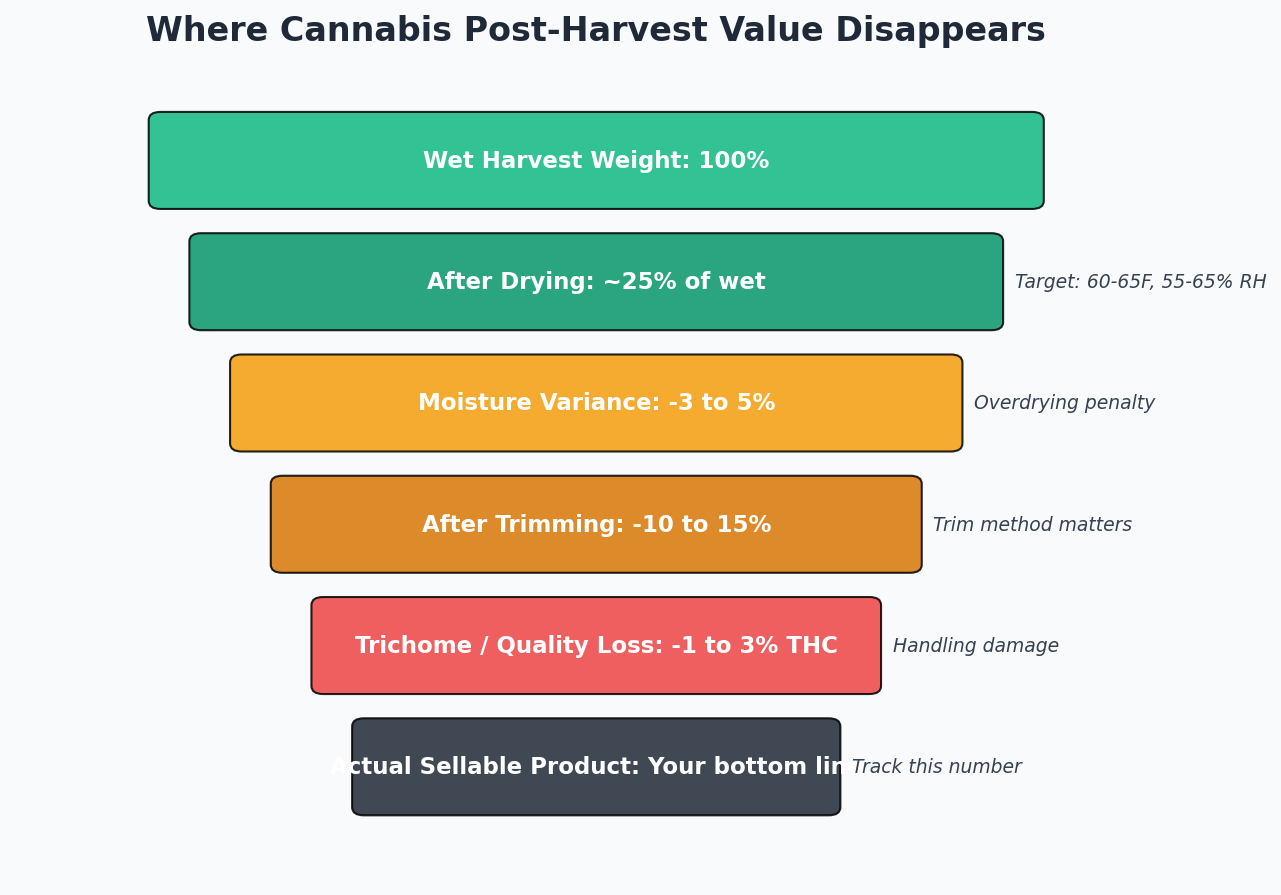
Value loss compounds through each post-harvest stage. Small percentages at each step add up fast.
Overdrying alone can cost you 3 to 5% of dry weight in lost moisture, and that’s before you factor in trichome degradation from brittle, over-handled flower. A trim crew running without clear SOPs can push trim ratios 5 to 10 points worse than your best runs. Flower that tests at the wrong water activity gets rejected, discounted, or develops mold in the bag. None of these are catastrophic on their own. Together, across 50 or 100 runs a year, they define your margins.
The pattern across top-performing operations is consistent: they measure at every stage, they have target ranges, and they review the data after every run. The operations that treat post-harvest as “just hang it and bag it” are the ones wondering why their numbers are flat while running the same genetics as everyone else.
Harvest Timing: Setting the Baseline
Cannabis post-harvest optimization starts before anything gets cut down. Harvest timing determines your starting material, and everything downstream depends on it.
Trichome maturity is the call. You’re looking at the ratio of clear to milky to amber trichome heads under magnification. Most commercial operations target predominantly milky with 10 to 20% amber, but the right ratio depends on the cultivar and what your market wants. The biggest harvest timing mistake isn’t pulling early or late. It’s not having a consistent protocol for the decision. If harvest timing is a gut call that changes depending on who’s looking, your starting material varies run to run, and that variance carries all the way through dry and trim.
Document the decision criteria. Take photos of trichome condition at harvest. This becomes data you can reference when comparing runs later.
Drying: The Make-or-Break Phase
If there’s one stage where cannabis post-harvest quality is won or lost, it’s the dry. Get it right and you preserve terpenes, maintain structure, and hit target moisture. Get it wrong and you’re dealing with hay smell, crumbling buds, or (worse) mold.
The target ranges most commercial operations work within: 60 to 65°F and 55 to 65% relative humidity, with a dry time of 10 to 14 days for whole-plant hang. But those numbers are starting points, not gospel. Room size, plant density, airflow design, and even the cultivar’s bud structure all influence the actual protocol.
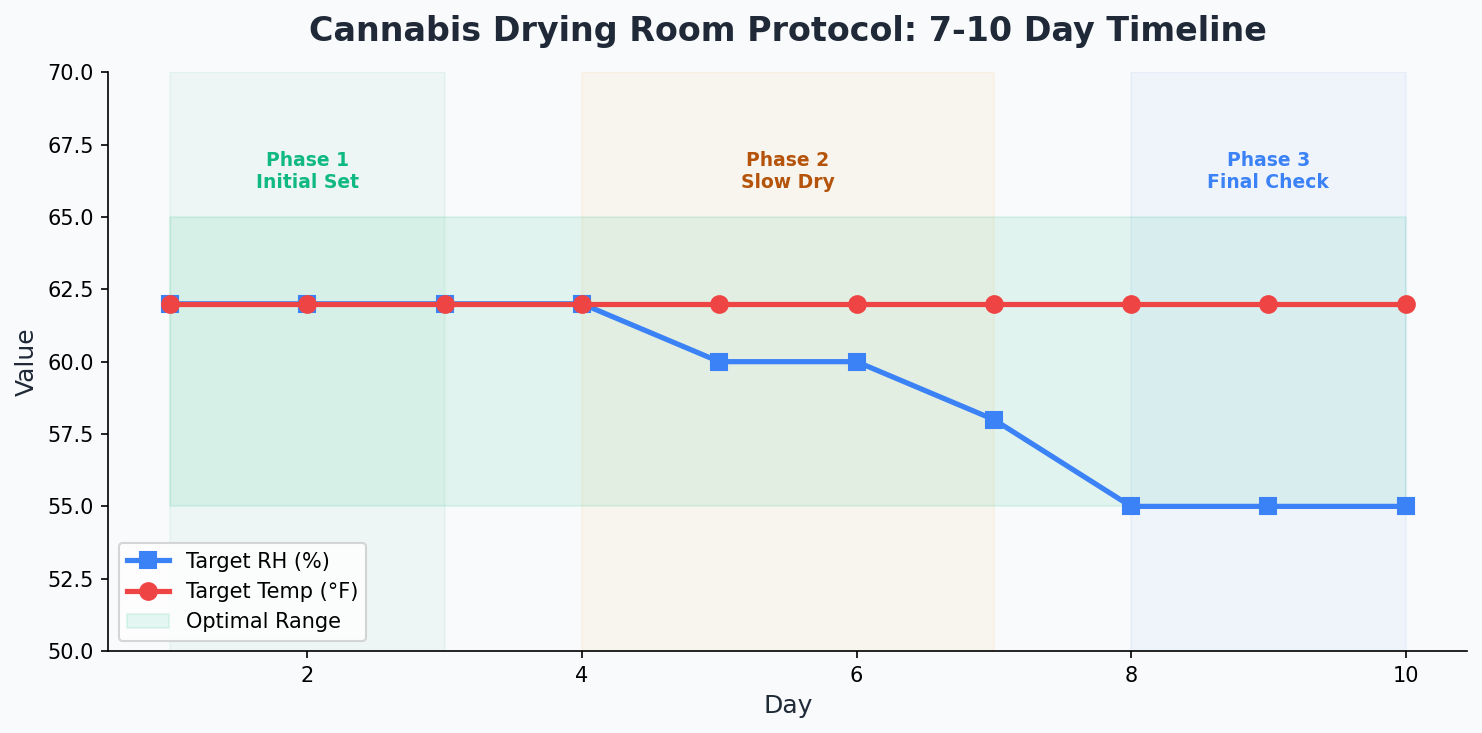
A controlled dry isn’t a single setting. Environmental targets shift across the drying window.
What separates good drying from great drying is control and consistency. The room should do the same thing every time, regardless of season, load size, or who’s working that day. Environmental drift during the dry is one of the most common (and most fixable) sources of batch-to-batch variation. If your dry room swings 10°F between day and night, or humidity spikes when you load a fresh batch, that shows up in the final product.
We go deep on room setup, airflow, and monitoring in the full cannabis drying room management guide.
Dry Weight Optimization: Stop Leaving Pounds on the Table
Here’s a number that doesn’t get enough attention: how much dry weight you’re losing to overdrying. Cannabis that’s dried below the optimal moisture window doesn’t just smoke harsh. It weighs less. And you sell by weight.
A batch that finishes at 8% moisture instead of 11% has lost roughly 3% of its sellable weight purely from excess moisture removal. On a 100-pound harvest, that’s 3 pounds gone. At estimated wholesale of $500 to $600 per pound, that’s $1,500 to $1,800 evaporated because the dry ran a day too long or the room was a few degrees too warm.
That math alone should make dry weight optimization a priority. But the weight loss isn’t even the worst part. Overdried cannabis is brittle, which means more trichome loss during handling and trim. The quality degradation compounds on top of the weight loss.
The fix is straightforward: measure moisture at multiple points during the dry, know your target range, and pull when the data says pull. Not when the room “feels” done. Not based on stem snap alone. Consistent measurement, consistent results.
Trimming: Where Labor Meets Quality
Trim is the most labor-intensive stage of cannabis post-harvest processing, and it’s where a lot of money either gets saved or burned. Your trim ratio (the percentage of starting weight that becomes sellable flower versus trim waste) is one of the clearest indicators of post-harvest efficiency.
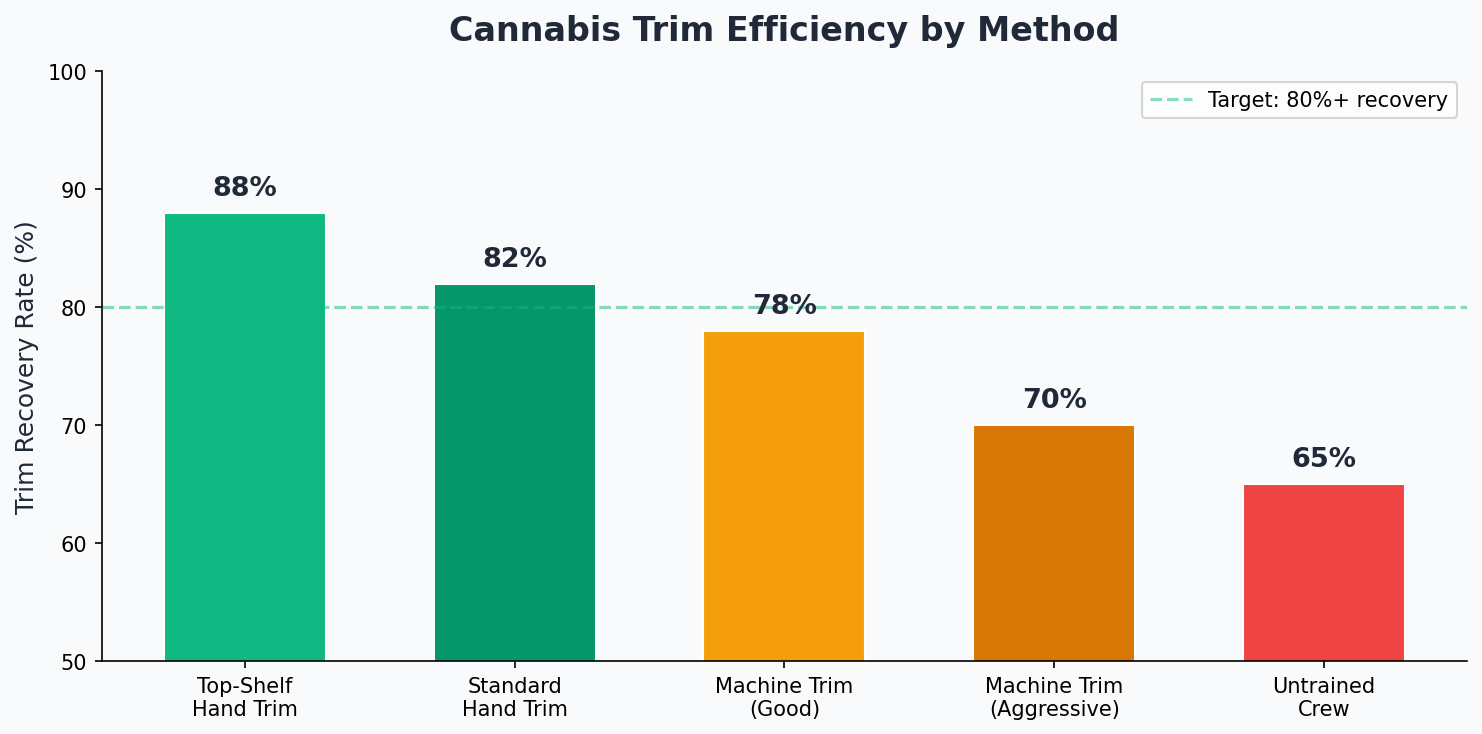
Trim ratio variance across runs. The gap between your best and worst represents real dollars.
A tight cannabis trim ratio means more of what you grew ends up in saleable bags. A loose or inconsistent ratio means you’re paying a crew to turn flower into trim waste beyond what’s necessary. The spread between your best trim run and your worst tells you exactly how much room there is to tighten up.
Factors that drive trim ratio: bud structure (genetics and grow-side decisions), how well the dry preserved flower integrity, trim crew training and SOPs, and whether you’re hand-trimming, machine-trimming, or running a hybrid approach. Each has tradeoffs, and the right choice depends on your scale and quality tier.
The full breakdown on benchmarks, crew management, and efficiency gains is in the cannabis trim ratio optimization guide.
Water Activity: The Number That Protects Your Product
If you’re not measuring water activity (aw), you’re guessing at shelf stability. Moisture content tells you how much water is in the flower. Water activity tells you how available that water is for microbial growth. That distinction matters enormously for storage, compliance, and quality preservation.
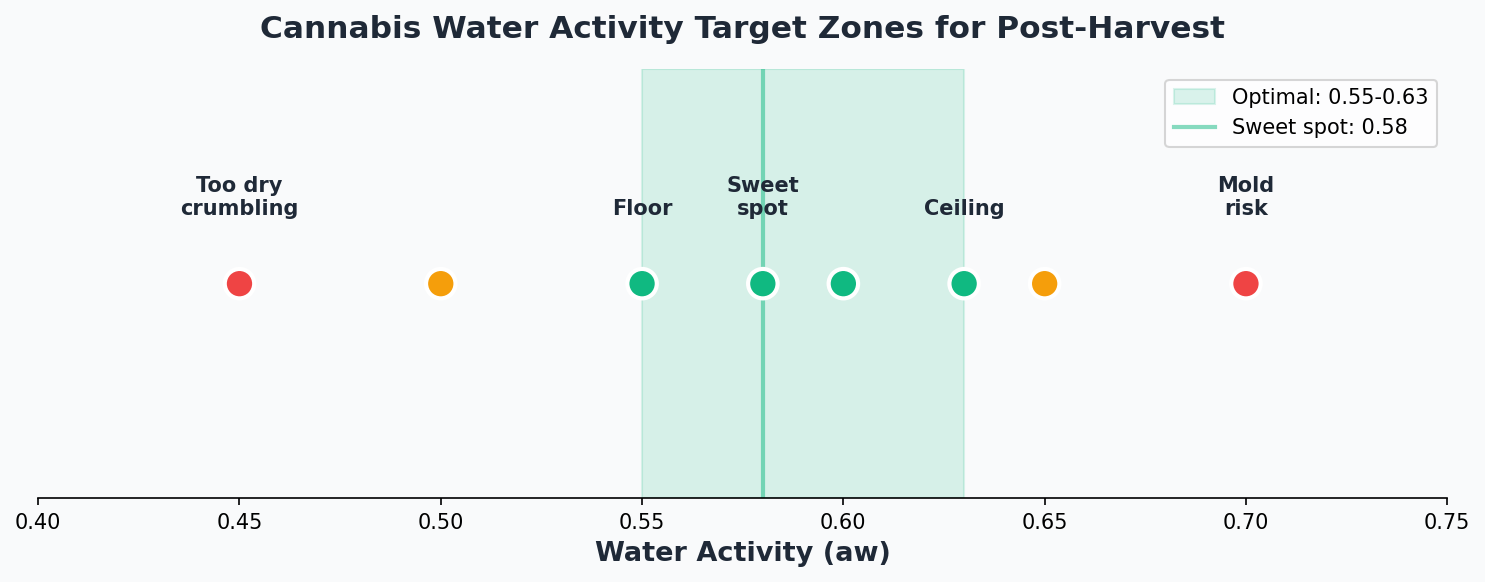
The target zone: 0.55 to 0.63 aw balances shelf stability with terpene and weight preservation.
The optimal aw range for cured cannabis flower is 0.55 to 0.63. Below 0.55, the flower is overdried: brittle, harsh, and lighter than it needs to be. Above 0.65, you’re in the danger zone for mold and microbial growth. The sweet spot preserves terpenes, maintains a pleasant smoke, and keeps the product stable on shelf.
A quality aw meter runs $300 to $600. For a commercial cannabis operation, that’s one of the highest-ROI instruments you can buy. One rejected batch from a dispensary or one mold issue in storage costs more than the meter. Measure aw at the end of dry, after cure, and before packaging. Three checkpoints, consistent protocol.
We cover the science, measurement protocols, and common mistakes in the full cannabis water activity guide.
Curing: Locking in Quality
Curing is where good flower becomes great flower. The biochemistry is straightforward: residual chlorophyll breaks down, terpene profiles develop, and moisture equilibrates throughout the bud. Rush it and you get a harsh, grassy product. Skip it entirely and you’re leaving quality (and customer satisfaction) behind.
A proper cannabis cure typically runs 2 to 4 weeks in sealed containers at 60 to 65°F, with periodic burping in the first week. Commercial operations handling large volumes often use sealed bins or totes with humidity packs rather than traditional mason jars. The principle is the same: controlled, slow moisture equalization in a stable environment.
The cure is also your last chance to catch problems. If aw readings drift up during the first few days of cure, that tells you the dry wasn’t as complete as it seemed. If you’re seeing ammonia smell, anaerobic conditions are developing. These are signals, and the earlier you catch them, the more product you can save.
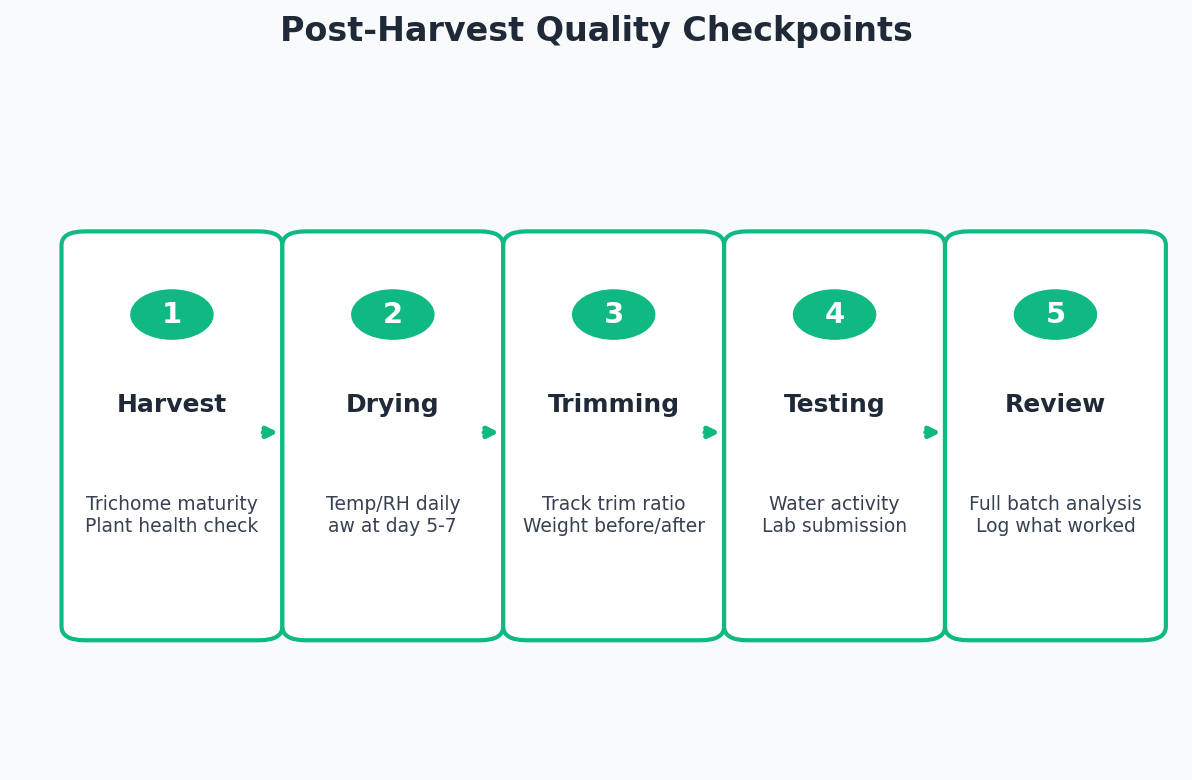
Quality checkpoints at each stage catch problems before they compound downstream.
The Batch Review: Closing the Loop
Here’s where most cannabis operations leave the biggest gains on the table. The run is done, the product is packaged, and everyone moves on to the next cycle. No structured review. No comparison to previous runs. No record of what worked and what drifted.
A batch review after every harvest is what turns individual runs into a system that improves over time. Without it, your best run and your worst run teach you the same amount: nothing. The review doesn’t need to be complicated. It needs to be consistent.
The key questions: What were the final yield numbers? How did the dry perform against targets? What was the trim ratio? Where did aw land? And the big one: how does this compare to the last run of the same cultivar in the same zone?
The complete framework for structuring this review is in the cannabis batch review post-harvest checklist. If you want to see how AI can automate the comparison and surface the patterns that matter, the AI batch analysis breakdown explains how that works in practice.
This is the piece that separates operations that plateau from operations that compound improvements. Every run generates data. The question is whether that data goes anywhere. The facilities with the tightest cost per pound aren’t the ones with the best single run. They’re the ones where the gap between their best and worst run keeps shrinking. That only happens with structured review, and it accelerates dramatically when the review process has real data to work with instead of memory and gut feel.
Treating Post-Harvest as a Discipline
Cannabis post-harvest optimization isn’t one big fix. It’s a series of small, measurable decisions at each stage. Harvest timing, dry room control, dry weight preservation, trim efficiency, water activity targets, cure protocols, and batch review. Each one compounds with the others.
The operations that do this well aren’t running fancier equipment. They’re measuring more, reviewing more, and making smaller adjustments more frequently. The data from each run feeds the next one. If you’re looking at your overall yield consistency and wondering why identical setups produce different results, start with post-harvest. The variance hiding there is often bigger than what’s happening in the grow room.
Growgoyle doesn’t replace your post-harvest protocols. It gives you the data and AI analysis to refine them run after run. Track your batches and see what each harvest actually produced. Already mid-flower? Start there. Try it free.
Leave a Reply