Everyone in cannabis talks about yield. Fewer people talk about what it costs to produce that yield. You can pull 4 lb/light and still lose money if your cost per pound sits above wholesale price. Yield without cost discipline is a treadmill. You’re moving fast and going nowhere.
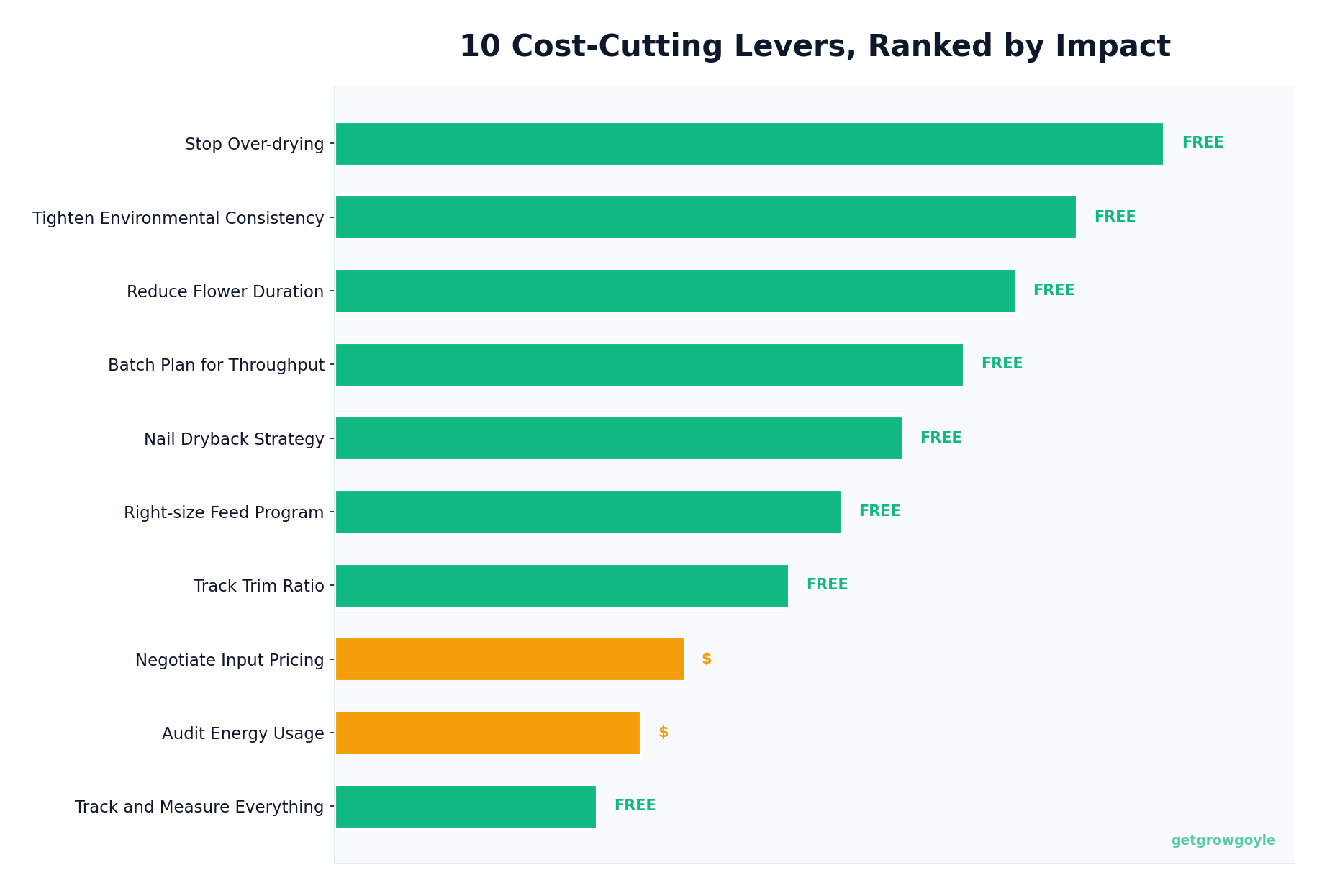
These 10 changes actually lower your cost per pound. None of them involve buying cheaper nutrients or skipping a defoliation. These are operational changes, not quality sacrifices. Some cost nothing. A few require a modest tool purchase. None require a capital equipment overhaul.
If you want to understand what cost per pound actually means for your cannabis operation and why it’s the metric that determines survival, start there. If you already know the number and want to move it, keep reading.
1. Tighten Your Environmental Consistency
Every degree of temperature swing costs you. Wide swings stress plants, reduce metabolic efficiency, and suppress yields in ways that are easy to miss because they don’t show up as dramatic deficiencies. They show up as a run that was “fine” instead of great.
The difference between a cannabis grow room that holds 78-80°F and one that swings 74-84°F can be 10-15% yield on the same genetics with the same feed program. You’re already paying for the HVAC. The cost of tighter control is attention and tuning, not new equipment.
VPD consistency matters just as much. Plants in a room that holds 1.2-1.4 kPa VPD throughout canopy hours transpire steadily and uptake nutrients efficiently. Plants in a room that swings from 0.8 to 1.8 are constantly adjusting stomatal aperture. That metabolic overhead comes out of yield.
Check your overnight temps, your lights-off period, your transition ramps. Fix those before buying anything new.
2. Stop Over-drying (This Is Free Money)
If I had to pick one single change that recovers the most money for the most cannabis facilities, it’s this one. Over-drying destroys weight you already grew, already paid to grow, and already harvested. It costs you nothing to fix except attention.
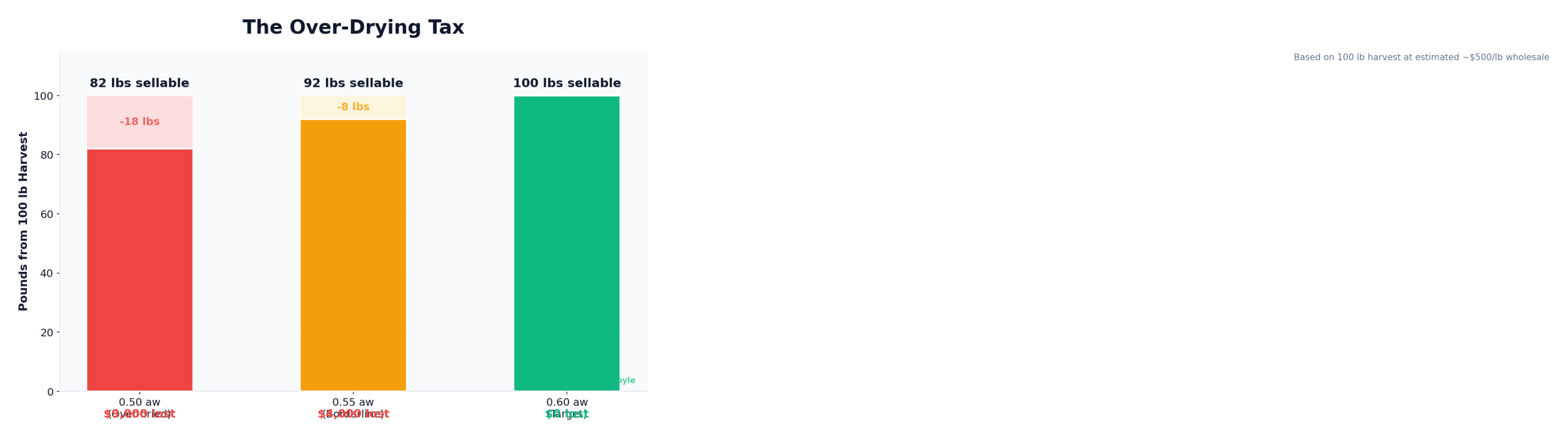
If your water activity is sitting below 0.55 aw, you’re literally evaporating product. Target 0.55-0.63 aw for compliant, stable flower that doesn’t lose a pound it didn’t have to lose. The difference between 0.50 aw and 0.60 aw on a 100 lb harvest can be 15-20 lbs of dry weight. At estimated ~$500/lb wholesale, that’s $7,500 to $10,000 you dried into thin air. Per harvest.
A $200 water activity meter pays for itself on the first harvest. If you don’t have one, get one this week. Check it on every batch. Log the number.
For a full breakdown of targets, technique, and common mistakes, the cannabis water activity guide covers it in detail. This one change, consistently applied, is the fastest route to recovering margin without touching anything else in your operation.
3. Track Your Trim Ratio
If you’re trimming 20% or more of your gross weight, you have a canopy management problem, a genetics problem, or a light penetration problem. Probably a combination.
Trim labor is expensive. Trim product (if you can move it at all) sells for a fraction of flower. An uneven canopy (popcorn, larf, poor light penetration) means more trim labor and less sellable product per hour worked. Your trim ratio tells you immediately how bad the problem is.
Goal: get trim ratio under 15%. Better canopy uniformity, better light distribution, and strategic defoliation all move this number. None of them cost money. They cost discipline and time in the grow room.
More importantly, track it batch over batch. A trim ratio that climbs from 14% to 18% to 22% across three or four runs isn’t random variation. Something changed. Could be a new phenotype expression, a defoliation timing shift, or light degradation you haven’t caught yet. The trend is the signal.
For deeper detail on what drives trim ratio and how to bring it down, cannabis trim ratio optimization is worth the read.
4. Right-size Your Feed Program
Overfeeding doesn’t produce bigger cannabis plants. Past a certain point, it produces salt stress, nutrient lockout, and waste. You’re spending money on inputs the plant can’t use and then spending more on flush cycles to clear the buildup.
Run runoff EC tests consistently. If your runoff EC is sitting 30% or more above your input EC, you’re pushing more nutrients than the root zone can process. That’s money going down the drain. Literally.
The fix isn’t cheaper nutrients. It’s dialing in your feed rate so you’re not wasting what you already bought. Pull back on the input EC, watch your runoff, and find the equilibrium. Most growers find they can reduce nutrient costs 10-20% without any change in plant performance once they start measuring instead of guessing.
Document your input EC, runoff EC, and pH for every irrigation event across a full run. The pattern will tell you exactly where to make adjustments.
5. Nail Your Dryback Strategy
Consistent, aggressive drybacks (25-35%+ VWC reduction between irrigations) steer cannabis plants toward generative growth. More flower, less vegetative bulk, better structure. Inconsistent drybacks create unpredictable root zone stress. Some days 15%, some days 40%, no clear rhythm. Plants respond to that chaos by prioritizing survival over reproduction.
This costs nothing to implement. You’re irrigating either way. Dryback precision is about timing and measurement, not additional inputs. Better drybacks produce better yields from the same plants under the same lights with the same nutrients. That’s cost per pound improvement with zero additional spend.
Track your substrate moisture sensors batch over batch. If your drybacks are inconsistent across a run, figure out why. Was it timing? Irrigation system response time? Room humidity affecting transpiration rates? The answer is in the data. If you want the full picture of how dryback fits into a broader crop steering strategy for commercial cannabis, that’s worth understanding before you start adjusting irrigation schedules.
6. Reduce Your Flower Duration (If the Strain Allows)
Every extra day in flower costs electricity, labor, nutrients, and facility time. Some strains finish in 56 days. Some growers run them 70 “just to be safe.” That’s two extra weeks of operating cost per batch for no additional product.
Know your strain’s actual finish window. Track trichome maturity consistently across runs. Harvest on time, not on instinct.
Here’s the math: if you can shave 10 days off a 70-day flower cycle reliably, you add nearly one full extra harvest per year in that room. Fixed costs (rent, depreciation, insurance) don’t change. You’re getting more product from the same facility cost base. Cost per pound drops without touching a single input.
This only works if you have the strain data to support it. Don’t rush a run that needs more time. But don’t drag out a run that’s ready because you’re not sure. Know the difference.
7. Batch Plan for Throughput
Dead room days are pure cost. A room sitting empty between flips is still running electricity, still accruing rent, still depreciating your equipment. It’s producing nothing.
Plan your batch pipeline so rooms flip within 2-3 days. Stagger your batches so harvest prep and transplant activities overlap cleanly. This isn’t complicated scheduling, but it takes intentional planning. Most facilities that struggle with room downtime don’t have a workflow problem. They have a visibility problem. Nobody has a clear view of when each room is finishing, what’s queued, and where the bottleneck is.
At 23 harvests per year versus 20, you’re pulling 15% more product from the same facility. Fixed costs don’t change. Revenue goes up. Cost per pound drops. The only investment is better planning.
8. Fix Your Lighting Uniformity
Even with quality fixtures, the question is: are they positioned right? Running the right intensity for the phase? Producing uniform light distribution across the canopy?
A $30 PAR meter and 20 minutes of measurement can reveal that your “1000 PPFD” canopy actually ranges from 650 to 1200 PPFD across the footprint. The low spots are producing popcorn and larf. You’re paying for light you’re not converting into sellable flower.
Uniform light produces a uniform canopy. A uniform canopy means less trim labor, better yield distribution, and more consistent results batch over batch. Map your PPFD at canopy height before each run. Adjust fixture height and positioning until you’re within 15-20% variance across the footprint. Do it once per strain per room and document the result.
If you’re still on HPS, the economics of LED conversion work in most scenarios within 12-18 months on electricity savings alone, with yield improvements on top. Run the numbers for your facility specifically before committing, but don’t skip the analysis because you assume it won’t pencil.
9. Audit Your Labor Hours
Most cannabis facilities don’t actually know what it costs in labor to produce a pound. They know their total payroll. They know headcount. They don’t know hours per task, hours per batch, or hours per pound produced.
Start tracking it. Log hours by task type: daily plant maintenance, irrigation, training, defoliation, harvest, trim, cleaning. Then attribute those to batches. At the end of each run, you’ll have a labor cost per batch. Divide by dry weight and you have labor cost per pound.
The biggest labor costs in most facilities are trim, harvest, and daily maintenance. Anything that reduces trim weight (better canopy management), speeds harvest prep (better batch planning), or streamlines daily tasks directly reduces labor cost per pound. You don’t need to push your team harder. You need to direct them toward the tasks with the highest return.
Phase-aware scheduling helps here. The tasks that matter in week 2 of flower are different from week 6. Having a clear schedule that reflects what phase each room is in means less time figuring out what to do and more time doing the things that matter.
10. Measure Everything, Then Compare
You can’t cut costs you can’t see. And you can’t improve what you don’t compare.
Track your cost per pound per batch. Compare the last run to the one before it. Compare the same strain across different seasons. Look for the outliers, both the great runs and the disappointing ones, and figure out what was different. Was it environment? Feed timing? A team change? A genetics lot? Something always explains the variance. Find it.
This is where batch-over-batch comparison becomes more valuable than any single metric. One great run is luck. A pattern of great runs is a process. The comparison work is what turns luck into process.
Most growers track yield because it’s the obvious number. Better growers track cost per pound because it’s the number that determines whether the business survives. Great growers compare both across every run and can tell you exactly what made their best batch great and exactly what went sideways on their worst one.
That level of operational knowledge compounds. Every batch you measure and compare gets a little better. After four or five cycles of serious batch-over-batch review, the cumulative improvement is significant. It doesn’t happen from a single good run. It happens from consistent measurement and honest comparison.
Understanding how batch-over-batch improvement actually works in commercial cannabis is worth spending some time on if you’re not already doing it systematically.
Know your number before you try to lower it. Our free cost per pound calculator has 27 expense categories, tax presets for major states, and what-if yield modeling. No signup required.
The Compounding Effect
None of these tips is a silver bullet. Tightening your VPD consistency is worth something. Fixing your dryback strategy is worth something. Reducing flower duration by 10 days is worth something. But doing all ten of these, consistently, across every batch? That’s where cost per pound actually moves in a meaningful way.
The cannabis operations pulling the best margins aren’t doing one magic thing. They’re doing a dozen ordinary things with discipline and consistency. They measure. They compare. They adjust. They don’t forget what they learned last cycle.
Tracking all of this by hand is possible for one room, one strain, one grower. Doing it consistently, batch after batch, across multiple rooms and strains and team members? That’s where most facilities fall off. Not because they don’t care. Because there’s no system holding it together.
Growgoyle connects the crop schedule, task labor, maintenance, and harvest records so cost-cutting ideas have evidence behind them. Review attributed overhead alongside the run history, then check actual savings against your accounting records.
Comments
One response to “10 Ways to Cut Cannabis Cultivation Costs Without Cutting Corners”
[…] is the boring, repetitive work that actually reduces your cannabis production costs. No silver bullets. No magic nutrients. Just data, comparison, and incremental improvement, run […]