You spent 60 to 70 days dialing in your cannabis grow. You tracked VPD, hit your DLI targets, managed irrigation drybacks, and pulled a solid canopy. Then it all goes into the dry room, and you kind of just… hope for the best.
That’s not a knock on anyone. It’s how most commercial cannabis operations actually work. The dry room is the most consequential room in the facility and the one managed most by feel. Seven to fourteen days can undo months of careful cultivation. Weight loss, terpene volatilization, hay smell, mold, reduced bag appeal. All of it happens here, and most facilities have less environmental control in the dry room than they do in a vegetative zone.
This is the drying reference I wish existed when I started. Not the hobby guides that assume you have a $200K custom dry room with precision HVAC. The real-world guide for commercial cannabis operations that live with undersized dehumidifiers, seasonal humidity swings, and room turnover pressure from ownership.
The Target Envelope: Temperature, Humidity, and Airflow
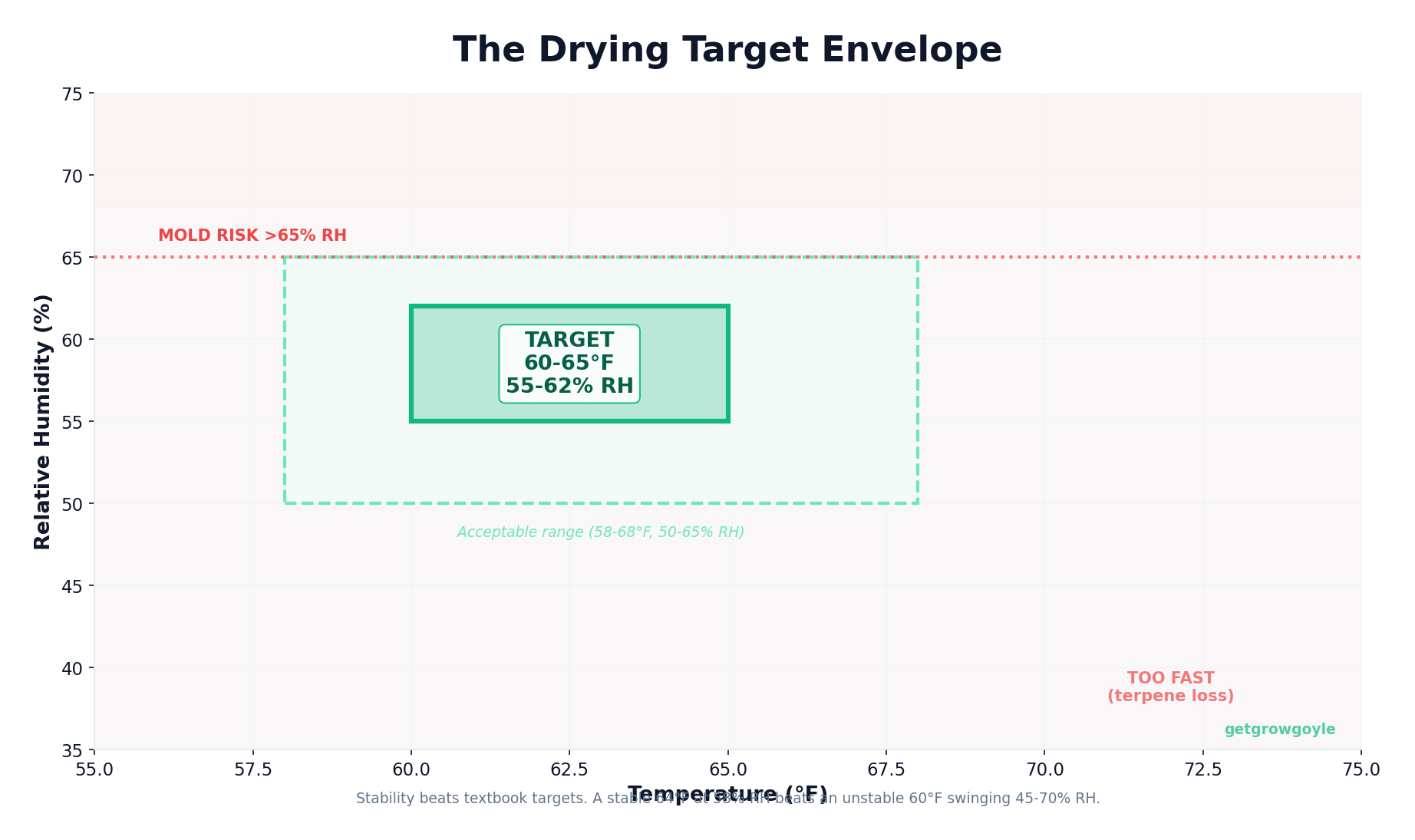
The standard recommendation you’ll see everywhere: 60 to 65 degrees Fahrenheit, 55 to 62% RH. That’s correct as a baseline. But here’s the actual conversation nobody has.
If your HVAC can’t hold 60F without cratering humidity to 40%, chasing 60F is going to cost you more terpenes than running 64F at stable 58% RH. Stability beats the textbook target every time. A stable 62 to 68F with RH that doesn’t swing more than 3 to 4 points is a better environment than a facility fighting to hit 60F while watching RH bounce between 45% and 70%.
The physics: you’re targeting a lower VPD in the dry room compared to flower. Lower VPD slows moisture migration from the plant, which gives terpenes more time to preserve before the surface dries out. This is why fast drying at low RH produces that characteristic hay smell. The chlorophyll and starches haven’t had time to break down, and the terpenes left with the water vapor before the plant even fully dried. Curing cannot fix a fast dry. That’s worth reading again: curing will not rescue a batch that dried in four days.
Darkness is non-negotiable. Light degrades cannabinoids and terpenes at rates that matter commercially. If your dry room has windows or any ambient light exposure, fix that before anything else.
The Airflow Problem at Scale
Airflow in a dry room is where commercial operations diverge most from small-scale guides. A room with 10 hanging lines, 500+ branches, and 50 to 100 lbs of fresh-cut cannabis hanging from the ceiling is a fundamentally different airflow problem than a spare bedroom with 10 plants.
The dead zones are real and predictable. Perimeter plants dry faster than interior ones. Top of the canopy dries faster than the bottom. Dense hanging areas create moisture pockets. If your fan placement is creating oscillating air movement across the room, you’re generating uneven drying rates by position, and that means you’ll need to make harvest decisions based on your fastest-drying corner while your interior branches are still two days out.
Ducted airflow performs better at commercial scale than oscillating fans. Consistent, distributed air movement at low velocity (you want air movement, not wind) beats point-source fans. The test is simple: pull samples from three positions at day seven, weigh them, and check water activity. More than a 0.05 aw spread across positions tells you the environment isn’t uniform.
Practical rules: don’t exceed hanging density that prevents airspace between branches. Row spacing matters. If you’re hanging by the branch, four to six inches of clearance between branches is a workable minimum. More is better. The yield hit from harvesting in two smaller batches is usually less than the quality hit from overcrowding a single load.
Timing: The Dry-Speed Tradeoff
Too fast: three to five days produces a batch with terpene loss, harsh smoke characteristics, and that hay smell that’s hard to explain to a buyer. The chlorophyll breakdown that should happen during a proper dry gets truncated. Curing extends shelf life and helps with potency preservation, but it does not rebuild what a fast dry stripped out.
Too slow: sixteen or more days in a commercial dry room creates serious mold risk in any climate with seasonal humidity. It also means the room is occupied for two-plus weeks, creating scheduling pressure on your next harvest.
The commercial sweet spot is 10 to 14 days with whole-plant or branch hanging. That’s where terpene preservation is maximized, chlorophyll breaks down properly, and you’re not running the room long enough to invite Botrytis.
The hardest part of drying room management in a commercial facility is resisting the pressure to move product faster. Room turnover pressure is real. Ownership wants the next batch in. But rushing the dry is one of the most expensive mistakes in cannabis cultivation because the quality loss compounds all the way to the sale price. A batch that comes off the dehumidifier in six days instead of twelve might save you three days of room time and cost you $10 to $15 per pound at wholesale.
Seasonal adjustments matter more than most operators plan for. Summer humidity means your HVAC is fighting harder to hit target RH, which often results in running warmer and drier than intended. Winter conditions can swing the other direction, with low ambient humidity accelerating surface drying while moisture stays locked in the stem. Document your HVAC settings by season and track outcomes. The same settings that produce perfect results in October may need significant adjustment in July.
Water Activity: The Objective Metric
The “stems snap” test is not a measurement. It’s a heuristic, and it’s inconsistent between cultivars, individual plants, and the person doing the assessment. At commercial scale, you need an objective number.
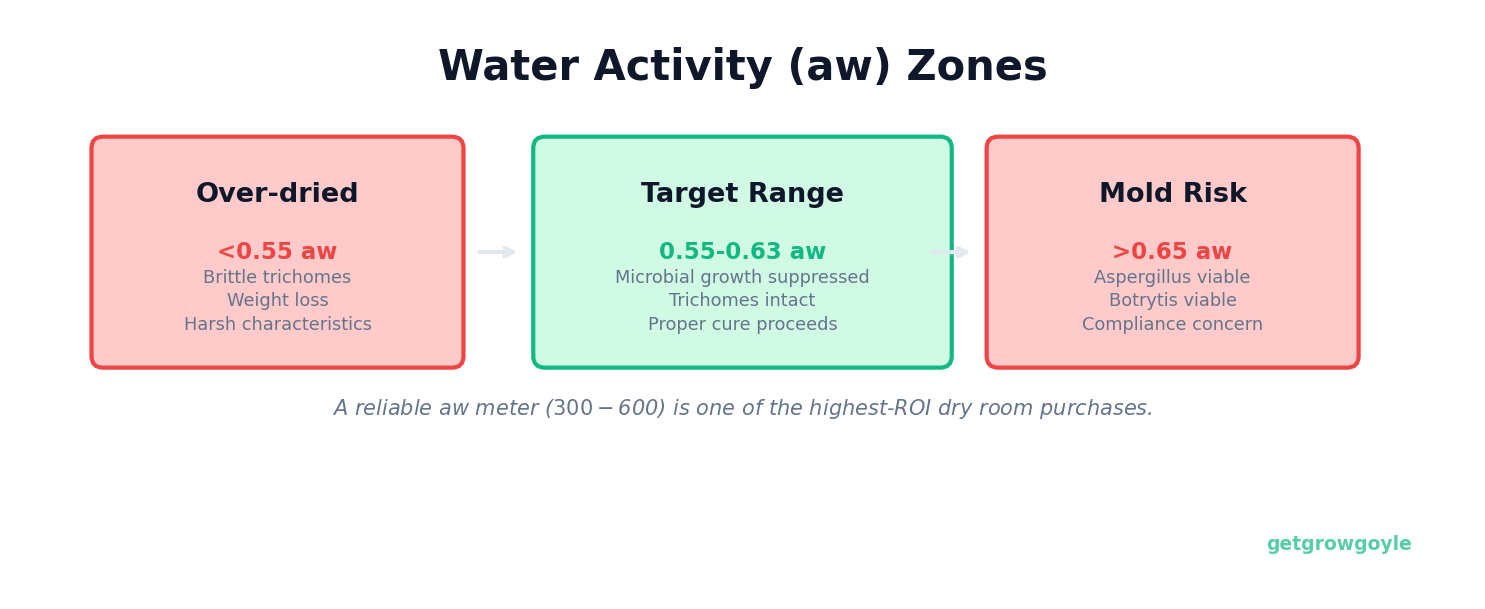
Water activity (aw) is that number. It measures the energy of water in the product, which predicts microbial growth risk and shelf stability far better than moisture percentage alone. For commercial cannabis, the preservation zone is 0.55 to 0.63 aw.
- Below 0.55: overdried. Brittle trichomes, weight loss you already paid for, harsh characteristics. You’re leaving money on the scale.
- 0.55 to 0.63: the target range. Microbial growth suppressed, trichomes intact, proper cure can proceed.
- Above 0.65: mold risk. Aspergillus and Botrytis both find viable conditions above this threshold. For cannabis destined for patients or regulated sale, this is also a compliance concern.
A reliable aw meter runs $300 to $600. It’s one of the highest-ROI purchases in your dry room. The Growgoyle water activity guide has a full breakdown of testing protocols and what the numbers mean at each phase.
Testing protocol: pull three to five samples from different positions in the room (perimeter, interior, high, low). If you’re seeing more than a 0.05 spread between samples, the environment isn’t uniform. That’s an airflow or HVAC distribution problem, not a genetics problem.
Common Commercial Drying Mistakes
The patterns that show up repeatedly across operations:
Rushing the dry for room turnover. Already covered this, but it’s the most expensive mistake in the dry room. The math on lost sale price almost always exceeds the cost of the extra room time.
Ignoring airflow dead zones. Set up the room, hang the product, run the fans, and assume it’s uniform. The aw spread test catches this quickly.
Set-and-forget HVAC. This one is subtle. The moisture load in a dry room changes dramatically across the dry cycle. Day one with 80 lbs of fresh-cut material is a completely different HVAC demand than day ten when that same material has lost 70% of its water weight. A dehumidifier running at its day-one setting on day ten may be pulling the room too dry. Checking conditions at day three, seven, and ten catches drift before it affects the batch.
No monitoring during drying. Cannabis grow room environment control gets attention. Dry room monitoring often doesn’t. A supported sensor connection and properly configured alerts can help flag an RH excursion between walkthroughs. Check the readings are current and make sure somebody owns the response.
Overcrowding. The temptation to get one more line in the room is real. The airflow physics don’t care about scheduling pressure.
Drying Room Design Considerations
If you’re designing or retrofitting a dry room, a few principles that matter more than most people account for:
Interior rooms dry more evenly. Exterior walls create temperature gradients, especially in climates with significant seasonal swings. An interior room insulated on all sides holds its setpoint more consistently and costs less to condition.
HVAC sizing is the number one infrastructure mistake. Calculate your moisture removal requirement based on maximum harvest weight. Fresh-cut cannabis is roughly 75 to 80% water by weight. A 100-lb wet harvest puts approximately 60 to 65 lbs of water into the air over 10 to 14 days. Undersized dehumidification means you’re either rushing the dry (bad) or fighting mold in the back half of the cycle (worse).
Separate zones help when you can build them. Different cultivars dry at different rates. If you’re running a mixed harvest, the strain that needs 12 days shouldn’t be sharing a room setpoint with the one that finishes in nine. Two smaller dry rooms with independent HVAC give you more flexibility than one large room.
Flooring matters more than it sounds. Sealed or epoxy concrete prevents moisture absorption and makes sanitation straightforward. Raw concrete holds moisture and is harder to keep clean.
From Drying to Curing: When to Transition
The transition point: aw in the 0.58 to 0.62 range, outer buds dry to the touch, stems with slight flex (not snap, not bend without resistance). At this point the product is ready to move into sealed containers for cure.
Commercial curing in buckets or bins: burp daily for the first three to five days, then seal with humidity packs targeting 58 to 62% (Boveda 58 is the standard). Check aw at day three, seven, and fourteen. If aw rises above 0.63 after sealing, moisture is still migrating out of the inner stem material. That means the dry didn’t fully complete before you transitioned, and you’ll need to open the containers and let it breathe.
Minimum cure window for commercial flower: two to four weeks. The enzymatic processes that improve flavor and smooth smoke characteristics take time. A two-week cure is a floor, not a target.
Building a Drying SOP That Adapts
The operators who consistently produce quality product across seasons aren’t the ones with the fanciest dry rooms. They’re the ones who document, track, and adjust. Every dry room run should capture: room conditions at start, hanging density, start and end weights, aw readings at day three, seven, and completion, total days, and final product quality notes.
That documentation does two things. First, it builds seasonal SOPs so you’re not reinventing the approach every August. Second, it creates the feedback loop that connects drying performance to the full batch picture. A post-run batch review that includes drying data (weight retention, days to target aw, quality outcomes) shows the complete picture from clone to cure, not just the flower phase.
The difference between a sensor dashboard and actual cultivation intelligence is exactly this: data that’s recorded but never connected to outcomes doesn’t improve anything. Drying conditions that feed into a full batch analysis give you something to actually work with when the next run is setting up.
Growgoyle includes drying records in the completed-run review. The Goyle Score’s drying dimension uses the available dry duration, dry-to-wet ratio under the recorded weight convention, and water activity, assessed against defined scoring ranges. It does not prove that drying alone caused a quality or weight difference; inspect the records behind a low score.
For operations working to cut cannabis cultivation costs, the dry room is worth treating with the same rigor as the flower room. The consistency that drives low cost per pound doesn’t stop at harvest. It runs all the way through cure.
Use Growgoyle to keep the dry-room observations, checks, and harvest records with the crop. That makes the next drying review easier to turn into a clear protocol and assigned work.
Comments
One response to “Cannabis Drying Room Management for Commercial Operations”
[…] space carry many of the same coil, filter, drain, and sensor concerns as flower-room equipment. Our guide to commercial drying room management covers the environmental process; this schedule covers keeping the equipment maintained to its […]