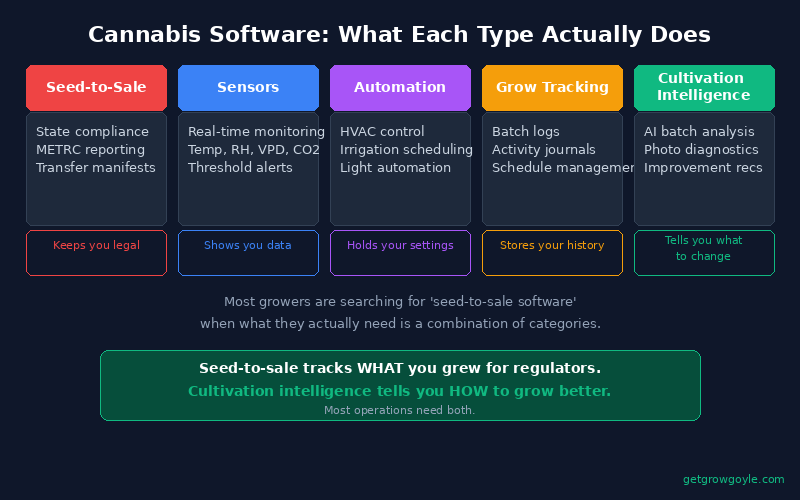
I’ve onboarded a lot of cannabis growers at this point. And there’s a moment that keeps repeating. I’ll ask something simple: “When did you flip this room?” And there’s a pause. Then they open METRC.
Two separate commercial operators did this in the same week. Both running real facilities with real teams, both experienced, both passing every compliance audit. One of them was a full week off on his flip date and had to back-calculate it from his harvest date in METRC. These are not sloppy growers. These are professionals running multi-room cannabis cultivation facilities, hitting deadlines, managing staff. They just didn’t have anywhere to write it down except the system the state gave them.
And that’s the problem. Not METRC. METRC does exactly what it’s supposed to do. The problem is that METRC became the default cannabis grow journal because nothing else existed.
METRC Does Its Job. That’s the Point.
METRC is a compliance system. It tracks plant counts, harvest weights, package IDs, transfers, lab results, and waste manifests. It does this well. It gives the state what the state needs: a chain of custody from seed to sale. Every licensed cannabis cultivation operation in a METRC state uses it because they’re required to. And that’s fine.
The issue is what METRC was never designed to capture. It doesn’t know your flip date. It doesn’t know your VPD targets during week 5 of flower. It doesn’t know that you adjusted your feed EC on day 21 because your runoff was climbing. It doesn’t know why your January run hit 2.8 lb/light and your March run only hit 2.3.
METRC can tell you that you harvested 47 pounds. It cannot tell you why it wasn’t 52.
What METRC Tracks vs. What You Actually Need
Here’s the gap, laid out plainly.
METRC gives you the compliance picture. Your grow needs the full picture.
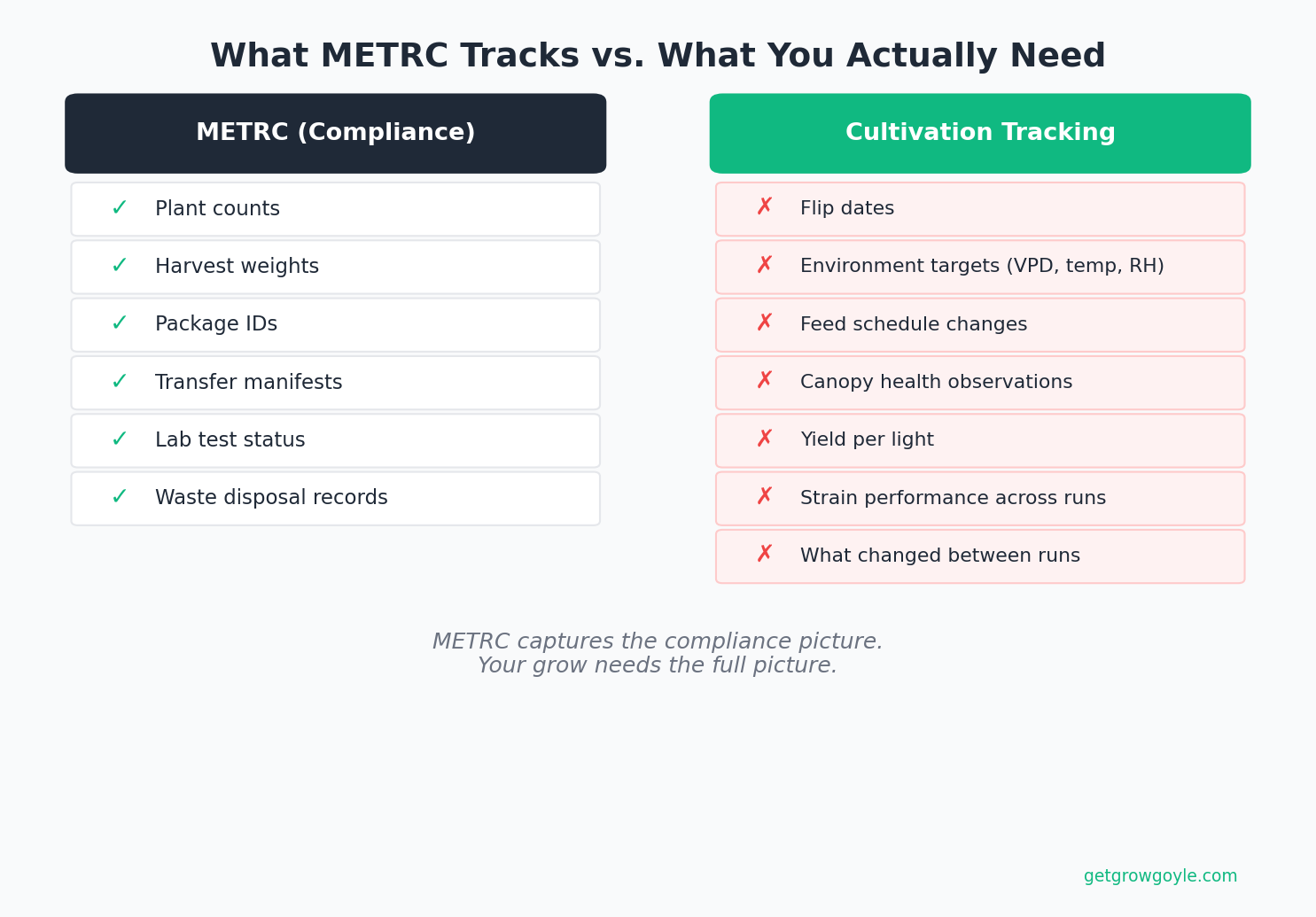
On the METRC side: plant counts, harvest weights, package IDs, transfer manifests, lab test status, waste disposal records. That’s the compliance picture. It’s complete for its purpose.
On the cultivation side, what your cannabis grow tracking actually needs: flip dates, environment targets during flower, feed schedule changes, canopy health observations, yield per light, strain performance across runs, and what changed between your best run and your worst. None of that lives in METRC. Because METRC wasn’t built for you. It was built for the state.
If you’re relying on METRC as your batch-over-batch improvement system, you’re trying to use a compliance ledger as a grow journal. It’s like doing your taxes with a recipe book. Both are useful documents. Neither can do the other’s job.
The Invisible Cost of No Cannabis Cultivation Records
Here’s what this looks like in practice. You had a great run in October. Frosty, dense, 2.9 lb/light. Your team was hyped. Fast forward four months. You’re running the same strain in the same room. And it comes back at 2.4.
What changed? You think it might have been the environment. Maybe the VPD was off during stretch. Maybe you pushed the dry too fast. But you can’t look it up because nobody wrote it down. METRC says you harvested. Your memory says “I think we did something different with the lights.” That’s not cannabis grow tracking. That’s guessing.
The data gap compounds over time. One forgotten detail per run is manageable. But across 4 rooms, 6 strains, 3 runs per room per year, you’re looking at dozens of lost data points. Each one represents a question you can’t answer later. What feed schedule produced your best terpene profile? What was your dry room humidity when that batch came out perfect? The answers existed. They just weren’t captured anywhere that persists.
This is the real cost per pound problem that nobody talks about. Not just inputs and labor. It’s the yield left on the table because you can’t reliably repeat what works.
What a Cannabis Batch Actually Needs Recorded
Think about the lifecycle of a single batch. From flip to cure, there are dozens of inflection points where decisions get made and conditions shift.
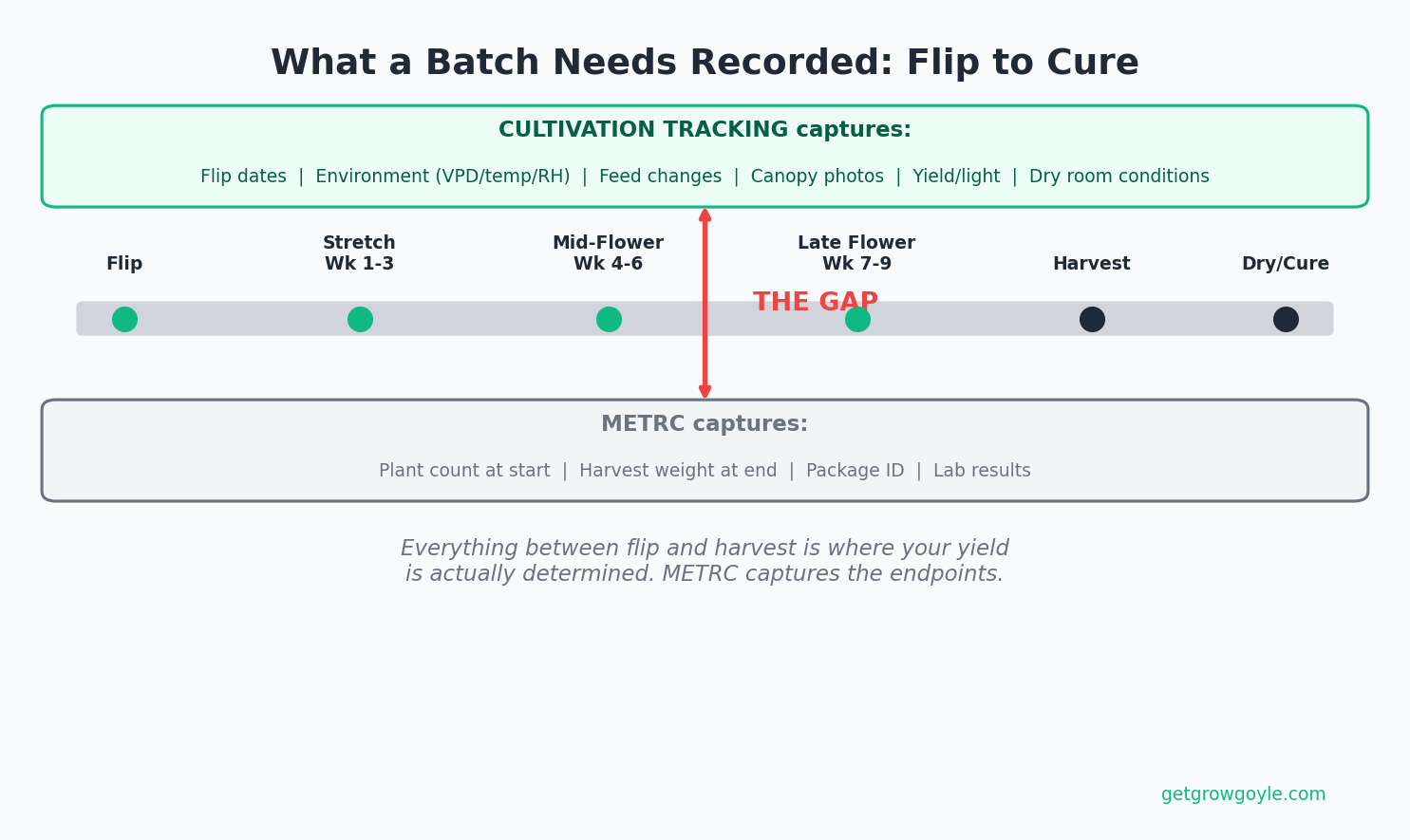
METRC captures the endpoints. Everything between flip and harvest is where your yield is actually determined.
At flip, you need the date, the strain, the plant count, the room, and your target environment parameters. During stretch (weeks 1 through 3 of flower), you’re watching canopy development, adjusting light height, maybe defoliating. Mid-flower (weeks 4 through 6), you’re monitoring trichome development, adjusting VPD, watching for deficiencies. Late flower (weeks 7 through 9+), you’re deciding when to flush, when to chop, tracking fade.
Then harvest. Wet weight. Trim. Dry room conditions. Final dry weight. Cure parameters. Lab results. Yield per light.
METRC captures the endpoints: plant went in, weight came out. Everything in between (the part that actually determines your yield and quality) is either in someone’s head, on a whiteboard that got erased, or in a text thread from three months ago that nobody can find.
That’s not a character flaw. That’s a systems problem. And it’s universal. Every cannabis cultivation facility I’ve talked to has some version of this gap.
When Your Best Grower Leaves
There’s a version of this problem that keeps operators up at night. Your lead grower, the one who dialed in your environment, who knows exactly when to push the DLI, who can eyeball a canopy and call the yield within 10%. What happens when they leave?
All that institutional knowledge walks out the door. METRC can’t tell you what they did differently. Neither can your spreadsheet from 6 months ago. The new person comes in and starts from scratch, making the same adjustments your last grower already figured out. You’re paying for lessons your facility already learned.
This is why cultivation intelligence matters. Not as a buzzword. As a practical concept: your facility should accumulate knowledge over time, independent of any single person. When the data from every run is captured, structured, and analyzed, your operation gets smarter whether or not the same person is running it.
You Need Two Systems
The answer isn’t to replace METRC. You can’t, and you shouldn’t try. METRC does its job. The answer is to stop expecting it to do a job it was never designed for.
You need one system for the state and one system for you.
Your state system tracks compliance: did you account for every plant, every gram, every transfer? Your cultivation system tracks what actually happened during the run: environment data, feed changes, canopy observations, and what your best runs had in common.
Two systems, two purposes. METRC answers the state’s questions. Cultivation tracking answers yours.
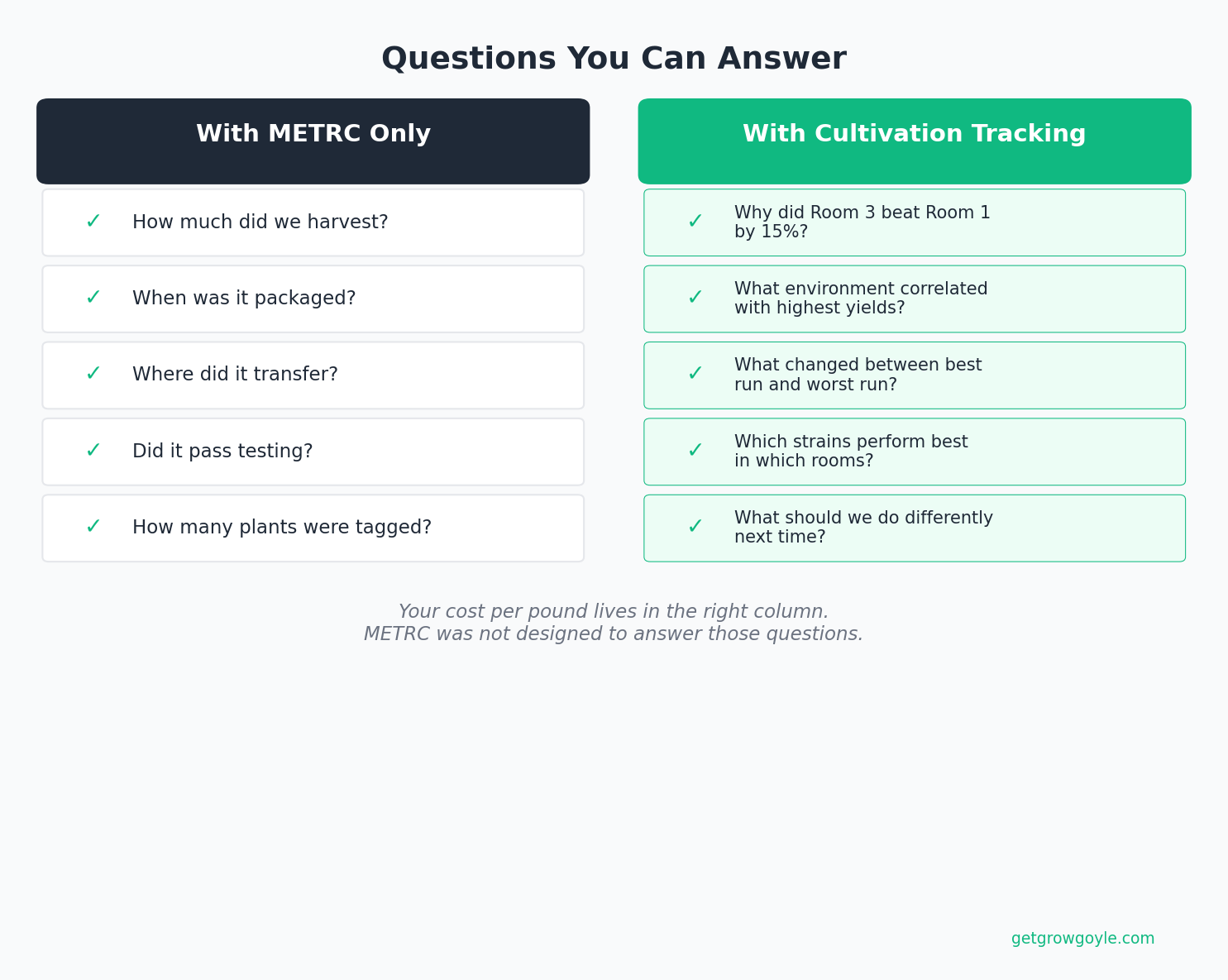
With METRC alone, you can answer: How much did we harvest? When was it packaged? Where did it transfer? Did it pass testing?
With real cannabis batch tracking, you can answer: Why did Room 3 outperform Room 1 by 15% on the same strain? What environment conditions correlated with your highest yields? What changed between your best run and the one that fell short? Which strains perform best in which rooms? What should you do differently next time?
That second set of questions is where your cost per pound actually lives. And right now, for most operations, those questions go unanswered.
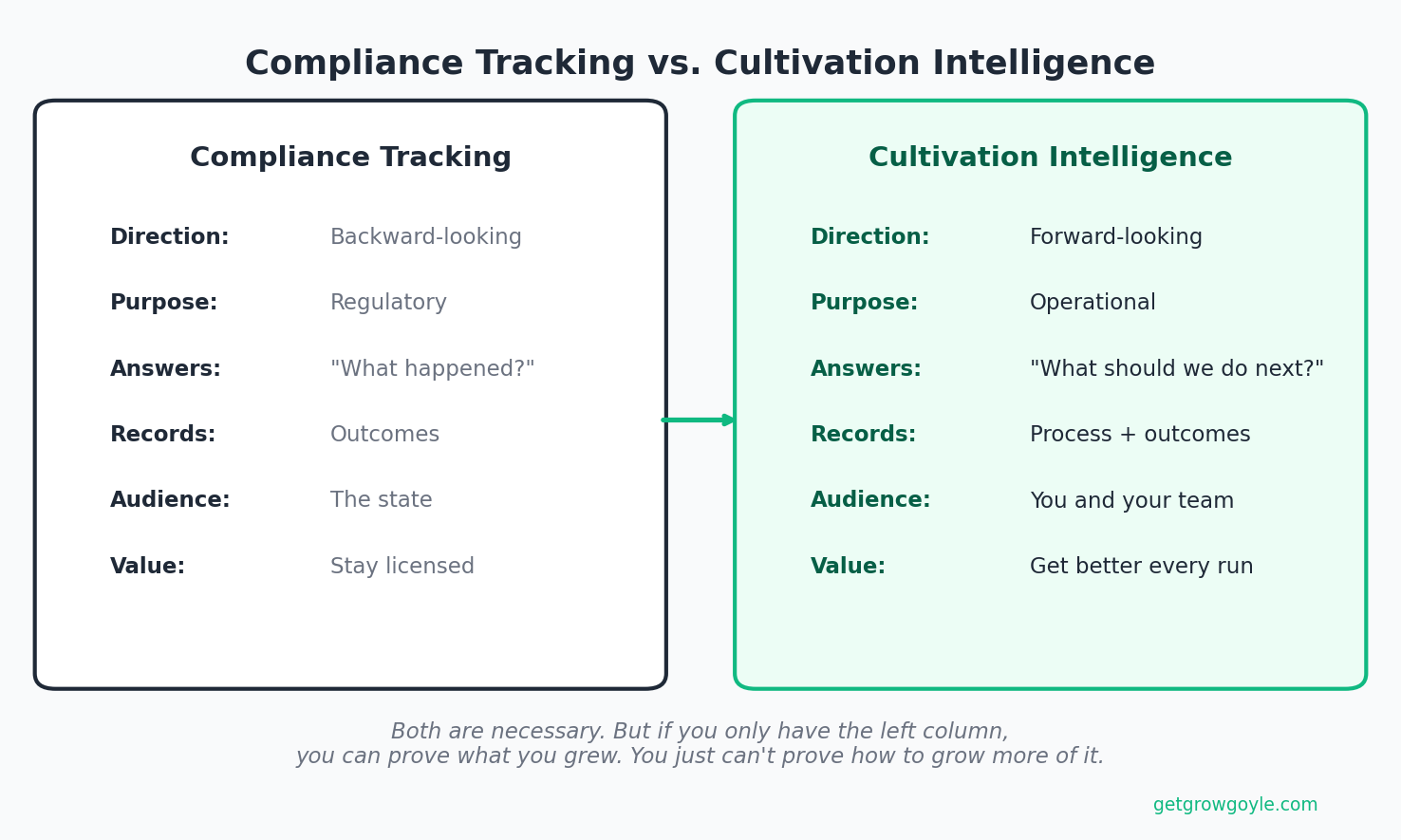
Compliance tracking is backward-looking by design. It answers: what happened? It’s regulatory. It satisfies an external requirement. It records outcomes.
Cultivation intelligence is forward-looking. It answers: what should we do next? It’s operational. It satisfies an internal need. It records the process that created those outcomes, then helps you refine that process run after run.
Both are necessary. But if you only have the first one, you’re running your cannabis facility with one eye closed. You can prove what you grew. You just can’t prove why, or how to grow more of it next time.
This is exactly the gap that AI batch analysis was built to fill. After every run, a full breakdown of what worked, what to adjust, and specific estimates for where improvements would come from. Not replacing your judgment. Adding structured recall to it. The data shows what happened so you can decide what to change.
And when you want to understand why one run outperformed another, batch comparison puts them side by side. Here’s what your best run had in common. Here’s what was different about the mediocre one. No guessing. No trying to reconstruct it from memory four months later.
Your Compliance System Tracks Your Grow for the State. You Need Something That Tracks Your Grow for You.
METRC isn’t the problem. The gap is the problem. And the gap exists because for years, the only tracking system cannabis growers had access to was the one the state required. Everything else (flip dates, environment data, feed changes, canopy observations) got carried in someone’s head, scribbled on a whiteboard, or lost in a group text.
Your operation’s rate of improvement depends on how much you retain from your last run. And right now, most of what you retain is whatever you can hold in your head. That’s not a failure of discipline. That’s a failure of systems. Your facility deserves consistent yields, and consistency requires a record that’s actually built for growing, not for compliance.
METRC is for the state to track your grow. Growgoyle is for you to track your grow and repeat what works, run after run.
Growgoyle doesn’t replace METRC. It fills the gap METRC was never designed to fill. See the full system built by a grower who got tired of losing lessons between runs. See how it works.
About the Author
Eric is a 15-year software engineer who operates a commercial cannabis cultivation facility in Michigan. He built Growgoyle to solve the problems he faces every day: inconsistent yields, forgotten lessons from past runs, and the constant pressure to lower cost per pound. Every feature in Growgoyle comes from real growing experience, not a product roadmap.
If you’re managing a commercial grow room by relative humidity alone, you’re flying with half the instrument panel dark. Relative humidity tells you about the air. VPD tells you about the plant.
Vapor Pressure Deficit is the climate metric that ties temperature and humidity into a single number the plant actually responds to. It directly measures the atmospheric demand on your plants and influences how fast they transpire and how efficiently they uptake nutrients. Once you understand VPD, you’ll never look at a humidity reading the same way again.
🌡️ Free Cannabis VPD Calculator
Enter your temperature and humidity, get your VPD instantly. Includes leaf temperature offset and phase-specific targets.
VPD measures the difference between how much moisture the air holds and how much it could hold at saturation. The unit is kilopascals (kPa).
In plain terms: VPD tells you how “thirsty” the air is. High VPD means the air is dry and aggressively pulling moisture from every surface, including your plants’ leaves. Low VPD means the air is nearly saturated and the plants can barely transpire at all.
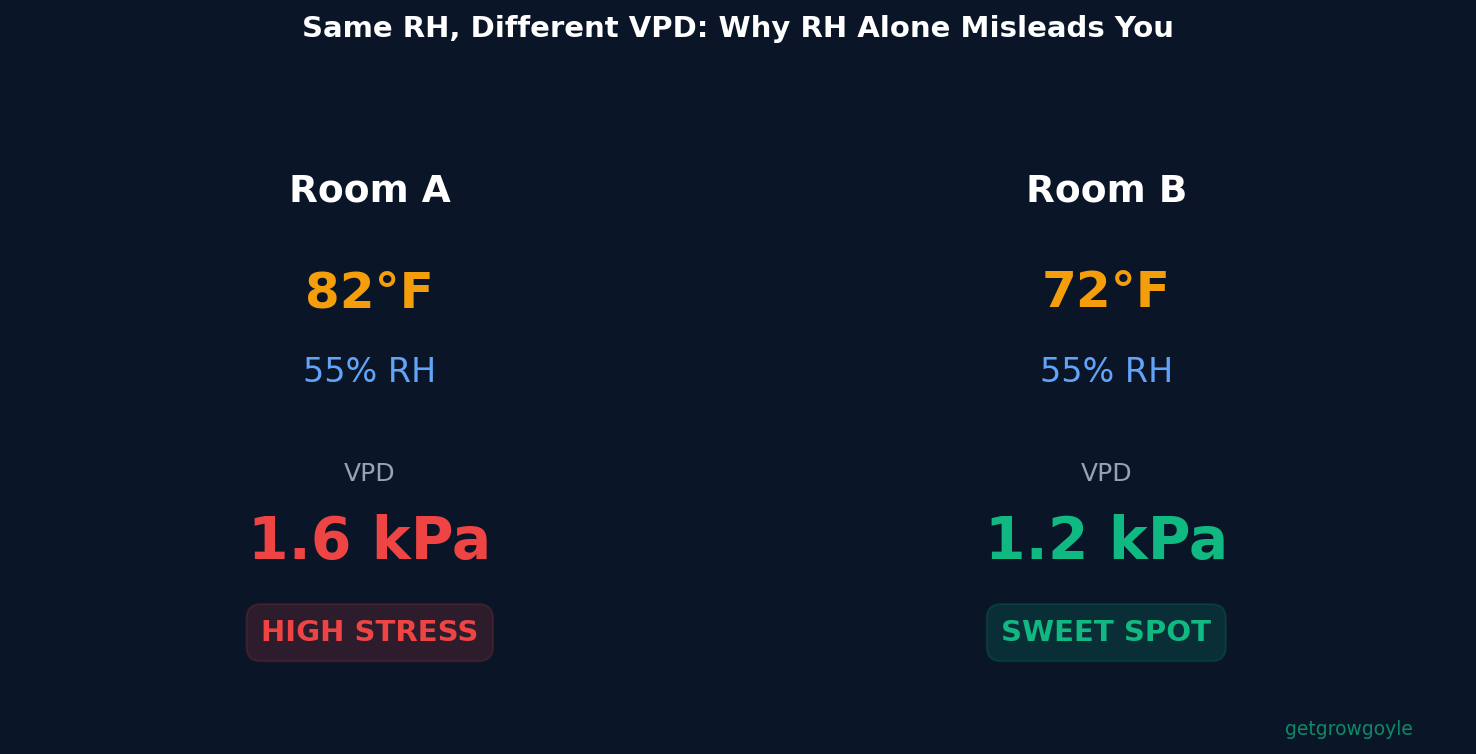
Why this matters more than RH: Relative humidity is relative to temperature. The same 55% RH reading creates completely different conditions for the plant depending on whether the room is 72°F or 84°F.
At 55% RH and 82°F, VPD is approximately 1.6 kPa. The air is pulling hard. Plants are transpiring heavily, and nutrient uptake is high.
At 55% RH and 72°F, VPD drops to approximately 1.2 kPa. Same humidity reading, very different plant response.
The math behind it: VPD = SVP(leaf) – AVP(air), where SVP is the saturation vapor pressure at leaf temperature and AVP is the actual vapor pressure of the air. You don’t need to calculate this manually. The Growgoyle VPD Calculator does it instantly.
The Cannabis VPD Chart: Optimal Ranges by Phase
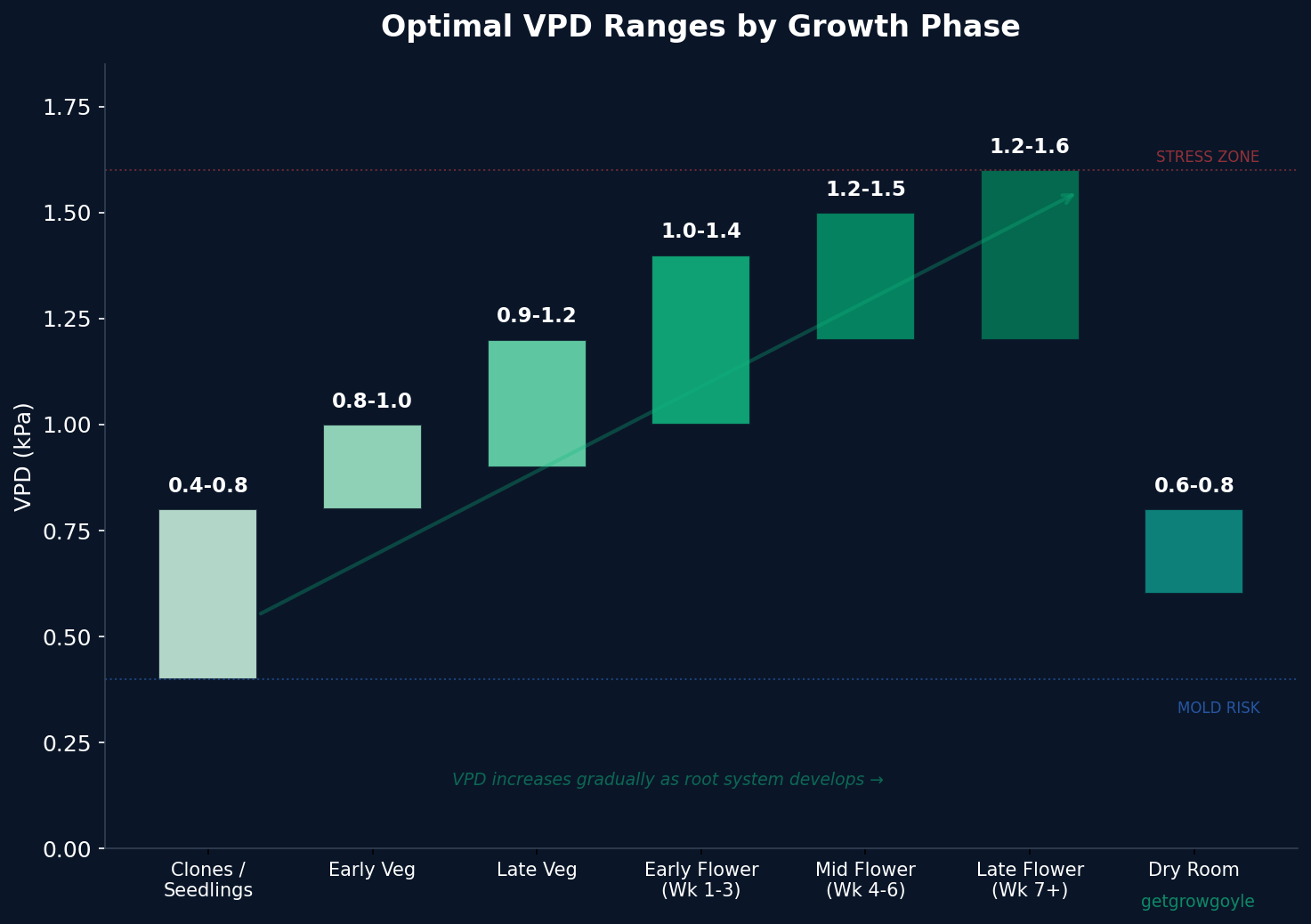
This chart represents the target VPD ranges for cannabis at each growth phase, based on published research and commercial cultivation experience.
Stretch phase. Plants are metabolically active and water demand is increasing.
Mid Flower (Wk 4-6)
1.2 – 1.5
75-80°F
45-55%
Peak transpiration. Bud development requires consistent nutrient delivery.
Late Flower (Wk 7+)
1.2 – 1.6
72-78°F
40-50%
Dense buds create mold risk. Higher VPD keeps moisture moving out of the flower structure.
Dry Room
0.6 – 0.8
60-65°F
55-65%
Slow, controlled moisture loss. Low VPD prevents case hardening.
The pattern to notice: VPD gradually increases from clone through late flower. You’re progressively asking the plant to work harder as its root system and vascular capacity develop. Think of it like training. You don’t start a new clone at the same VPD you run in week 7 of flower for the same reason you don’t hand a new employee the most complex task on day one.
A note on precision: Dr. Bruce Bugbee at Utah State University has noted that the optimal VPD range is wider than many growers assume, particularly with adequate root zone moisture and supplemental CO2. He’s right. The difference between 1.1 and 1.3 kPa is unlikely to make or break a run. These phase targets are guidelines based on commercial experience, not rigid rules you need to hit exactly. Where VPD awareness becomes important is the fundamentals: knowing your actual VPD, understanding that two rooms with the same RH can have very different VPD, and recognizing when you’ve drifted into ranges that create real problems (below 0.8 kPa at night, for example).
Cannabis VPD Lookup Chart: Every Temperature and Humidity Combination
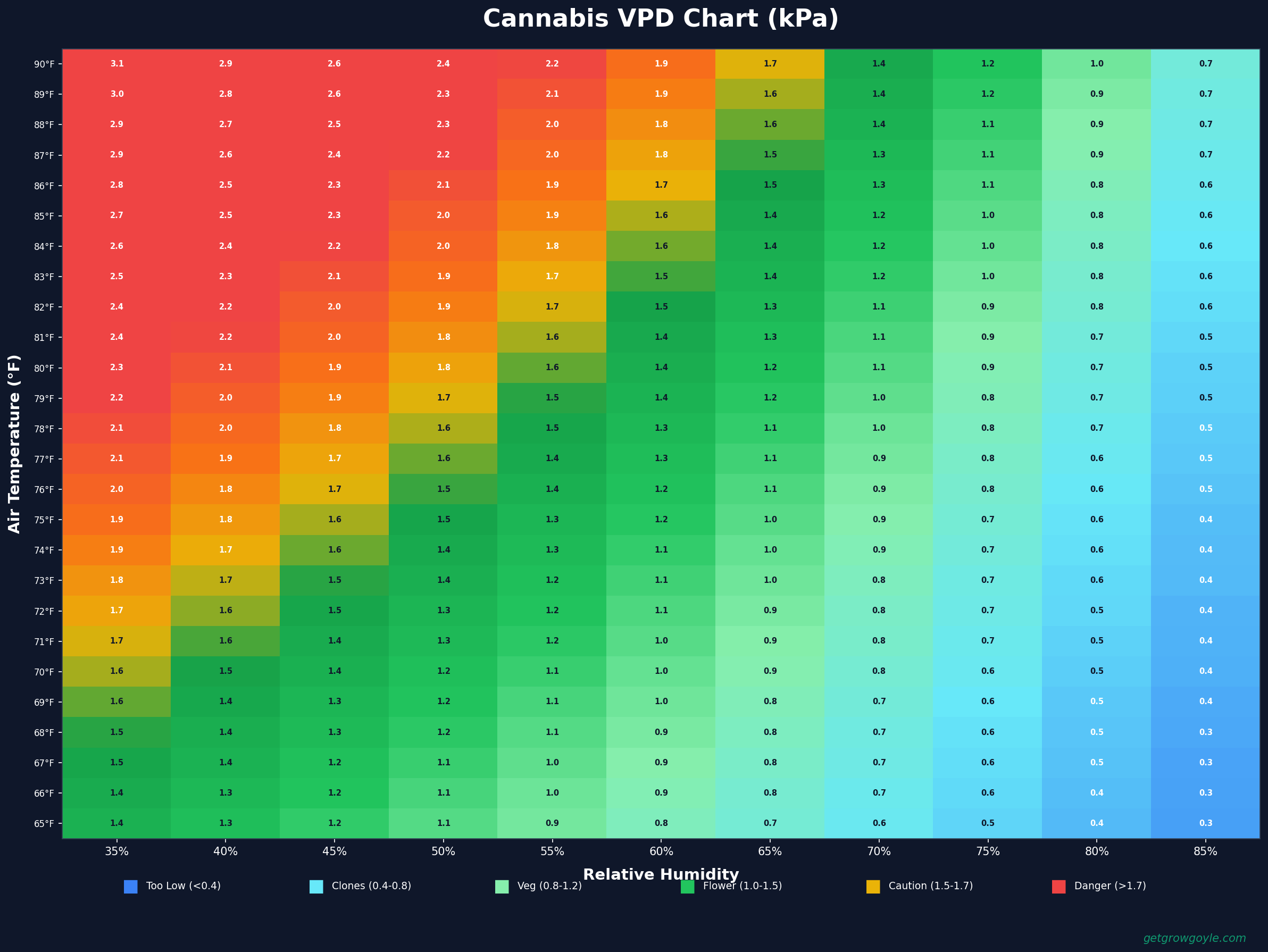
This is the cannabis VPD chart most growers want taped to the wall. Find your air temperature on the left, your relative humidity across the top, and read your VPD in kPa. Color coding shows which growth phase each value is appropriate for.
How to read this cannabis VPD chart:
Blue zones (below 0.4 kPa): VPD is too low. Transpiration is stalled. Mold risk is elevated.
Cyan zones (0.4-0.8 kPa): Appropriate for clones, seedlings, and the dry room.
Light green zones (0.8-1.2 kPa): Vegetative growth range. Plants are transpiring at a healthy, moderate rate.
Green zones (1.0-1.5 kPa): Flower sweet spot. Peak nutrient uptake and bud development.
Yellow zones (1.5-1.7 kPa): Caution. Plants can handle this briefly but water demand is high.
Red zones (above 1.7 kPa): Danger. Expect leaf curl, tip burn, and reduced growth.
For real-time calculations with leaf temperature offset, use the free VPD calculator instead of eyeballing the chart. It accounts for the leaf-to-air temperature difference that can shift your actual VPD by 0.2-0.3 kPa under high-intensity lighting.
The Night VPD Problem (That Most Growers Miss)
Most VPD discussions focus on the lights-on period. That’s a mistake. Night VPD is where most crop losses actually originate.
When lights turn off:
Temperature drops 8-15°F
Moisture content of the air stays the same
Relative humidity spikes (cooler air holds less moisture)
VPD crashes
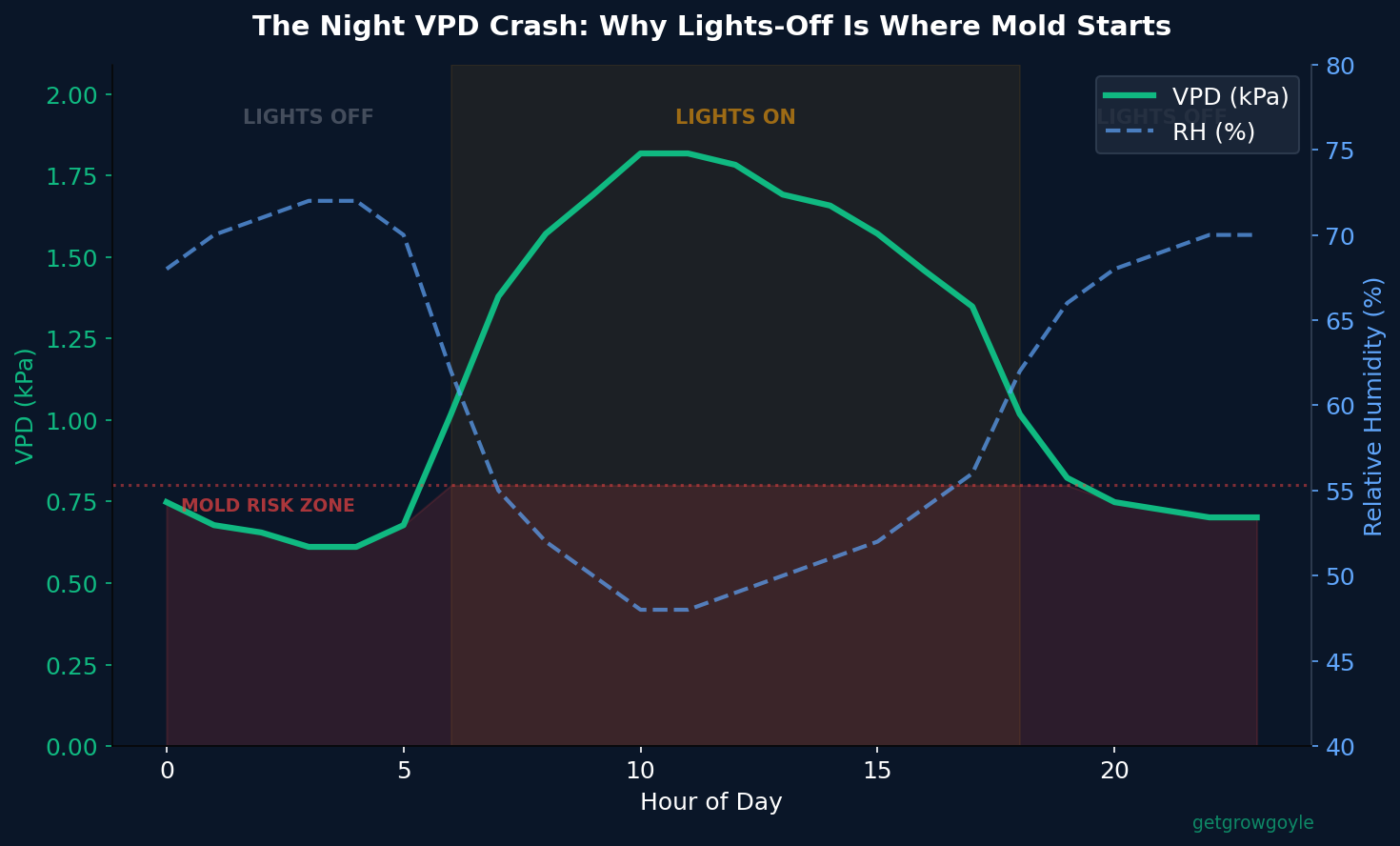
A room running a healthy 1.3 kPa during the day can easily drop to 0.4 kPa during lights-off. At 0.4 kPa, the air is nearly saturated. Transpiration virtually stops. And the conditions are perfect for Botrytis cinerea (gray mold) and powdery mildew to establish.
The target: Keep lights-off VPD above 0.8 kPa. This usually requires dedicated dehumidification that ramps UP when lights go off, not down. Some facilities add supplemental heat during the dark period to keep the temperature drop manageable and prevent VPD from cratering.
Night VPD is the number one reason late-flower rooms develop botrytis. Dense flower structures trap moisture at the bud site, and if the surrounding air is already near saturation (low VPD), there’s nowhere for that moisture to go.
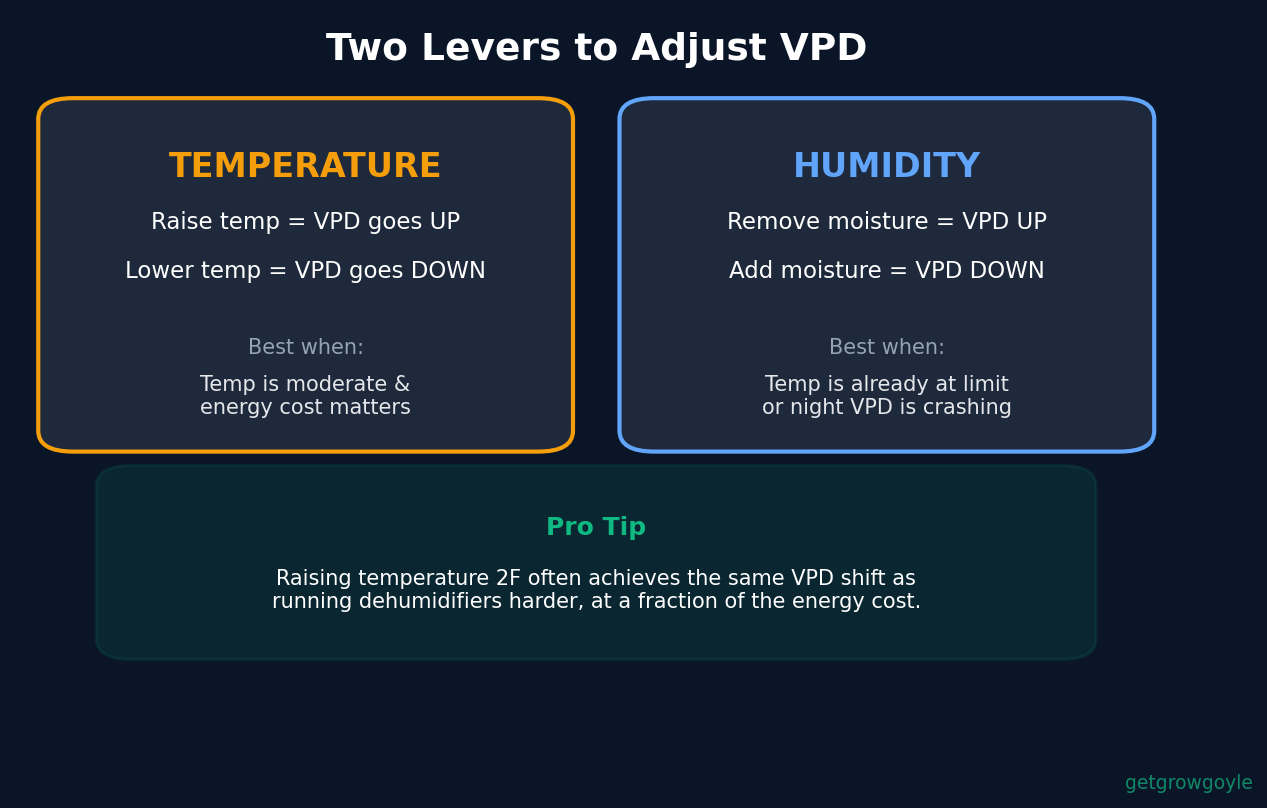
Raising temperature increases the air’s capacity to hold moisture, which raises VPD (makes the air “thirstier”). Lowering temperature reduces that capacity, which lowers VPD.
Which lever to pull depends on where you’re starting:
Scenario
Best Lever
Why
VPD too low, temp is already high
Dehumidify
Can’t raise temp further without heat stress
VPD too low, temp is moderate
Raise temp 2-3°F
Cheaper than running dehumidifiers harder
VPD too high, RH is very low
Humidify or slow down airflow
Adding moisture is the only option
VPD too high, temp is high
Lower temp
Reduces atmospheric demand and saves on cooling
Night VPD crashing
Dehumidify + minimal heat
Prevent temp drop from pulling VPD below 0.8
The cost angle: Adjusting temperature by 2°F to shift VPD often costs less in energy than running additional dehumidification. When you’re managing a 50-light room, every watt matters on the electric bill. Knowing which lever is cheaper for a given situation is the difference between a $30 adjustment and a $300 one.
Why VPD Matters More Than RH: A Real Scenario
Consider two rooms running identical RH at 55%:
Room A: 82°F, 55% RH = VPD of 1.6 kPa Plants are transpiring aggressively. Nutrient uptake is high. Water demand is extreme. If irrigation can’t keep up, you’ll see leaf curl and tip burn.
Room B: 72°F, 55% RH = VPD of 1.2 kPa Plants are transpiring comfortably. Nutrient uptake is moderate and manageable. Irrigation stays ahead of demand.
Same RH. Totally different plant experience. A grower monitoring only RH would think both rooms are identical. A grower monitoring VPD knows Room A is pushing the plants harder and would adjust irrigation scheduling accordingly.
This is why VPD profile is worth investigating when two rooms with the same strain, same feed, and same light produce different results. Different HVAC configurations create different VPD profiles, and different VPD profiles mean different transpiration rates, different nutrient uptake speeds, and different water demand throughout the cycle.
Leaf Surface Temperature: The Missing Variable
The standard VPD calculation uses air temperature and relative humidity. But the plant doesn’t experience air temperature. It experiences leaf temperature.
Under high-intensity lighting (LED or HPS), leaf surfaces can be 3-8°F warmer than the surrounding air depending on distance to light, airflow, and transpiration rate. This means the “real” VPD the plant feels is different from what your controller calculates.
The practical impact: If your sensor reads 78°F and 55% RH, it calculates a VPD of about 1.4 kPa. But if leaf surface temperature is actually 83°F due to radiant heat from LEDs, the plant is experiencing a VPD closer to 1.7 kPa. That’s a meaningful difference and could explain why plants show water stress even when your VPD “looks fine.”
Measuring leaf temperature: Infrared thermometers (point-and-shoot at the canopy) are cheap ($20-40) and give you a direct leaf surface reading. Some commercial sensor systems include IR leaf temperature sensors. If you’re running high PPFD (1,000+ µmol), checking leaf temps regularly is worth the 30 seconds it takes.
LED vs. HPS leaf temperature: Contrary to common belief, LEDs can create higher leaf temperatures than HPS at the same PPFD. HPS produces radiant heat that warms the entire room volume. LEDs concentrate photon energy more directly at the leaf, and the reduced ambient heat means less convective cooling around the leaf surface. Research in controlled environment agriculture has shown that leaf temperatures under LEDs can run 2-4°F higher than under HPS at equivalent light output, due to reduced convective air heating and more concentrated photon energy at the leaf surface.
VPD and Irrigation Timing
VPD directly influences when and how much you should water. Higher VPD means faster transpiration, which means faster substrate dry-back.
The connection:
High VPD (>1.4 kPa): Plants drink faster. Shorter irrigation intervals or larger shot sizes may be needed. Monitor substrate VWC (volumetric water content) closely.
Low VPD (<0.9 kPa): Plants drink slowly. Longer intervals between irrigation events. Over-watering risk increases because the plant isn’t pulling moisture from the substrate fast enough.
VPD crash at night: Substrate stays wet longer during lights-off because transpiration nearly stops. This is why many commercial operations use their final irrigation event 2-3 hours before lights-off, giving the substrate time to partially dry before the VPD drops.
This is a feedback loop. VPD drives transpiration, which drives water demand, which drives irrigation timing, which affects substrate moisture, which affects root zone oxygen availability, which affects nutrient uptake. If VPD is wrong, every downstream decision in your fertigation program is compensating for it.
VPD Across the Facility: Room-to-Room Consistency
Every room in a facility has slightly different thermal characteristics. South-facing walls, different HVAC duct lengths, varying insulation quality, and different equipment layouts all create room-specific VPD fingerprints.
This matters because persistent yield differences between rooms can have environmental roots that aren’t obvious from temp and RH readings alone. If Room 1 consistently produces 3.2 lb/light and Room 3 consistently produces 2.8 lb/light with identical genetics and nutrients, comparing the VPD profiles of both rooms across a full cycle is worth investigating. Night, day, transition periods. The data often reveals the answer.
Tracking VPD data alongside harvest outcomes over multiple runs is the only way to isolate environmental factors from everything else. One run’s data is noise. Five runs of the same strain in two rooms with recorded VPD profiles starts telling you something real about what’s driving the difference.
Quick-Reference VPD Troubleshooting
Symptom
Likely VPD Issue
Check This
Leaf tips curling upward
VPD too high
Leaf temperature, airflow intensity, RH
Leaf edges browning
VPD too high + inadequate irrigation
Substrate VWC, irrigation frequency
Slow growth despite good feed
VPD too low
Night VPD especially. Transpiration may be stalled.
Powdery mildew appearing
VPD too low, likely at night
Lights-off VPD. Target > 0.8 kPa overnight.
Botrytis in dense flowers
Night VPD crashing
Dehumidification capacity during lights-off
Uneven ripening across canopy
VPD microclimates
Airflow dead zones, canopy-level measurements
Nutrient lockout despite correct pH
VPD driving over/under-transpiration
Match irrigation to actual VPD, not schedule
FAQ
What is the ideal VPD for cannabis in flower?
During lights-on in flower, target 1.2-1.5 kPa. Early flower (weeks 1-3) can run slightly lower at 1.0-1.4 kPa during the stretch phase. Late flower (week 7+) benefits from the higher end of the range (1.2-1.6 kPa) to reduce moisture at the bud site and preserve terpenes.
What VPD is too high for cannabis?
Above 1.6 kPa, most cannabis cultivars show signs of water stress: upward leaf curl, reduced growth rate, and increased irrigation demand. Some desert-adapted genetics handle higher VPD, but for most commercial strains, staying below 1.5 kPa is the safe zone. Above 2.0 kPa is problematic for almost all cultivars.
How do I calculate VPD?
VPD = SVP(leaf temperature) – AVP(air). The saturation vapor pressure is calculated from temperature using the Tetens formula, and actual vapor pressure is derived from RH. Use a VPD calculator rather than doing this manually.
Should I monitor VPD at night?
Absolutely. Night VPD is where most mold and mildew problems originate. When lights go off, temperature drops, RH spikes, and VPD can crash to 0.3-0.5 kPa. Keeping lights-off VPD above 0.8 kPa should be a non-negotiable target for commercial flower rooms.
Does VPD affect cannabis potency?
Indirectly, yes. Terpene volatility increases at higher temperatures and VPD levels. Running excessively high VPD (and the high temperatures that usually accompany it) in late flower can reduce terpene content in the finished product. On the other end, a 2025 peer-reviewed study published in Plants (MDPI) found that elevated relative humidity during flowering, creating low VPD conditions of 0.62 kPa and below, significantly decreased cannabinoid concentrations and delayed flowering. Both extremes have documented consequences. Maintaining moderate VPD (1.2-1.5 kPa) at appropriate late-flower temperatures (72-78°F) preserves the aromatic and flavor compounds that affect perceived potency and bag appeal.
Where can I find a cannabis VPD chart?
The printable cannabis VPD chart above covers every temperature from 65-90°F and humidity from 35-85%, color coded by growth phase. For dynamic calculations that account for leaf temperature offset, use the Growgoyle VPD calculator.
What VPD should I run in the dry room?
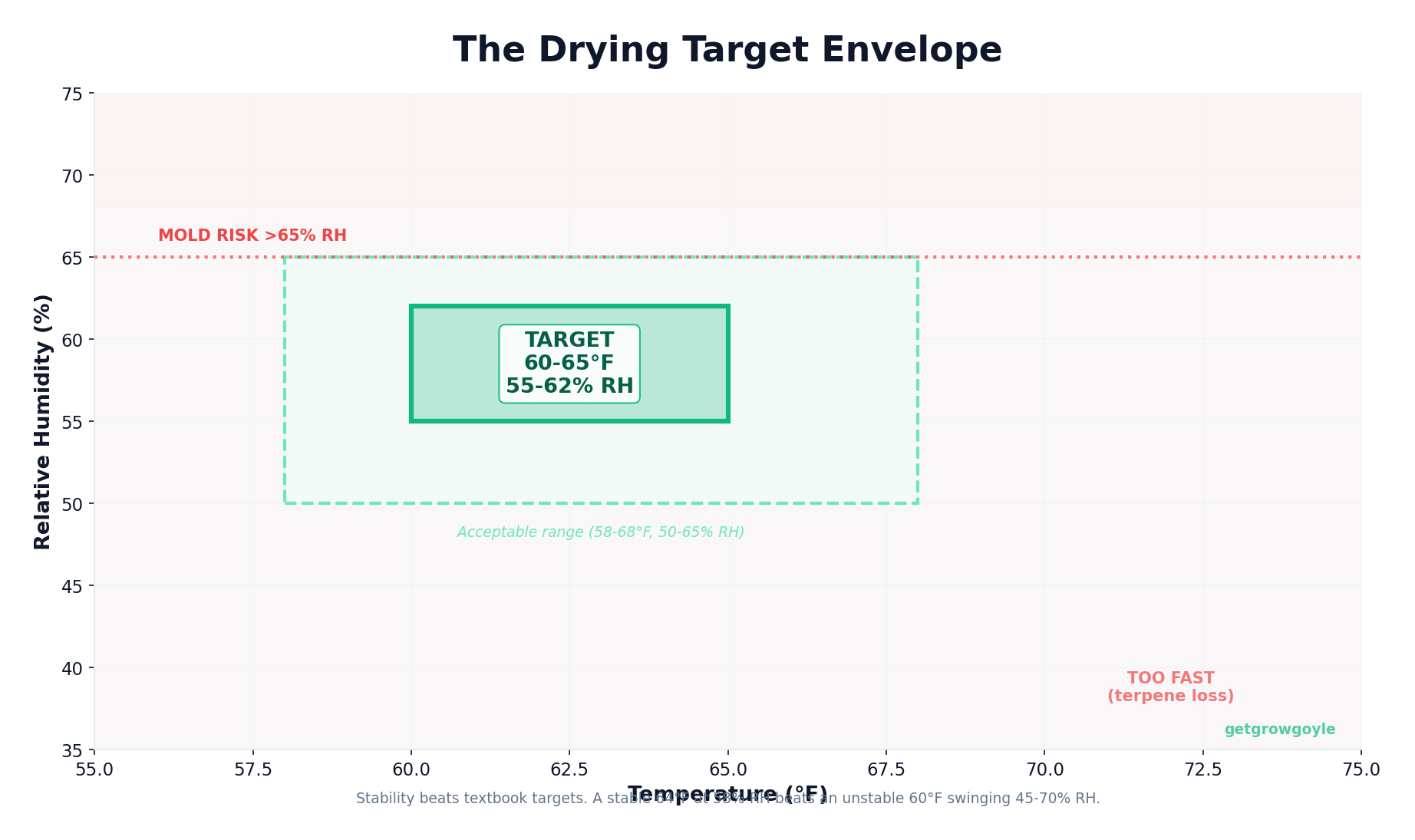
Target 0.6-0.8 kPa at 60-65°F and 55-65% RH. Low VPD in the dry room prevents case hardening (the outside of the flower drying faster than the inside), which traps moisture and creates conditions for mold during cure. A slow, even dry at controlled VPD preserves terpenes and produces a more consistent final product.
VPD is the metric that connects everything in your grow room: temperature, humidity, transpiration, irrigation, and ultimately yield. Understanding it turns environmental management from guesswork into a repeatable system.
Growgoyle tracks your environment data alongside harvest outcomes across every run and uses AI to identify which climate factors actually drove results. It doesn’t track your costs. It helps you lower them through better yields and tighter consistency.
About the Author: Eric Klamer is a 15-year software engineer who operates a commercial cannabis cultivation facility in Michigan. He built Growgoyle to run his own operation and these guides are based on real production experience, not theory.
Your genetics don’t change between runs. Your nutrients don’t change between runs. Your lights don’t change between runs. But your yields do. The variable almost every time? Environment.
Climate control isn’t a checkbox on a facility build-out list. It’s the single biggest factor separating a 2.5 lb/light average from a 3.5 lb/light average. And the gap between those two numbers, multiplied across a commercial facility, is the difference between surviving wholesale compression and getting squeezed out.
This guide breaks down what actually matters in grow room climate management, what the research shows, and where most operations lose yield without realizing it.
The Four Pillars of Grow Room Climate
Every grow room environment comes down to four things working together:
Temperature controls metabolic rate and terpene preservation
Humidity (and its relationship to temperature via VPD) drives transpiration and nutrient uptake
CO2 fuels photosynthesis when light levels justify it
Airflow distributes everything evenly and prevents microclimates
Miss one and the other three can’t compensate. A room running perfect VPD with dead spots in airflow will still produce uneven canopies and inconsistent harvests.
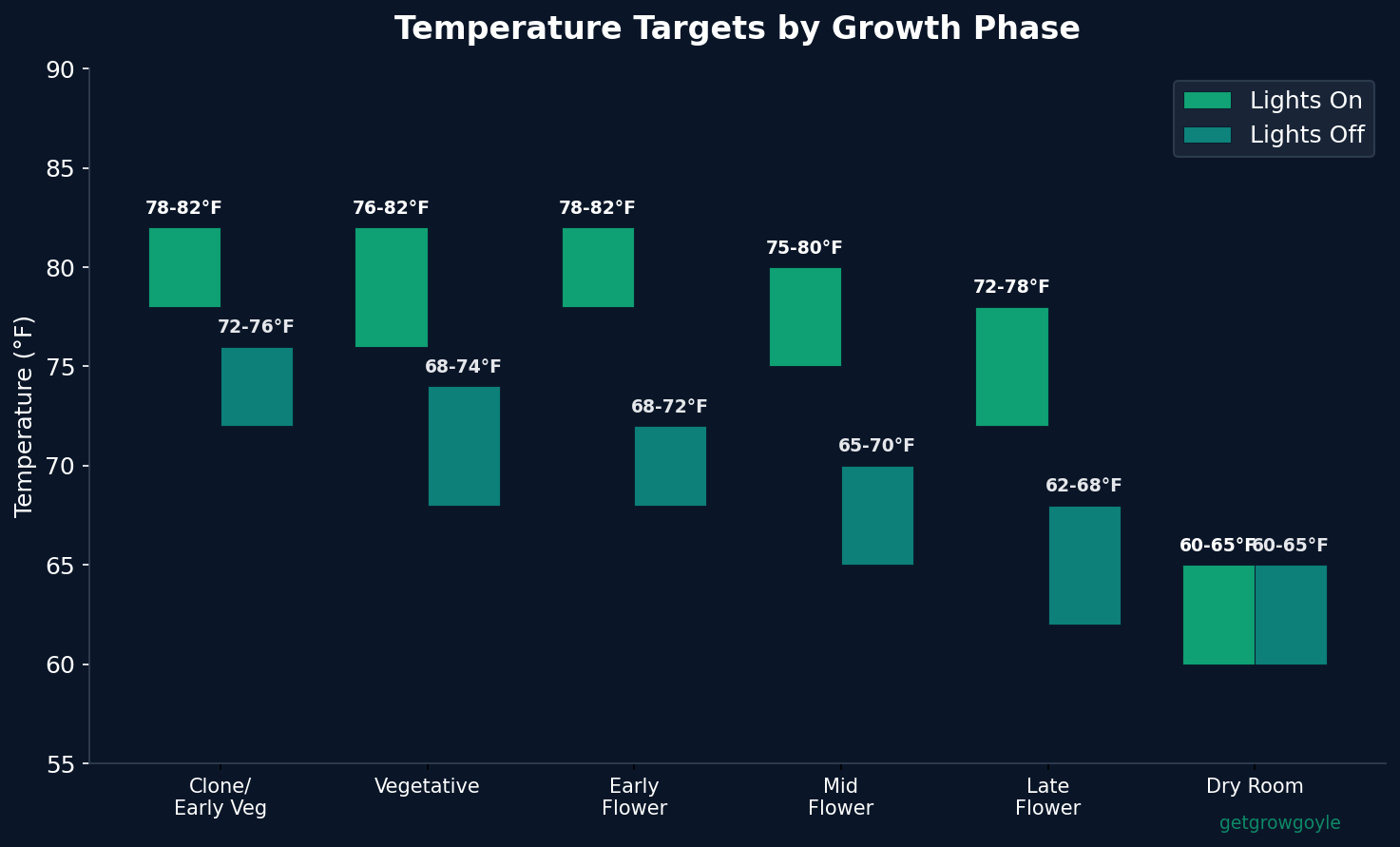
Temperature Targets by Growth Phase
Temperature requirements shift as plants move through their lifecycle. Running the same setpoint from clone to harvest is one of the most common mistakes in commercial cultivation.
Optimal temperature ranges shift with each growth phase. Late flower runs coolest to preserve terpenes.
Phase
Lights On
Lights Off
Key Notes
Clone/Early Veg
78-82°F
72-76°F
Higher temps promote root development. Domes help maintain humidity.
Vegetative
76-82°F
68-74°F
Warmer temps drive faster growth. Don’t exceed 85°F even with CO2.
Begin stepping temps down. Resin production increases at cooler temps.
Late Flower (Wk 7+)
72-78°F
62-68°F
Coolest phase. Enhances anthocyanin expression and terpene preservation.
Dry Room
60-65°F
60-65°F
Constant. No light cycle. Target 55-65% RH.
The DIF principle: The difference between day and night temperatures (called DIF) directly influences plant morphology. A 10-15°F DIF promotes compact growth and stronger stems. Research published in the Journal of the American Society for Horticultural Science demonstrated that negative DIF (cooler days, warmer nights) reduces stem elongation, though this is more applicable in vegetable production than cannabis flowering.
For cannabis, maintaining a positive DIF of 8-12°F during flower is the practical sweet spot. It preserves terpene profiles (many terpenes are volatile above 80°F) while keeping metabolic processes active during the day.
Humidity and VPD: Why RH Alone Misleads You
Relative humidity is what most growers monitor. But RH is relative to temperature, which means the same RH percentage at two different temperatures creates completely different transpiration conditions for the plant.
This is where Vapor Pressure Deficit (VPD) matters. VPD measures the actual drying power of the air independent of temperature. It tells you how hard the plant has to work to move water through its vascular system.
Growth Phase
Target VPD (kPa)
Equivalent Conditions (example)
Clones
0.4-0.8
78°F / 80% RH
Veg
0.8-1.2
80°F / 65% RH
Early Flower
1.0-1.4
80°F / 58% RH
Late Flower
1.2-1.6
76°F / 50% RH
When VPD is too low (humid, stagnant air), transpiration slows. Nutrient uptake drops. Stomata close. Botrytis and powdery mildew thrive.
When VPD is too high (dry, aggressive air), plants transpire faster than roots can deliver water. Leaf edges curl. Stomata close defensively. Growth stalls.
The critical insight: you can hit the same VPD target by adjusting temperature OR humidity. Most growers reach for the dehumidifier first, but sometimes raising the temperature 2°F achieves the same VPD shift with less energy cost.
CO2 Supplementation: When It Helps and When It Doesn’t
CO2 enrichment is one of the most oversold and under-understood inputs in commercial cannabis.
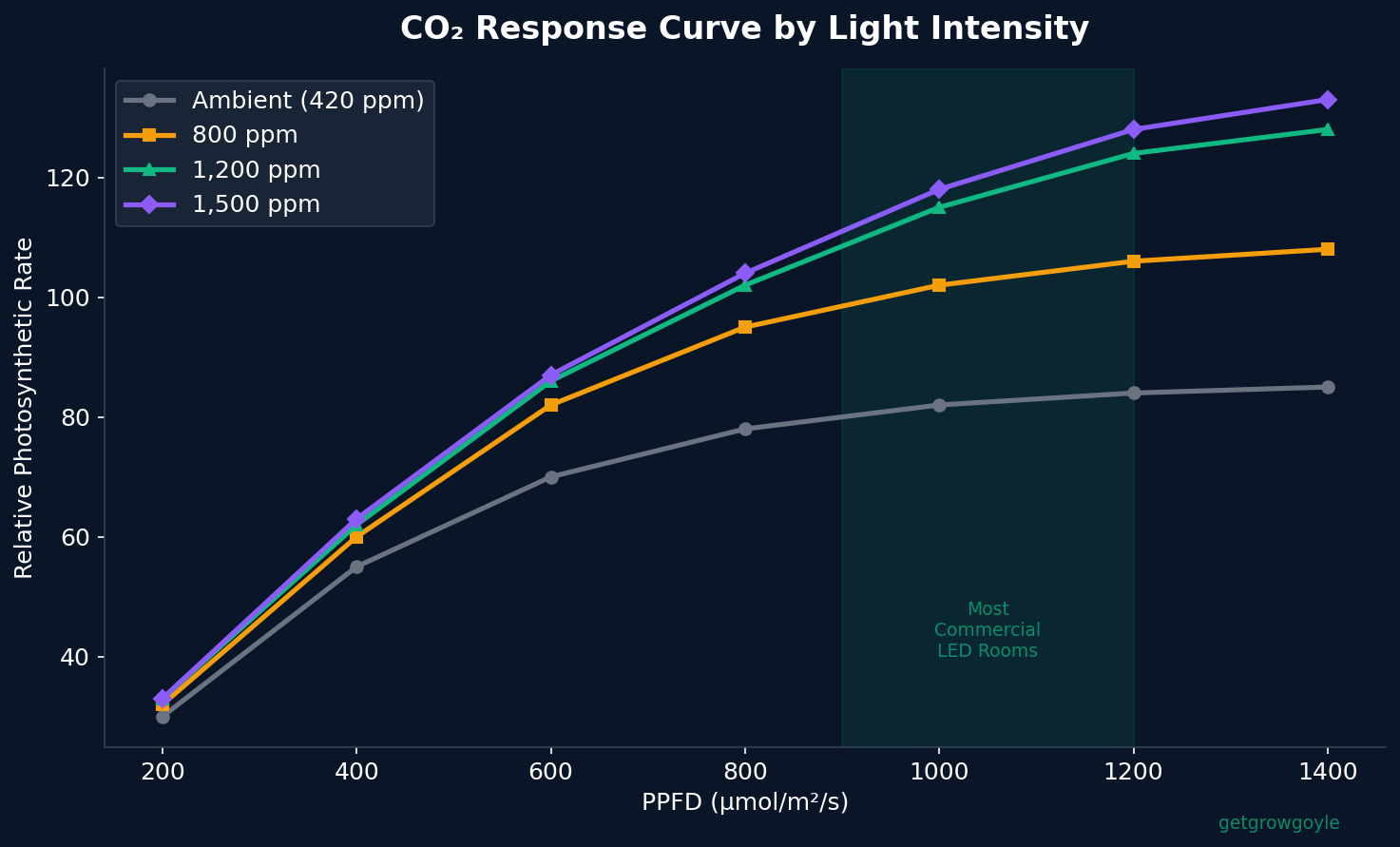
The baseline: Ambient air contains approximately 420 ppm CO2. Plants can use more, up to a point. Research from Plant Physiology journals consistently shows photosynthetic rates in C3 plants (which includes cannabis) increase with CO2 concentration up to approximately 1,200-1,500 ppm, after which returns plateau.
But CO2 only helps when light is the limiting factor it removes. At low light levels (below 600 PPFD), plants can’t use the extra CO2. You’re just venting money.
CO2 supplementation only pays off when light levels support it. Most commercial LED rooms operate in the 900-1,200 PPFD range.
A study by Chandra et al. (2008) in Physiology and Molecular Biology of Plants found that cannabis photosynthesis increased 50% when CO2 was raised from 250 to 750 ppm at saturating light levels. But the delta from 750 to 1,500 ppm was much smaller. The biggest bang for your CO2 dollar comes from getting to 800 ppm, not from pushing to 1,500.
The timing mistake: CO2 should only run during lights-on. During lights-off, plants respire (consume O2, release CO2). Supplementing CO2 at night is pure waste, and can create dangerously high concentrations in sealed rooms.
The temperature relationship: Higher CO2 levels allow plants to tolerate (and benefit from) slightly higher temperatures. At 1,200+ ppm, running 82-85°F during lights-on is acceptable and can increase photosynthetic efficiency. At ambient CO2, those temperatures cause stress.
Airflow Design: The Invisible Yield Killer
You can have perfect temperature, perfect humidity, and perfect CO2 levels at your sensor. And still have problems. Because your sensor measures one point in the room. The canopy doesn’t care about the average. It cares about what’s happening at leaf level.
Canopy-level microclimates are responsible for more mold, more uneven ripening, and more inconsistent yields than most growers realize. The center of a dense canopy can be 5-8°F warmer and 15-20% higher RH than the data your controller sees.
Common Airflow Mistakes
Oscillating fans pointed at the canopy create hot spots and cold spots on a timer. Constant, directional airflow from multiple angles is better.
Fans too strong cause wind stress, thickened stems (which sounds good but actually diverts energy from flower production), and localized drying.
Fans too weak or too few leave dead zones. The center of the room, directly under lights, is always the worst spot.
No vertical air exchange allows heat to stratify at ceiling level. Ceiling fans or ducted air returns prevent this.
The benchmark: A well-designed commercial room moves enough air to achieve 0.5-1.0 air exchanges per minute at canopy level. This isn’t the same as HVAC air changes per hour (ACH) for the whole room. It specifically means the air touching the leaves is being replaced constantly.
The Night Climate Problem
When lights go off, VPD crashes into the mold risk zone. This is where most crop losses actually originate.
Most climate discussions focus on daytime parameters. But the lights-off period is where climate control breaks down in the majority of commercial operations.
VPD plummets into the danger zone for mold and mildew
CO2 from plant respiration accumulates in sealed rooms
Night VPD management is arguably more important than daytime VPD for crop health. A room that runs 1.2 kPa VPD during the day but drops to 0.4 kPa at night is creating the exact conditions Botrytis cinerea needs to establish.
The fix: Dehumidification ramps UP when lights go off, not down. Some operations add a small amount of supplemental heat during lights-off to keep the day/night VPD gap manageable. The target is keeping lights-off VPD above 0.8 kPa through the entire dark period.
Sealed Rooms vs. Open Rooms
Most commercial facilities run sealed rooms with dedicated HVAC and dehumidification. This is the right approach for flower rooms because:
Full environmental control (no outside air variables)
CO2 retention (supplemented CO2 doesn’t escape)
Pest pressure reduction (no intake from outdoors)
Humidity control (no ambient moisture entering)
HVAC sizing rule of thumb: Plan for 4-5 tons of cooling per 1,000 square feet of canopy in a sealed room with modern LED fixtures. HPS rooms need more (6-7 tons) due to higher radiant heat.
HVAC System Types for Commercial Grows
Not all cooling is created equal, and the system you choose shapes how well you can manage climate long-term. Here is what each option actually looks like in a commercial flower room.
System Type
Best For
Upfront Cost
Operating Cost
Dehumidification
Ductless Mini-Splits
Small rooms (1-4 lights)
Low ($2-5K/room)
Moderate
Minimal. Needs standalone dehumidifier.
Ducted Split Systems
Mid-size rooms (5-20 lights)
Moderate ($5-15K/room)
Moderate
Partial. Still needs supplemental dehumidification in flower.
Chilled Water Systems
Multi-room facilities
High ($30-80K+ for chiller plant)
Lowest at scale
Excellent with proper air handlers. Best overall control.
Integrated. Designed for high-transpiration crops.
Mini-splits are the entry point. They cool well but remove almost no moisture. In a flower room with 50+ plants transpiring gallons per day, a mini-split alone will leave you chasing humidity every night. They work for veg rooms and small personal grows. For commercial flower, plan on adding standalone dehumidification.
Ducted split systems are the standard for rooms in the 5-20 light range. Better air distribution than wall-mounted heads, and some passive dehumidification during cooling cycles. The limitation is that cooling and dehumidification are still partially coupled. When the thermostat is satisfied, the compressor cycles off and humidity creeps back up.
Chilled water systems are the commercial standard for multi-room facilities. A central chiller produces cold water, which circulates to air handlers in each room. The advantage: you size the chiller for the entire building’s load, and each room gets precisely the cooling it needs through its own air handler. Operating costs are significantly lower at scale, and the central plant can run at partial load during lights-off rather than cycling compressors on and off.
Purpose-built grow room HVAC units from companies like Desert Aire, Surna, and Quest integrate cooling and dehumidification into a single system designed for the specific conditions cannabis creates. They handle the high latent loads (moisture removal) that general HVAC systems struggle with. The tradeoff is higher per-unit cost, but for a single large flower room, they often outperform a split system plus standalone dehumidifier at a similar total price point.
Niu et al. (2020) published research in Energy and Buildings showing that LED fixtures reduce HVAC cooling requirements by 30-40% compared to HPS at equivalent light output. If you recently switched from HPS to LED, your existing HVAC may be significantly oversized, which sounds like a benefit but actually causes short-cycling: the compressor reaches setpoint too quickly, shuts off, humidity climbs, compressor kicks back on. Short-cycling wears equipment faster and creates the temperature and humidity swings that hurt consistency.
Seasonal Climate Challenges
Most climate control discussions assume a static outdoor environment. Reality is different. The hardest weeks to manage are not peak summer or deep winter. They are the transition seasons, when outdoor conditions swing 30-40°F in a single day and your controllers spend the whole time chasing setpoints.
Summer
The primary challenge is heat load stacking. Your lights produce heat. Your dehumidifiers produce heat (they are essentially refrigeration units, and all the energy they consume becomes heat in the room). Your HVAC fights both. On a 95°F day with high outdoor humidity, cooling capacity that was comfortable in April starts falling short in July.
The secondary summer challenge is nighttime outdoor conditions. In many climates, summer nights stay warm and humid enough that there is no free cooling available from outside air. Sealed rooms handle this fine, but operations that rely on any nighttime air exchange lose their usual assist.
Winter
Winter flips the problem. Indoor air becomes extremely dry, especially in northern climates where outdoor air at 10°F holds almost no moisture. Humidification suddenly becomes necessary in veg rooms and clone areas. Flower rooms usually have enough transpiration to maintain humidity, but veg rooms with fewer plants per square foot can drop to 30% RH without supplementation.
The other winter risk is cold surfaces. Exterior walls, poorly insulated ceiling corners, and any surface touching the outside can drop below the dew point of room air. Condensation forms. Mold follows. Insulation and vapor barriers on exterior walls are not optional in cold climates.
Transitions (Spring and Fall)
This is where the data shows the most climate failures. A day that starts at 45°F and ends at 78°F creates a moving target for HVAC. The room that was slightly over-cooled at 8 AM is under-cooled by 2 PM. Controllers that work fine in steady-state conditions lag behind rapid outdoor changes.
The practical fix is slightly more aggressive setpoints during transition months: tighter deadbands, faster response times, and closer monitoring. Operations that track environment data across entire runs will see yield inconsistency cluster in the spring and fall harvests. That pattern is a direct signal to tighten climate control during those months. Scoring your operational efficiency across seasons helps identify whether climate is the weak link.
The Dehumidification Challenge
Cannabis plants transpire heavily, especially in flower. A room of 50 plants in mid-flower can release 50+ gallons of water per day into the air. If your dehumidification can’t remove it as fast as the plants release it, humidity climbs every evening and your VPD falls apart during lights-off.
This is where most operations fail at climate control. Not during the day, when HVAC cooling provides some passive dehumidification. At night, when lights go off, temperature drops, and relative humidity spikes because cooler air holds less moisture.
The solution is dedicated dehumidification sized for the lights-off period, not the lights-on period. Quest, Anden, and similar commercial units designed for grow rooms are built for continuous operation at the temperature and humidity ranges cannabis requires.
Sizing rule of thumb: In flower, budget 2-3 pints of moisture removal capacity per plant per day. A 50-plant flower room needs 100-150 pints/day of dehumidification capacity. Size for the lights-off peak, not the average. The hours after lights turn off are when transpiration continues (plants don’t stop immediately) while temperature drops and RH spikes. That two-hour window after lights-off is the highest-demand period for your dehumidifier.
Monitoring: What to Measure and Where
A single temperature/humidity sensor on the wall tells you almost nothing about what the canopy is experiencing.
Minimum monitoring for a commercial room:
Temperature and RH at canopy level (not wall-mounted, not ceiling-mounted)
Temperature and RH at multiple points if the room exceeds 500 sq ft
CO2 concentration at canopy level
Substrate metrics (VWC, EC, temperature) if running automated irrigation
What sensors miss: Even good sensor placement captures a point in time at a point in space. It doesn’t capture microclimates, gradual drift within a day, or the cumulative impact of small environment deviations across an entire run.
This is where AI-powered environment analysis adds a layer that sensors alone can’t provide. Cultivation intelligence platforms can analyze environment data alongside yield outcomes, photo-based plant health assessments, and historical batch data to identify which environmental factors actually drove results on a specific run. A sensor tells you the humidity spiked Tuesday night. AI batch analysis tells you that the same pattern preceded the quality drop in your last three harvests.
Automation: What to Automate First
Full environmental automation is expensive. But not all automation is equal. Some investments pay for themselves immediately, others are nice-to-have. Here is the priority order based on where manual control fails most often.
Tier 1: Automate immediately.
Temperature and dehumidification. No human can maintain consistent VPD through an 8-12 hour dark period. The transition from lights-on to lights-off requires dehumidification to ramp up within minutes, not whenever someone checks the room. This is the single highest-value automation in any grow.
CO2 injection tied to light schedule. A simple relay that kills CO2 at lights-off prevents waste and dangerous nighttime buildup. Timer-based works. Sensor-based is better but not mandatory for most operations.
Tier 2: High value, moderate cost.
Integrated environmental controllers that manage HVAC, dehumidification, and CO2 from a single brain. TrolMaster, Agrowtek, and IntelliClimate are the most common in commercial cannabis. The reason these matter: without coordination, your HVAC and dehumidifier fight each other. The HVAC cools the room (which raises RH). The dehumidifier removes moisture (which adds heat). They cycle back and forth, wasting energy and creating unstable conditions. An integrated controller manages both simultaneously to reach the combined temperature and humidity target.
Tier 3: Nice to have.
Automated irrigation tied to substrate sensors. VWC-based irrigation removes the guesswork from watering frequency and helps maintain consistent rootzone conditions. Valuable, but environment automation pays off first.
Light dimming schedules. Stepping PPFD up gradually during early flower and dimming during the last week of flower can optimize DLI without manual adjustment. Most modern LED controllers support this natively.
The common mistake is automating irrigation before automating climate. A perfectly watered plant in a room where VPD swings from 0.6 to 1.8 kPa every night is still going to produce inconsistent results.
What temperature should I run my cannabis grow room?
It depends on the growth phase. Vegetative rooms run 76-82°F during lights-on, dropping to 68-74°F at night. Flower rooms start at 78-82°F in early flower and step down to 72-78°F in late flower. Late-flower night temps of 62-68°F help preserve terpenes and can enhance color expression.
Is VPD more important than relative humidity?
Yes. RH is a relative measurement that changes meaning with temperature. VPD directly measures the atmospheric demand on the plant. A room at 55% RH and 82°F has a completely different VPD than 55% RH at 72°F. Monitor VPD, not RH alone.
How much CO2 should I add to my grow room?
Only supplement CO2 if your light intensity supports it. Below 600 PPFD, ambient CO2 (420 ppm) is sufficient. At 900-1,200 PPFD (most commercial LED rooms), target 800-1,200 ppm during lights-on only. The photosynthetic benefit plateaus above 1,500 ppm.
Why does my humidity spike at night?
When lights turn off, temperature drops but the moisture content of the air stays the same. Cooler air has a lower capacity to hold moisture, so relative humidity rises. The fix is dedicated dehumidification that ramps up during the dark period, not down.
How do I prevent mold in a grow room?
Mold prevention is a climate control problem. Maintain VPD above 0.8 kPa during lights-off, ensure consistent airflow at canopy level, avoid dead zones, and size dehumidification for the lights-off worst case. Botrytis establishes during the exact conditions that occur when dehumidification fails at night.
How many BTUs do I need for a grow room?
The standard estimate for LED flower rooms: 3,500-4,000 BTU per 1,000W equivalent of LED lighting. A 24-light room running 720W LEDs produces roughly 17,000W of heat load, which translates to approximately 60,000 BTU of required cooling capacity. Always oversize by at least 20% to account for dehumidifier heat output, which adds back into the room. Facilities that switched from HPS to LED may have oversized HVAC that short-cycles. Caplan et al. (2019) in HortScience documented that LED-grown cannabis achieved comparable yields to HPS at lower environmental heat loads, which directly affects HVAC sizing requirements.
What size dehumidifier do I need for a grow room?
In flower, budget 2-3 pints of removal capacity per plant per day. A 50-plant flower room needs 100-150 pints/day of dehumidification capacity. The critical sizing factor is lights-off performance, not rated capacity at standard conditions (most manufacturers rate at 80°F/60% RH, which is warmer than your lights-off room). Check the unit’s performance specs at 65-70°F, which is closer to your actual lights-off conditions. Many units lose 30-40% of their rated capacity at lower temperatures.
How do I control humidity in a sealed grow room at night?
Three strategies work together. First, dedicated dehumidification that ramps up the moment lights turn off, not when humidity reaches a threshold (by then it is already too high). Second, a small reheat coil or supplemental heat that prevents temperature from dropping too fast. Slowing the temperature decline reduces the RH spike. Third, consistent airflow through the canopy during the entire dark period. The target: VPD stays above 0.8 kPa through the full lights-off cycle. Monitor VPD at canopy level, not at your wall sensor, since the canopy microclimate is always more humid than ambient room conditions.
Climate control is the foundation every other input sits on. Genetics, nutrients, and light only express their potential when the environment lets them. For operations serious about consistent yields, tracking environmental data alongside harvest outcomes across every run is the only way to know whether your climate program is working or just working sometimes.
Knowing what your environment costs you starts with knowing your cost per pound. Once you have that number, the question becomes which operational factors are keeping it higher than it should be.
Growgoyle analyzes your environment data alongside yield, quality, and plant health data to identify what actually drove results on each run. It doesn’t track your costs. It helps you lower them through better yields and tighter consistency.
About the Author: Eric Klamer is a 15-year software engineer who operates a commercial cannabis cultivation facility in Michigan. He built Growgoyle to run his own operation and these guides are based on real production experience, not theory.
Based on published research and commercial facility data, the three highest-impact yield optimization techniques for commercial cannabis are genetics selection (20-40% improvement potential), CO2 supplementation at 1,200-1,500 ppm (widely reported in commercial settings to boost yields 20-30%), and light intensity optimization through DLI management (Rodriguez-Morrison et al. 2021 showed linear yield increases with light intensity up to the highest levels tested). However, the factor most operations overlook is consistency: repeating peak performance across every batch compounds into more total pounds per year than any single technique improvement.
Cannabis Yield Optimization Techniques Compared
Technique
Typical Yield Impact
Cost to Implement
Complexity
Best Phase
Key Research
Genetics selection
+20-40%
Variable (cuts/seeds)
Low (selection), High (phenohunting)
Pre-cycle
Backer et al. 2019, various cultivar trials
CO2 supplementation (1,200-1,500 ppm)
+20-30%
$200-500/mo (tank + controller)
Low
Flower
Chandra et al. 2008, 2011
Light intensity / DLI optimization
+15-25%
$0 (dimmer adjustment) to $5,000+ (fixture upgrade)
Medium
Flower
Rodriguez-Morrison et al. 2021; Eaves et al. 2020
VPD optimization (0.8-1.2 kPa flower)
+10-15%
$0 (controller adjustment)
Medium
All phases
Backer et al. 2019
Irrigation and EC management
+8-15%
$0-200/mo
Medium
All phases
Caplan et al. 2017
Defoliation timing
+5-12%
$0 (labor only)
High (skill-dependent)
Week 3 and Week 6 of flower
Danziger & Bernstein 2021
Batch-over-batch analysis
+10-20% cumulative over 3-5 cycles
$499-999/mo (software)
Low
Post-harvest
Emerging practice (see below)
Individual techniques matter, but the real gains come from stacking them and then repeating the results. A facility that optimizes VPD, light, and CO2 but cannot replicate the results from one batch to the next leaves more pounds on the table than a facility with average technique but tight consistency.
See What Your Canopy Is Telling You
Snap a photo of your plants. Growgoyle’s AI identifies stress signals, uniformity issues, and optimization opportunities in 60 seconds. Free, no signup required. Growgoyle doesn’t track your costs. It helps you lower them through better yields and consistency.
Most yield optimization content comes from two places: home growers sharing anecdotes, and equipment companies telling you their product is the missing piece. Neither is particularly useful if you’re running a licensed commercial indoor operation where cost per pound determines whether you stay open next year.
This is what the published research actually says about cannabis yield optimization, filtered through the reality of running a commercial facility. Not fixture specs. Not strain reviews. The actual controllable variables and how much they matter.
What Yield Actually Means in a Commercial Context
Before you can optimize yield, you need to measure the right thing. Three metrics matter, and they answer different questions.
Grams per square foot measures canopy utilization. It tells you how efficiently you’re using the physical space you’re paying for. Watch this one when canopy management is the constraint.
Pounds per light measures capital efficiency. Since lighting is a major fixed cost, lb/light tells you how much production you’re extracting per dollar of infrastructure. For most facilities with fixed canopy, this is the most actionable number.
Grams per watt measures energy efficiency. Useful when comparing strains or light recipes, but less useful as an operational benchmark because it conflates genetics with environment.
Total pounds is the wrong metric for optimization purposes. A facility producing 200 lb/run across 80 lights is underperforming one that produces 160 lb across 40 lights. Infrastructure matters. Yield per square foot is often a vanity metric. lb/light gives you a cleaner signal on operational performance.
For benchmarks: Cannabis Business Times data (Lange, 2019) puts the commercial indoor range at roughly 1.5 to 3.0 lb/light, with top performers pushing above 3.0. A separate CBT/Fluence 2025 survey of 185 growers found g/sqft medians in the 35-80 range for indoor canopy. If your numbers consistently land in the bottom half of those ranges, something is leaving yield on the table. You can benchmark your operation in about 30 seconds with a free efficiency scorecard.
Light Is the Primary Yield Driver (But Not How You Think)
Every equipment company will tell you their fixture increases yield. Some of them are even right. But the mechanism matters more than the hardware.
The variable that drives cannabis yield from lighting isn’t wattage. It’s DLI: Daily Light Integral, measured in mol/m²/day. DLI is the cumulative photons your canopy receives across the full photoperiod. Two facilities running the same fixture at different heights, for different hours, with different canopy depths will see dramatically different results even though their “wattage” is identical.
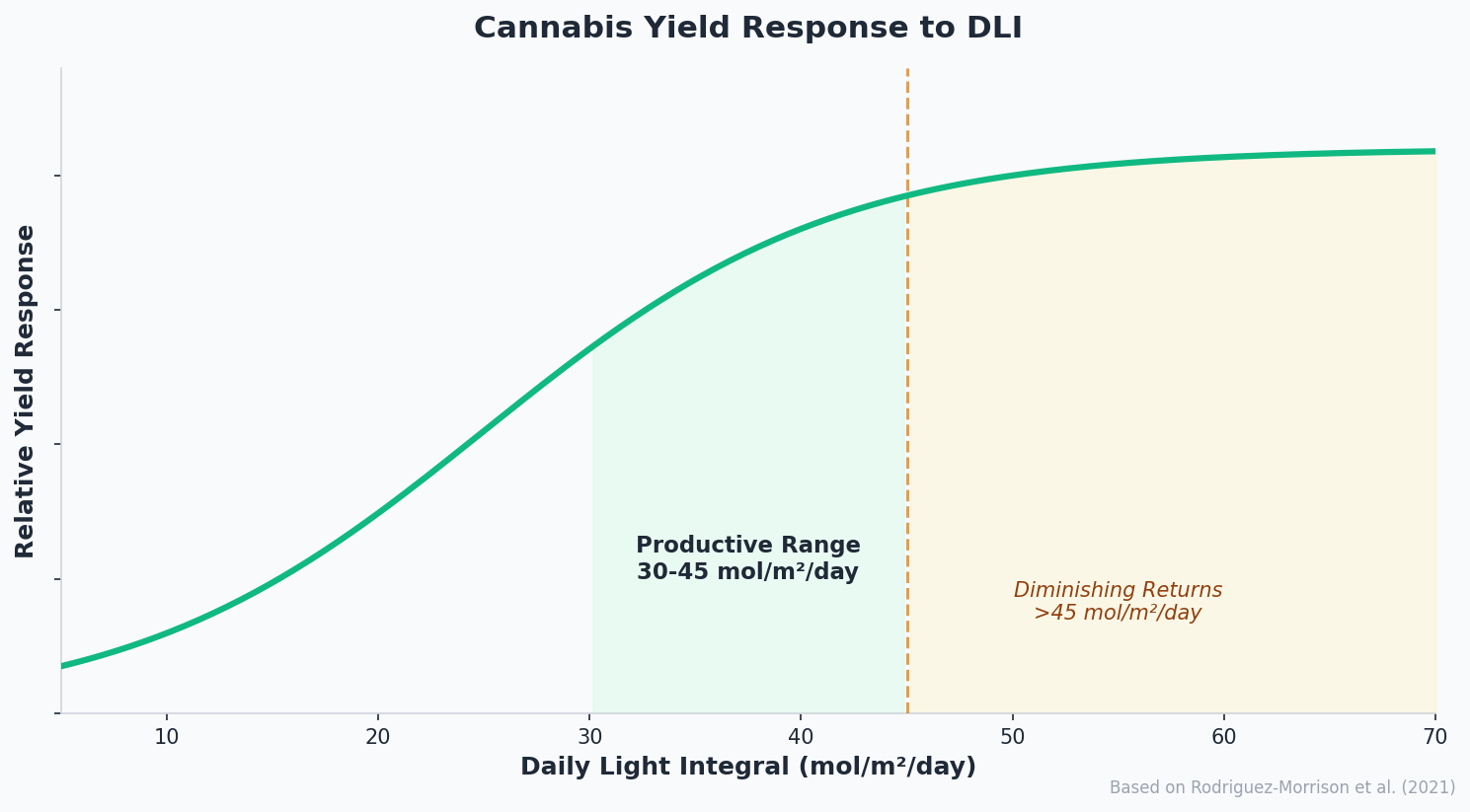
Rodriguez-Morrison et al. (2021) found that increasing PPFD and DLI simultaneously increased both flower yield and cannabinoid content. That’s important because conventional growing wisdom has long treated potency and yield as a tradeoff. The data doesn’t support that in well-managed environments. You can get more of both by increasing DLI within the productive range.
The diminishing returns curve is real, though. Beyond roughly 40-50 mol/m²/day, additional DLI produces less incremental yield while adding heat load and energy costs. Most facilities running modern LED fixtures are working in the 30-45 mol/m²/day range, which is appropriate. The issue is usually not total DLI but uniformity: canopy hotspots and cold spots that create uneven development.
The most common LED optimization failure isn’t choosing the wrong fixture. It’s upgrading fixtures without adjusting canopy management. A high-output LED at 24 inches with an uneven canopy lights the tops of the tallest plants and leaves the rest underserved. An uneven canopy (popcorn, larf, poor light penetration) means more trim labor and lower effective yield even when the top colas look great.
Cannabis yield response to DLI: gains are significant up to roughly 45 mol/m²/day, then level off. Most operations underperform their fixture potential through canopy management gaps, not wrong hardware.
Environment Sets the Ceiling, Genetics Sets the Floor
VPD, CO2, and temperature don’t produce yield. They remove the cap on what your genetics can express. That’s a meaningful distinction when you’re troubleshooting a run that underperformed.
Llewellyn et al. (2022) published a comprehensive review of environmental factors in cannabis cultivation (Front. Plant Sci.), documenting the interaction effects between temperature, humidity, CO2, and light intensity. The key finding for commercial operators: environmental variables have multiplicative effects, not additive ones. Dialing in CO2 at 1200 ppm when VPD is out of range doesn’t deliver the CO2 benefit. The plant can’t use it. The whole stack has to be right.
The practical ceiling for most operations sits around 1200-1500 ppm CO2, 80-85°F canopy temperature, and VPD held in the 1.2-1.6 kPa range during late flower. Getting those numbers right doesn’t guarantee yield, but getting them wrong guarantees you’re leaving some on the table.
On genetics: the trap many commercial operations fall into is chasing new cultivars when proven performers aren’t dialed in yet. If a strain isn’t consistently hitting its genetic potential after 10 runs, a new strain isn’t the answer. The environment or execution has a constraint. Find it first.
One yield thief that’s genuinely underappreciated in commercial cannabis cultivation: Hop Latent Viroid (HLVd). Tumi Genomics data suggests 20-30% yield reduction in infected plants, and the infection accumulates in mother stock. Symptomatic or not, infected mothers propagate the problem into every cut taken from them. Test your mothers. Run clean stock. This one isn’t glamorous, but the yield impact is real and measurable.
Consistency Is Worth More Than Peak Performance
Here’s the argument that most commercial operators haven’t fully run the math on.
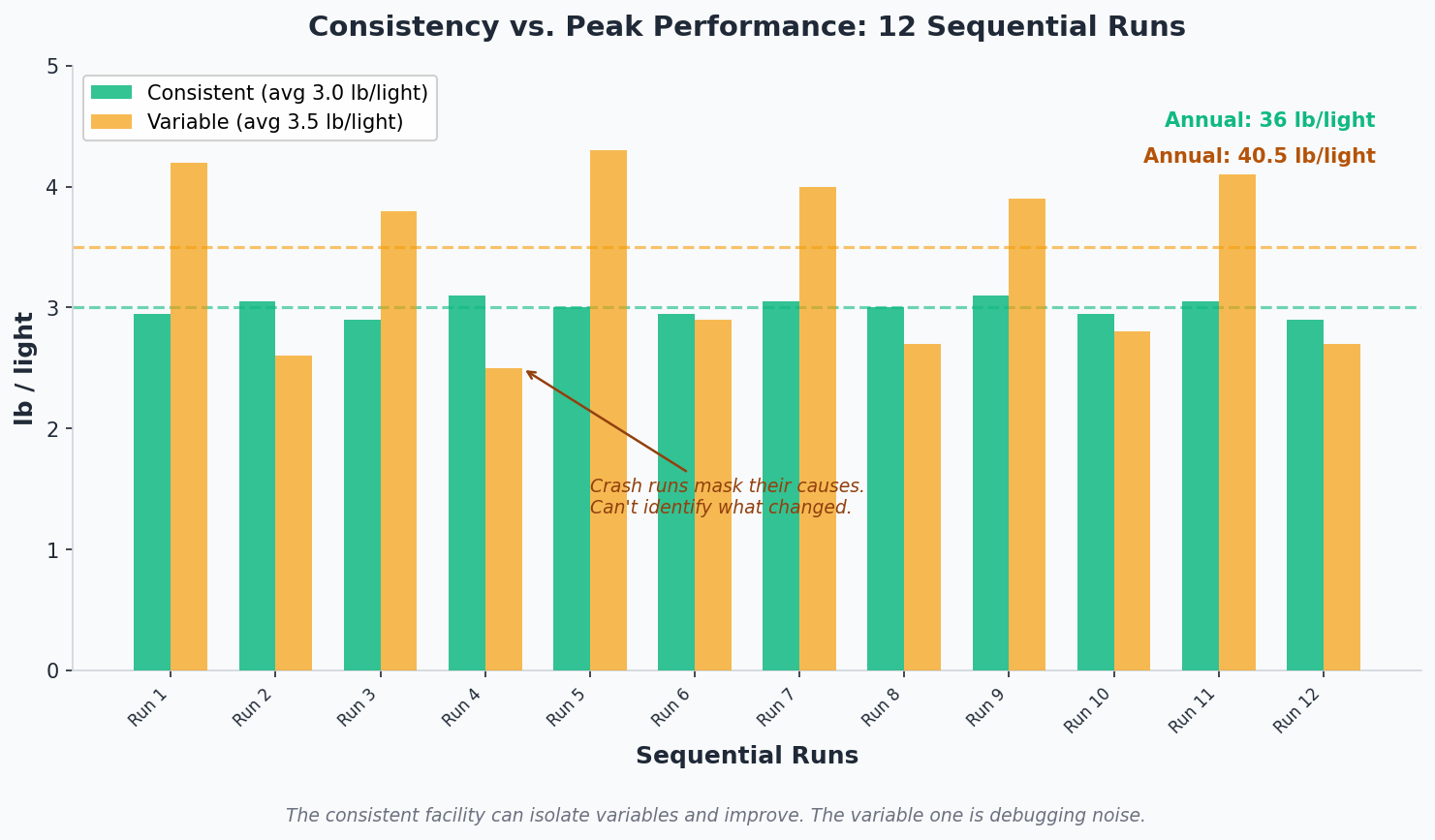
A facility that averages 3.0 lb/light with tight run-to-run consistency has a fundamentally different business than one that averages 3.5 lb/light with high variance. Work through the numbers across six runs per room:
Consistent facility: 3.0 lb/light, every run. Six runs. 18 lb/light/year.
Variable facility: Three runs at 4.2 lb/light, three runs at 2.8 lb/light. Average 3.5. Same six runs. 21 lb/light/year on paper.
The variable facility wins on raw numbers. But here’s what the math doesn’t capture: the three runs at 2.8 lb have a cause. Something changed between those runs and the good ones. Without systematic batch tracking, that cause doesn’t get identified, documented, or corrected. The same pattern shows up again, or something slightly different produces the same kind of drop.
High variance also means the signal from any intentional change gets lost in the noise. Adjust the dryback protocol, next run comes in at 3.8 lb. Was it the dryback? The weather pattern that kept the facility cooler? Without enough controlled runs to separate signal from noise, outcomes get attributed to interventions that may not have caused them.
The consistent facility can make one change at a time, observe the result, and build on it. That’s how 3.0 becomes 3.2, then 3.4 lb/light over 18 months. Yield consistency in cannabis cultivation is the foundation that makes compound improvement possible.
What drives variance? Four primary sources: execution timing differences (the same task done at different intervals, slightly different ways), environmental drift between runs that doesn’t get compensated for, pest or disease events that go undetected until they’ve already affected yield, and undocumented protocol changes where a recipe was adjusted without a log entry.
High variance looks good on a highlight reel. Across a full year, crash runs mask their own causes and prevent systematic improvement. The consistent facility can see what changed; the variable one is working with noise.
Turnaround Time: The Yield Metric Nobody Measures
Every day between chop and the next flip is a day your lights aren’t producing flower. Run the math and this stops being obvious and starts being alarming.
Pipp Horticulture’s 2023 benchmarking data puts average turns per year for commercial indoor operations at 4.5 to 5.5, with high-efficiency operations hitting 6 or more. The difference between 5 and 6 turns per year isn’t just one extra run. At 3 lb/light across 100 lights, one additional turn is 300 lb of production. At $500-600 per pound wholesale, that’s $150,000 to $180,000 in additional revenue from the same facility, same team, same infrastructure.
Two extra turnaround days per run across six annual runs equals 12 lost flower days per room. That’s roughly half a harvest cycle sitting empty while cleaning timelines stretch, transplants wait, or clone readiness doesn’t align with harvest schedule.
Where turnaround time hides: cleaning that takes longer because it isn’t scheduled with the same precision as the flowering calendar, transplant delays when the mother room isn’t keeping pace with harvest frequency, and scheduling gaps when team availability doesn’t line up with room readiness. These are operations problems, not grow problems. The plants are fine. The calendar is where the yield disappears.
The Compounding Effect
Here’s what happens when you pull these levers together.
Start with a baseline: 2.8 lb/light, five turns per year, 40 lights. That’s 560 lb/year. At $550/lb wholesale (a reasonable mid-market number), you’re looking at $308,000 in annual revenue.
Now: tighten DLI management and canopy uniformity, add 10% to yield per run. 3.08 lb/light. Add one additional turn per year through tighter scheduling. Reduce variance by systematically comparing runs and correcting drift. True average stabilizes and improves another 5-8%.
Result: roughly 3.2 lb/light at six turns per year. Same 40 lights. 768 lb/year. At $550/lb wholesale, that’s about $422,000 versus your $308,000 baseline at the same price.
That’s roughly 40% more revenue from the same physical infrastructure, through optimization rather than expansion. This is how cost per pound drops without adding a single dollar of fixed cost: more production from the same square footage, same team, same utility bills.
Batch comparison is the tool that makes this systematic. When any two runs can be placed side by side with data on what actually changed between them, the pattern becomes visible and actionable. A sensor dashboard that just displays readings doesn’t give you that. You need analysis that connects the variables to the outcome across runs, not just within them.
You don’t need a bigger facility. You need more from the one you have. The data to do it is already sitting in your runs.
Frequently Asked Questions
Q: What is the biggest factor in cannabis yield?
Genetics sets the floor and ceiling. Even with perfect environment control, a low-yielding cultivar cannot match a high-yielding one. Published cultivar trials show yield differences of 20-40% between strains grown in identical conditions (Backer et al. 2019). After genetics, light intensity (measured as DLI or daily light integral) is the strongest controllable factor, with research showing linear yield increases with no saturation point even at the highest light levels tested. Rodriguez-Morrison et al. (2021) demonstrated a 4.5-fold yield increase across their tested PPFD range in a controlled indoor study, confirming that more light continues to produce more flower up to at least 1,800 μmol/m²/s (approximately 78 mol/m²/day DLI).
Q: What is a good yield per light for commercial cannabis?
For modern commercial facilities using 600-700W LED fixtures, 2.0 to 2.5 pounds per light per cycle is common for average operations. Well-optimized facilities consistently hit 2.5 to 3.5 pounds per light. Above 3.5 is exceptional and typically requires strong genetics, dialed environment control, and experienced cultivation practices. Yield per light is more meaningful than yield per square foot or per plant because light is the primary energy input driving photosynthesis and biomass accumulation.
Q: How does VPD affect cannabis yield?
Vapor pressure deficit controls how fast your plants transpire, which directly affects nutrient uptake and photosynthetic rate. The optimal VPD range for flowering cannabis is approximately 0.8 to 1.2 kPa. Below 0.8, transpiration slows and the plant cannot move nutrients efficiently. Above 1.4, the plant closes stomata to conserve water, which reduces CO2 intake and slows growth. Commercial facilities that actively manage VPD within the optimal range typically see 10-15% yield improvements compared to those running off a static temperature and humidity setpoint.
Q: Can AI improve cannabis yields?
AI does not directly grow plants, but it can identify patterns across multiple batches that are difficult to spot manually. After each harvest, AI batch analysis can compare environment data, cultivation practices, and outcomes to previous runs and identify what drove improvements or declines. Over 3 to 5 cycles, this type of iterative analysis typically compounds into 10-20% cumulative yield improvement because each batch builds on lessons from the last. The key is consistent data collection: environment readings, harvest weights, photos, and grower notes.
Q: How do you measure yield consistency?
The standard statistical measure is coefficient of variation (CV%), which shows how much your yields swing from batch to batch. A CV below 10% means your operation is dialed in and repeatable. Between 10-20% is solid but has room to tighten. Above 20% means significant variation that is costing you pounds and profit. You can calculate this with as few as 4 harvests of the same strain. Track yield per light (or per plant or per square foot) across consecutive runs and look at the spread. A free tool for this is available at app.growgoyle.ai/consistency.
Growgoyle doesn’t track your costs. It helps you lower them. Upload a few canopy photos and see what the AI catches. Or connect your batches and see what your run data actually shows about yield patterns across harvests. Try it free on your own plants.
About the Author
Eric is a 15-year software engineer who operates a commercial cannabis cultivation facility in Michigan. He built Growgoyle to solve the problems he faces every day: inconsistent yields, forgotten lessons from past runs, and the constant pressure to lower cost per pound. Every feature in Growgoyle comes from real growing experience, not a product roadmap.
Most commercial cannabis growers have never calculated their actual cost per pound. Not a rough estimate for an investor meeting. Not a number they backed into from a tax return. Their real number, with every expense accounted for, divided by every sellable pound they actually produced.
The ones who do the math for the first time usually don’t like what it says.
In a market where wholesale has compressed to an estimated $500-600 per pound and keeps trending lower, your cost per pound is the distance between surviving and closing. Not revenue. Not THC percentages. Not how many lights you run. How much it costs you to produce one finished, sellable pound.
That’s the number. And most operators don’t know theirs.
This is not a list of cost-cutting tips. It’s the framework: what actually drives your cost per pound, which variables have the most impact, and how to build a system that improves the number run over run instead of hoping this cycle goes better than the last one.
What Actually Makes Up Your Cannabis Cost Per Pound
The formula is simple: total expenses divided by total pounds of sellable flower. Everything your facility spends in a given period, divided by everything that comes out the other end and passes QC.
The math is easy. Getting the inputs right is where most operators fall short. There are three buckets of costs to account for:
Fixed Costs
These run whether you’re harvesting or not: rent or mortgage, debt service, insurance, licenses, base compensation for core staff. Fixed costs are the floor your production has to clear before you make a single dollar. When wholesale sits at $500-600 and keeps compressing, a high fixed cost base is a structural problem that no amount of operational efficiency can fully fix.
Variable Costs
These scale with production: nutrients, media, packaging, harvest labor spikes, energy, water, consumables. Variable costs are where most operators try to find savings first, usually by squeezing nutrient spend or reducing inputs. Sometimes that works. More often, it trades short-term cost reduction for yield reduction that makes the number worse.
Invisible Costs
This is the bucket most cost analyses miss completely. Downtime between runs. Rejected product that took full resources to produce but can’t sell at full price. Rework on poorly dried or poorly trimmed batches. Labor spent fixing problems that could have been caught earlier. A two-week delay in a flip because the room wasn’t ready.
These costs are real. They show up in your P&L as general inefficiency, not as a line item. That makes them easy to ignore and hard to address without detailed run-by-run data.
If you haven’t built this number for your operation yet, that’s the first thing to fix. Use the free cost-per-pound calculator and start with what you know. Even a rough estimate is more useful than operating blind. Once you have the number, you’ll probably want to know where the biggest gaps are. The efficiency scorecard benchmarks your operation against published research thresholds and tells you exactly which metric to attack first.
Once you have the number, the question becomes: which side of the equation do you attack first?
The Two Levers That Actually Drive It
Every cost reduction in cannabis cultivation comes down to one of two things: increasing your denominator (more pounds from the same infrastructure) or decreasing your numerator (spending less per cycle). Most operators focus on the second one first. That’s backwards.
Lever 1: Increase the Denominator
More pounds from the same fixed cost base is the single highest-impact thing you can do. Your rent is the same whether you pull 1.8 lb/light or 2.4 lb/light. Your insurance is the same. Your core team is the same. Every additional pound produced from existing infrastructure comes at near-zero fixed cost, which drives your cost per pound down fast.
The metric that matters here depends on your operation’s constraint. For most indoor growers with purpose-built rooms, yield per light is the diagnostic metric. It isolates your production system’s performance from your facility’s footprint. But for operations running large buildings with significant open floor space, grams per square foot or cost per square foot might be the number that exposes the real gap, because a facility pulling 6 lb/light across 36 square feet per light might look incredible on one metric while running terrible economics on the other. The right metric is the one that connects to your constraint. The wrong one is whichever one makes you feel good while hiding the problem.
What’s universal: track it consistently, run over run, and compare against yourself. The absolute number matters less than the trend. Are you improving? Are you consistent? Are you closing the gap between your best run and your worst one?
Yield per light has two components: what you pull per harvest and how many times per year you harvest. Turns per year is underrated. Two extra days between every flip across 23 annual harvests costs you an entire harvest cycle. If that cycle would have been 90 lbs at $500, that’s $45,000 lost to slow turnarounds. A tighter schedule, faster room flips, and shorter veg phases all compound directly into cost-per-pound improvement without touching a single input cost.
The other component is consistency. One great run at 2.4 lb/light doesn’t lower your annual cost per pound. Twelve consistent runs at 2.2 lb/light does. Consistency is the multiplier that converts single-run performance into actual business economics. For a deeper look at why yield consistency matters more than peak yield, that breakdown covers the math. You can also benchmark your own consistency with the free yield consistency check.
Lever 2: Decrease the Numerator
Spending less per cycle matters. But it has a ceiling that yield improvement doesn’t have, and it carries more risk because cutting the wrong inputs cuts yield along with it.
The metrics to watch on this side:
Grams per watt (g/W): Your energy efficiency diagnostic. Useful in high-energy-cost markets where power is a meaningful chunk of variable cost. A room running 0.6 g/W has a different problem than a room running 1.1 g/W, and the fix is different in each case. But g/W alone doesn’t tell you whether your operation is profitable. You can run excellent grams per watt and still be underwater if your fixed costs are too high relative to total output.
Trim ratio: The percentage of wet weight that becomes sellable trimmed flower. An uneven canopy (popcorn, larf, poor light penetration) means more trim labor per pound and a worse ratio. This shows up as both a yield problem and a labor cost problem simultaneously.
Labor hours per pound: Total labor divided by total sellable output. The number most facilities have never actually calculated.
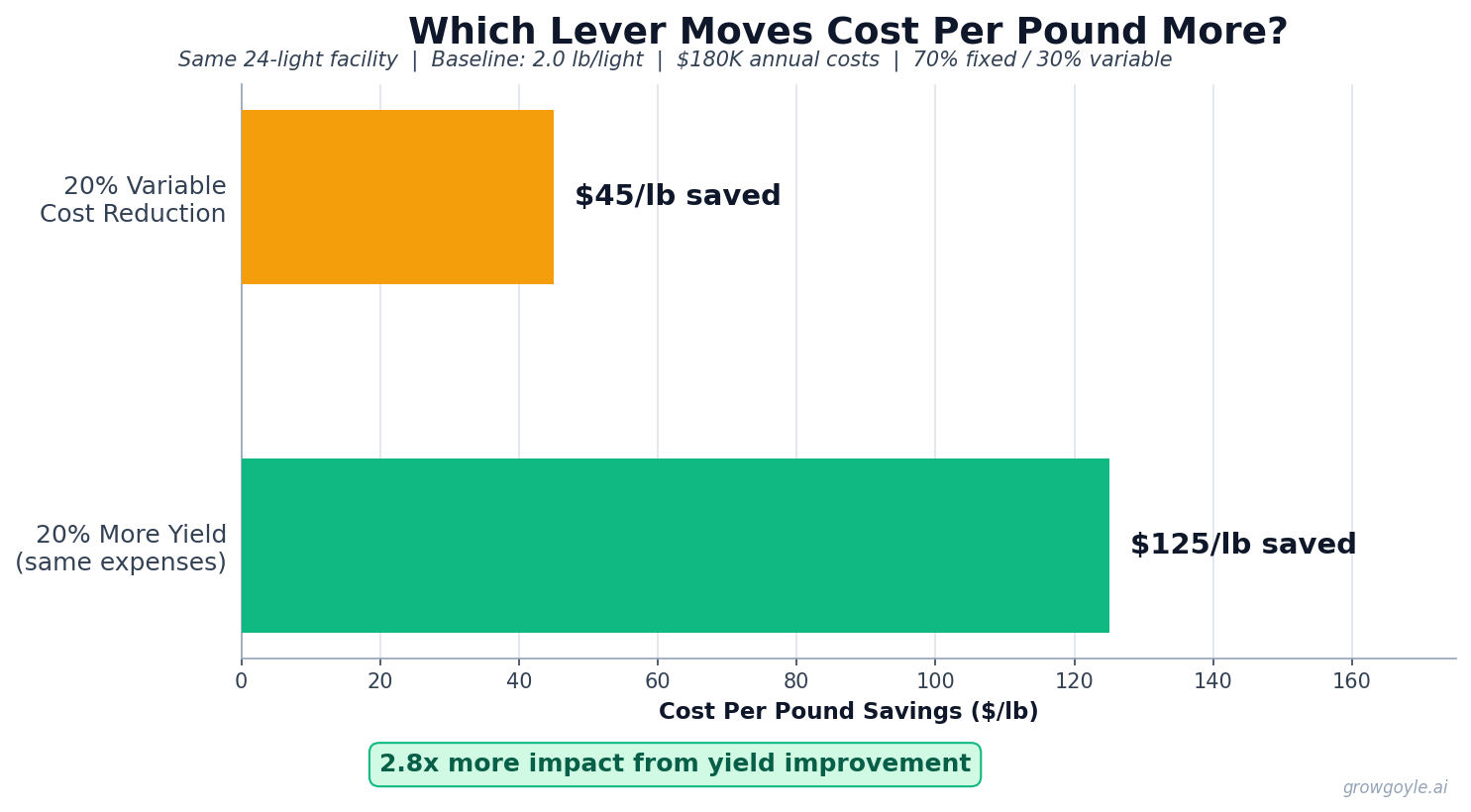
SOPs that reduce rework, energy efficiency upgrades, better scheduling that reduces idle labor time: these are real cost levers. But in most operations, improving yield by 20% saves nearly 3x more per pound than cutting variable costs by 20%. The math below shows why.
Same 24-light facility running 2.0 lb/light at $180K annual expenses (70% fixed, 30% variable). A 20% yield increase drops cost per pound by $125/lb. A 20% cut to variable costs drops it by $45/lb. Do both, but attack them in the right order. If you’re not sure which metric is your weakest, the efficiency scorecard will show you, with published research citations for every threshold.
The Yield Problem Nobody Talks About
Most cannabis growers know their best run. They know the cycle where everything clicked, the strain cooperated, the environment was dialed, and the harvest number was something they’ve quoted in every conversation since.
Far fewer know their average. And almost nobody has systematically analyzed the gap between their best run and their worst one.
That gap is the cost-per-pound problem.
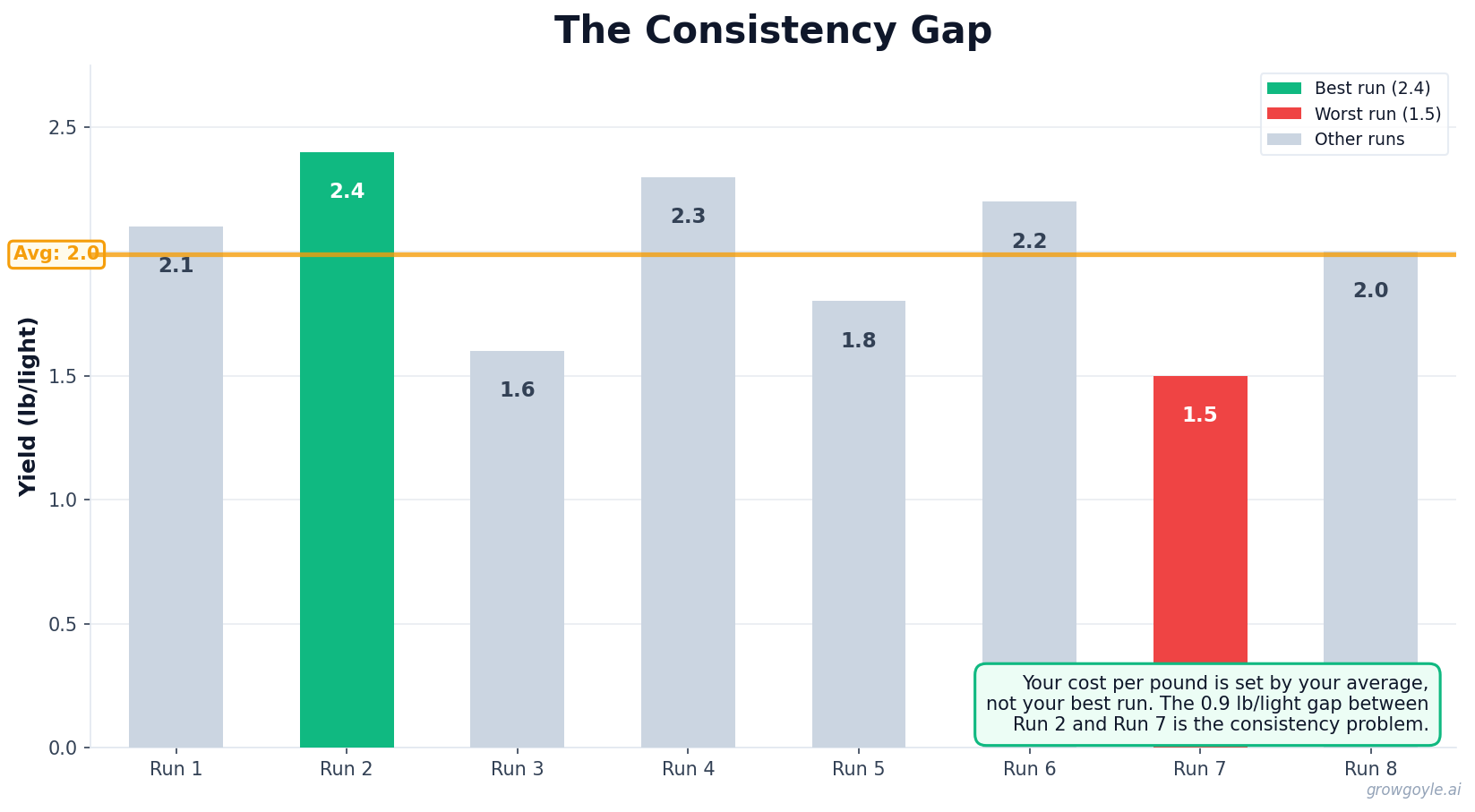
Your cost per pound isn’t set by your best run. It’s set by your worst one, averaged across the year. A facility that pulls 2.4 lb/light in one cycle and 1.5 lb/light in the next hasn’t “had a bad run.” It has a consistency problem, and that problem is showing up as a cost problem whether it’s been labeled that way or not.
This isn’t intuition. Rodriguez-Morrison et al. (2021) found significant correlations between DLI/PPFD delivery and yield outcomes across cannabis cultivation environments (PMC8144505). The implication goes beyond “higher light levels produce more yield.” Inconsistent light delivery, whether from positioning, fixture degradation, or canopy variation run to run, produces inconsistent yield outcomes. The variable isn’t just the bulb. It’s every decision that affects how that light actually reaches the canopy.
What drives run-to-run inconsistency in commercial cannabis operations:
Environmental drift: VPD, temperature, and CO2 that varies week to week within the same cycle, or differs between cycles because of seasonal HVAC pressure
Genetics variability: Phenotypic variation within a cut that wasn’t caught in selection, or mother stock that drifted between runs
Undocumented process changes: Someone adjusts the feed schedule, changes irrigation timing, or modifies the training method without logging it. The next run is different and nobody knows why.
Staff variation: Different people making judgment calls differently, especially in operations without tight SOPs
Pest and disease events: Even mild, resolved events take a toll on final yield that rarely gets attributed correctly in post-harvest review
The reason most facilities never close this gap is simple: the data to understand it doesn’t exist in any usable form. Your compliance system tracks that you harvested. It doesn’t track why one run outperformed another. The cultivation data, the stuff that actually explains yield variation, lives scattered across a whiteboard, a notes app, a text thread, and someone’s memory. For more on this gap between what compliance tracks versus what you need to improve, the data split is more extreme than most operators realize.
Environment Is the Foundation, Not the Answer
If you’ve been in cannabis cultivation for more than a few years, you know the pitch: dial in your VPD, get your DLI right, control your temps and RH, and yields will follow.
There’s truth in it. Environment is foundational. A room with chronically wrong VPD or extreme temperature swings is fighting itself. Llewellyn et al. (2022) documented the degree to which environmental factors influence not just yield but cannabinoid and terpene profiles in controlled cannabis production (Frontiers in Plant Science). The science is clear.
But “environment is everything” leads a lot of operators into what you might call the sensor dashboard trap: a room full of monitoring equipment, beautiful VPD charts, and still pulling 2.0 lb/light because the genetics or nutrition are telling a different story. Perfect environmental data doesn’t mean a perfect grow. It means you have good data on one piece of the system.
The correct role of environmental monitoring in a cost-per-pound framework:
Detect drift early. An alert when CO2 drops or RH spikes in week 5 of flower prevents yield loss from an unaddressed problem. The alert is valuable because it prevents the loss, not because it produces yield on its own.
Maintain cycle-to-cycle consistency. The same environment profile run to run reduces one source of yield variance, which compounds over time.
Provide context for post-run analysis. A harvest that underperforms is more interpretable when you have environmental data for the whole cycle alongside it. Did VPD run high during the stretch? Did pH drift in week 4? That context makes the post-mortem useful instead of speculative.
What sensors can’t do: replace agronomic judgment, fix a genetics problem, or tell you whether the low yield came from the environment, the feed, the canopy management, or the harvest timing. The difference between a sensor dashboard and a cultivation intelligence system comes down to the difference between data collection and data interpretation.
Post-Run Analysis: The Compounding Habit
Every run is an experiment. The genetics, the environment, the feed, the training decisions, the drying conditions: these are the variables. Yield and quality at harvest are the results. Most facilities run experiment after experiment without ever formally reading the results.
Post-run analysis isn’t complicated. It requires that the data exists and is accessible. Here’s what a useful review covers:
Yield Performance
Yield per light, total sellable pounds, trim ratio. How does this cycle compare to the last one? How does it compare to your best cycle in the last 12 months? The gap between this run and your best run is the starting point for every improvement conversation. For a deeper look at what your harvest data is actually telling you, this breakdown of cannabis batch analysis covers the five dimensions that matter most.
Quality Metrics
Water activity at cure completion, visual consistency, testing results if available. A run that yields well but finishes with inconsistent water activity has a different problem than one that yields well and cures clean. If water activity monitoring isn’t part of your post-harvest process yet, this guide to water activity explains why it should be.
Environmental Deviations
What weeks saw meaningful drift from targets? Were there periods where VPD, CO2, temperature, or irrigation was outside the intended range? How long, and at what growth stage?
Timeline Adherence
Did the cycle run on schedule? If not, where did it slip? A room that’s dark for an extra week between cycles is a direct cost-per-pound hit that rarely gets attributed correctly.
The Comparison Question
This is where the real insight lives: what was actually different about your best run versus the one that underperformed? Not what you think was different. What does the data show?
Most operations can’t answer this because the data from their best run lives in a different format, a different location, or only in someone’s memory. The comparison never happens because the infrastructure for comparison doesn’t exist.
Batch comparison is how the best facilities answer this question systematically. When two runs are side by side with all the data in the same place, “I think it was the feed program” becomes “VPD ran 0.4 kPa higher in weeks 5 and 6, and EC was 15% lower during the same window.” That kind of specific insight changes what you do next cycle. Speculation doesn’t.
The compounding happens when this review becomes a habit. Not once. Every run. Each cycle builds a knowledge base of what your facility responds to, what early warning signs look like before a yield miss, and what your best runs have in common. That knowledge base is the competitive advantage that accumulates over time and is nearly impossible to replicate quickly. For more on how this compounding plays out across different operation types, this breakdown of how top facilities cut cannabis cultivation costs lays out the pattern.
Building the System
The framework is a progression. Not a one-time project. A system that runs every cycle.
Step 1: Know Your Number
Calculate your actual cost per pound with real numbers: all expenses, all sellable pounds, the full cycle. If you don’t have it yet, start with the free calculator. A rough number is better than no number. But be honest with yourself about the inputs. Halving your expenses to get a friendlier result doesn’t change what it actually costs you to grow a pound.
Step 2: Find Your Weakest Metric
Is the problem yield per light? Consistency? Trim ratio? Turns per year? Energy cost relative to output? Each has a different root cause and a different fix. Trying to improve everything at once is how facilities make lots of changes and see no improvement, because nothing was targeted with enough precision to matter.
If you’re not sure where your biggest gap is, run your numbers through the efficiency scorecard. It benchmarks yield, energy efficiency, canopy utilization, and harvest frequency against published research thresholds and tells you exactly which metric to focus on first.
Step 3: Build the Post-Run Review Habit
After every harvest: yield, quality, environment, timeline. Compare to the previous run and to your best run. Document what changed, what held, and what the data suggests for next cycle. It doesn’t have to be elaborate. It has to be consistent.
The hard part isn’t the analysis. It’s having the data to analyze. If your cultivation records live in METRC and your head, the review will always be speculative. If the data is captured alongside your compliance data but separate from it, the review becomes specific and actionable.
Step 4: Make Changes Based on Data
The most common failure mode in cannabis cultivation improvement is the gut-feel change. Something felt off, so you adjusted the feed. The canopy looked different, so you changed the training. These adjustments may be right. But without a systematic before-and-after comparison, there’s no way to know whether they helped, hurt, or had no effect.
When the post-run analysis shows that EC dropped below target during weeks 4 and 5 in both of your last two underperforming runs, the feed adjustment you make next cycle has a specific hypothesis behind it. You’ll know whether it worked.
Step 5: Repeat
A facility that runs this loop every cycle for two years looks dramatically different on cost per pound than one that runs on instinct. Not because any single change was revolutionary, but because the rate of improvement is consistently positive. In a market that keeps compressing wholesale prices, the operators whose cost per pound declines faster than the market declines are the ones still standing when the shakeout ends.
Where Growgoyle Fits
Growgoyle doesn’t track your costs. It helps you lower them.
The AI batch analysis runs after every completed harvest: full breakdown of what worked, what the data shows, and specific improvement opportunities with estimated pound impact. The Goyle Score gives you a single number across five dimensions (yield, quality, environment, drying, efficiency) so you can track progress over time without manually assembling all the metrics. Batch comparison answers “what was different about that run?” without requiring you to dig through spreadsheets from six months ago.
Daily and weekly AI guidance keeps you current on what needs attention during the cycle, before it becomes a post-harvest conversation. Environmental data feeds the analysis automatically at the Pro tier, so the post-run review has full context.
The software you already have tracks compliance. It doesn’t tell you why your best strain stopped performing. That’s the gap Growgoyle fills.
Know your number. Find your weakest metric. Build the review habit. Upload a few canopy photos, complete a batch, and see what the AI surfaces. Try it free on your own plants.
About the Author
Eric is a 15-year software engineer who operates a commercial cannabis cultivation facility in Michigan. He built Growgoyle to solve the problems he faces every day: inconsistent yields, forgotten lessons from past runs, and the constant pressure to lower cost per pound in a compressing market. Every feature in Growgoyle comes from real growing experience, not a product roadmap.
Cannabis Drying Room Management for Commercial Operations
You spent 60 to 70 days dialing in your cannabis grow. You tracked VPD, hit your DLI targets, managed irrigation drybacks, and pulled a solid canopy. Then it all goes into the dry room, and you kind of just… hope for the best.
That’s not a knock on anyone. It’s how most commercial cannabis operations actually work. The dry room is the most consequential room in the facility and the one managed most by feel. Seven to fourteen days can undo months of careful cultivation. Weight loss, terpene volatilization, hay smell, mold, reduced bag appeal. All of it happens here, and most facilities have less environmental control in the dry room than they do in a vegetative zone.
This is the drying reference I wish existed when I started. Not the hobby guides that assume you have a $200K custom dry room with precision HVAC. The real-world guide for commercial cannabis operations that live with undersized dehumidifiers, seasonal humidity swings, and room turnover pressure from ownership.
The Target Envelope: Temperature, Humidity, and Airflow
The standard recommendation you’ll see everywhere: 60 to 65 degrees Fahrenheit, 55 to 62% RH. That’s correct as a baseline. But here’s the actual conversation nobody has.
If your HVAC can’t hold 60F without cratering humidity to 40%, chasing 60F is going to cost you more terpenes than running 64F at stable 58% RH. Stability beats the textbook target every time. A stable 62 to 68F with RH that doesn’t swing more than 3 to 4 points is a better environment than a facility fighting to hit 60F while watching RH bounce between 45% and 70%.
The physics: you’re targeting a lower VPD in the dry room compared to flower. Lower VPD slows moisture migration from the plant, which gives terpenes more time to preserve before the surface dries out. This is why fast drying at low RH produces that characteristic hay smell. The chlorophyll and starches haven’t had time to break down, and the terpenes left with the water vapor before the plant even fully dried. Curing cannot fix a fast dry. That’s worth reading again: curing will not rescue a batch that dried in four days.
Darkness is non-negotiable. Light degrades cannabinoids and terpenes at rates that matter commercially. If your dry room has windows or any ambient light exposure, fix that before anything else.
The Airflow Problem at Scale
Airflow in a dry room is where commercial operations diverge most from small-scale guides. A room with 10 hanging lines, 500+ branches, and 50 to 100 lbs of fresh-cut cannabis hanging from the ceiling is a fundamentally different airflow problem than a spare bedroom with 10 plants.
The dead zones are real and predictable. Perimeter plants dry faster than interior ones. Top of the canopy dries faster than the bottom. Dense hanging areas create moisture pockets. If your fan placement is creating oscillating air movement across the room, you’re generating uneven drying rates by position, and that means you’ll need to make harvest decisions based on your fastest-drying corner while your interior branches are still two days out.
Ducted airflow performs better at commercial scale than oscillating fans. Consistent, distributed air movement at low velocity (you want air movement, not wind) beats point-source fans. The test is simple: pull samples from three positions at day seven, weigh them, and check water activity. More than a 0.05 aw spread across positions tells you the environment isn’t uniform.
Practical rules: don’t exceed hanging density that prevents airspace between branches. Row spacing matters. If you’re hanging by the branch, four to six inches of clearance between branches is a workable minimum. More is better. The yield hit from harvesting in two smaller batches is usually less than the quality hit from overcrowding a single load.
Timing: The Dry-Speed Tradeoff
Too fast: three to five days produces a batch with terpene loss, harsh smoke characteristics, and that hay smell that’s hard to explain to a buyer. The chlorophyll breakdown that should happen during a proper dry gets truncated. Curing extends shelf life and helps with potency preservation, but it does not rebuild what a fast dry stripped out.
Too slow: sixteen or more days in a commercial dry room creates serious mold risk in any climate with seasonal humidity. It also means the room is occupied for two-plus weeks, creating scheduling pressure on your next harvest.
The commercial sweet spot is 10 to 14 days with whole-plant or branch hanging. That’s where terpene preservation is maximized, chlorophyll breaks down properly, and you’re not running the room long enough to invite Botrytis.
The hardest part of drying room management in a commercial facility is resisting the pressure to move product faster. Room turnover pressure is real. Ownership wants the next batch in. But rushing the dry is one of the most expensive mistakes in cannabis cultivation because the quality loss compounds all the way to the sale price. A batch that comes off the dehumidifier in six days instead of twelve might save you three days of room time and cost you $10 to $15 per pound at wholesale.
Seasonal adjustments matter more than most operators plan for. Summer humidity means your HVAC is fighting harder to hit target RH, which often results in running warmer and drier than intended. Winter conditions can swing the other direction, with low ambient humidity accelerating surface drying while moisture stays locked in the stem. Document your HVAC settings by season and track outcomes. The same settings that produce perfect results in October may need significant adjustment in July.
The drying target envelope: optimal temperature and humidity zones for commercial cannabis drying rooms.
Water Activity: The Objective Metric
The “stems snap” test is not a measurement. It’s a heuristic, and it’s inconsistent between cultivars, individual plants, and the person doing the assessment. At commercial scale, you need an objective number.
Water activity (aw) is that number. It measures the energy of water in the product, which predicts microbial growth risk and shelf stability far better than moisture percentage alone. For commercial cannabis, the preservation zone is 0.55 to 0.63 aw.
Below 0.55: overdried. Brittle trichomes, weight loss you already paid for, harsh characteristics. You’re leaving money on the scale.
0.55 to 0.63: the target range. Microbial growth suppressed, trichomes intact, proper cure can proceed.
Above 0.65: mold risk. Aspergillus and Botrytis both find viable conditions above this threshold. For cannabis destined for patients or regulated sale, this is also a compliance concern.
A reliable aw meter runs $300 to $600. It’s one of the highest-ROI purchases in your dry room. The Growgoyle water activity guide has a full breakdown of testing protocols and what the numbers mean at each phase.
Water activity zones: the objective measurement that determines drying outcomes, shelf stability, and compliance.
Testing protocol: pull three to five samples from different positions in the room (perimeter, interior, high, low). If you’re seeing more than a 0.05 spread between samples, the environment isn’t uniform. That’s an airflow or HVAC distribution problem, not a genetics problem.
Common Commercial Drying Mistakes
The patterns that show up repeatedly across operations:
Rushing the dry for room turnover. Already covered this, but it’s the most expensive mistake in the dry room. The math on lost sale price almost always exceeds the cost of the extra room time.
Ignoring airflow dead zones. Set up the room, hang the product, run the fans, and assume it’s uniform. The aw spread test catches this quickly.
Set-and-forget HVAC. This one is subtle. The moisture load in a dry room changes dramatically across the dry cycle. Day one with 80 lbs of fresh-cut material is a completely different HVAC demand than day ten when that same material has lost 70% of its water weight. A dehumidifier running at its day-one setting on day ten may be pulling the room too dry. Checking conditions at day three, seven, and ten catches drift before it affects the batch.
No monitoring during drying. Cannabis grow room environment control gets attention. Dry room monitoring often doesn’t. If you have Sentinel alerts configured, running them through the dry room catches the 3 AM humidity spike that would otherwise go unnoticed until you open the door.
Overcrowding. The temptation to get one more line in the room is real. The airflow physics don’t care about scheduling pressure.
Drying Room Design Considerations
If you’re designing or retrofitting a dry room, a few principles that matter more than most people account for:
Interior rooms dry more evenly. Exterior walls create temperature gradients, especially in climates with significant seasonal swings. An interior room insulated on all sides holds its setpoint more consistently and costs less to condition.
HVAC sizing is the number one infrastructure mistake. Calculate your moisture removal requirement based on maximum harvest weight. Fresh-cut cannabis is roughly 75 to 80% water by weight. A 100-lb wet harvest puts approximately 60 to 65 lbs of water into the air over 10 to 14 days. Undersized dehumidification means you’re either rushing the dry (bad) or fighting mold in the back half of the cycle (worse).
Separate zones help when you can build them. Different cultivars dry at different rates. If you’re running a mixed harvest, the strain that needs 12 days shouldn’t be sharing a room setpoint with the one that finishes in nine. Two smaller dry rooms with independent HVAC give you more flexibility than one large room.
Flooring matters more than it sounds. Sealed or epoxy concrete prevents moisture absorption and makes sanitation straightforward. Raw concrete holds moisture and is harder to keep clean.
From Drying to Curing: When to Transition
The transition point: aw in the 0.58 to 0.62 range, outer buds dry to the touch, stems with slight flex (not snap, not bend without resistance). At this point the product is ready to move into sealed containers for cure.
Commercial curing in buckets or bins: burp daily for the first three to five days, then seal with humidity packs targeting 58 to 62% (Boveda 58 is the standard). Check aw at day three, seven, and fourteen. If aw rises above 0.63 after sealing, moisture is still migrating out of the inner stem material. That means the dry didn’t fully complete before you transitioned, and you’ll need to open the containers and let it breathe.
Minimum cure window for commercial flower: two to four weeks. The enzymatic processes that improve flavor and smooth smoke characteristics take time. A two-week cure is a floor, not a target.
Building a Drying SOP That Adapts
The operators who consistently produce quality product across seasons aren’t the ones with the fanciest dry rooms. They’re the ones who document, track, and adjust. Every dry room run should capture: room conditions at start, hanging density, start and end weights, aw readings at day three, seven, and completion, total days, and final product quality notes.
That documentation does two things. First, it builds seasonal SOPs so you’re not reinventing the approach every August. Second, it creates the feedback loop that connects drying performance to the full batch picture. A post-run batch review that includes drying data (weight retention, days to target aw, quality outcomes) shows the complete picture from clone to cure, not just the flower phase.
The difference between a sensor dashboard and actual cultivation intelligence is exactly this: data that’s recorded but never connected to outcomes doesn’t improve anything. Drying conditions that feed into a full batch analysis give you something to actually work with when the next run is setting up.
A note on what AI batch analysis currently covers: Growgoyle’s AI batch analysis focuses on the flower phase. It doesn’t provide AI-specific drying room analysis yet. What it does do is include drying data in the full run picture, because what happened in the dry room shows up in the quality score and weight numbers. The Goyle Score’s 10% drying dimension reflects this. If drying repeatedly pulls the batch score down, that’s data worth acting on.
For operations working to cut cannabis cultivation costs, the dry room is worth treating with the same rigor as the flower room. The consistency that drives low cost per pound doesn’t stop at harvest. It runs all the way through cure.
Growgoyle doesn’t track your costs. It helps you lower them. Upload a few canopy photos and see what the AI catches. Try it free on your own plants.
About the Author
Eric is a 15-year software engineer who operates a commercial cannabis cultivation facility in Michigan. He built Growgoyle to solve the problems he faces every day: inconsistent yields, forgotten lessons from past runs, and the constant pressure to lower cost per pound. Every feature in Growgoyle comes from real growing experience, not a product roadmap.
Yield Is Not the Enemy of Quality in Cannabis (The Science Says So)
Post a big yield number in any cannabis forum and watch what happens. Someone will call it biomass. Someone will say you sacrificed quality for quantity. Someone will imply that real craft growers don’t chase numbers. It’s one of the most deeply held beliefs in this industry. And it’s wrong.
Not “wrong in some philosophical sense.” Wrong as in peer-reviewed, replicated research wrong. The idea that cannabis yield and quality exist on a seesaw, that more of one means less of the other, is a myth. And like most persistent myths, it’s built on a kernel of truth that got overgeneralized into a rule nobody bothered to question.
Let’s pull this apart.
Where the Myth Came From
To be fair, the cannabis yield vs quality belief didn’t come from nowhere. There are real scenarios where chasing weight tanked quality, and growers learned from that experience.
In outdoor and greenhouse production, plant density matters. Push too many plants into suboptimal light and you’re not giving each one enough photons to build dense, resinous flower. More plants, same light, same canopy, something gives. Per-plant yield drops and so does quality because the resources weren’t there to support either.
Home growers learned this the hard way. Overfed, over-stressed plants pumped to hit weight targets often produced airy, harsh flower. The association between chasing numbers and compromised quality got baked in early.
Then there’s the large-scale commercial side. Many large cannabis operations, especially the early multi-state operators, genuinely did cut corners. Mediocre genetics, inconsistent environments, rushed dry rooms, thin teams stretched too far. The output was high volume and low quality, and the market noticed. That association between “big” and “bad” stuck.
Add in craft branding that has spent years equating small batches with quality. Some of that is earned. Some of it is just marketing. But it reinforced the idea that the grower who cares about quality keeps things small and doesn’t worry about yield.
The problem is, none of that is about yield itself. It’s about bad process. And the science makes that very clear.
What the Research Actually Shows
In 2021, Rodriguez-Morrison and colleagues at the University of Guelph published a study on cannabis grown under light intensities ranging from 120 to 1,800 micromoles per square meter per second. That’s a massive range, from dim to extremely bright. The goal was to understand how DLI affects cannabis yield and quality metrics simultaneously.
What they found should put the tradeoff myth to rest.
Yield increased 4.5x from the lowest to the highest light intensity. Significant. But cannabinoid potency? No statistically significant change at any light level. Terpene content didn’t drop. Total terpene potency actually showed a modest increase with higher light, driven mainly by myrcene and limonene. Bud density improved. Harvest index improved. More light delivered more yield AND better physical quality metrics, with zero loss in potency. (Rodriguez-Morrison et al., 2021)
These weren’t backyard experiments. This was peer-reviewed research published in Frontiers in Plant Science.
A year later, Llewellyn and colleagues from the same lab published a follow-up using a high-THC cultivar called Meridian, a strain testing above 20% THC. They compared 600 versus 1,000 micromoles per square meter per second. Yield came in 1.6x higher at the higher intensity. Cannabinoid concentrations? No significant effect. Terpene concentrations? No significant effect. The plant simply produced more flower at identical quality. (Llewellyn et al., 2022)
Two separate studies, peer-reviewed, replicated findings: more light drives more yield, and quality doesn’t follow it down. The cannabis potency yield tradeoff, under controlled conditions with good process, doesn’t exist.
That’s worth sitting with for a minute.
So Why Does Quality Drop When Growers Push Yield?
This is the actual question. If the science shows no inherent tradeoff, why do growers experience one?
Because something else broke. Specifically:
Environmental control couldn’t keep up. A bigger canopy produces more transpiration. If your HVAC isn’t sized for it, or your airflow isn’t dialed, humidity climbs. VPD goes out of range. You get uneven canopy conditions, hot spots, stagnant air pockets, inconsistent leaf surface temps. That’s not yield causing quality problems. That’s the environment failing to scale with the grow.
Feed programs weren’t adjusted. Higher light intensity means higher photosynthesis rates, higher metabolic demand, more water and nutrient uptake. If your fertigation schedule is built for lower canopy productivity and you didn’t adjust it, you’re either underfeeding or running drybacks that don’t match what the plant actually needs. That stresses the plant, and stressed plants at the wrong time compromise bud development.
The dry room became the bottleneck. This is the one nobody talks about enough. More wet weight going into the same dry room means longer dry times, or the temptation to rush it. Rushing dries destroys terpenes. It also creates texture problems, brittle flower that turns to powder in the bag. Terpene loss in drying is one of the most common quality failures in commercial cannabis cultivation, and it has nothing to do with how much the plants yielded. It’s a dry room process failure.
Team capacity didn’t scale. More canopy with the same crew means less attention per plant. IPM issues get caught later. Irrigation problems go unnoticed. Training and pruning slip. Problems that a well-staffed team would catch early become harvest-time surprises. That’s an operational problem, not a yield problem.
Every one of these is a process variable. None of them is an inherent consequence of high cannabis yield. The yield didn’t cause the quality drop. The failure to adjust process to support the yield caused it.
What Actually Drives Quality
When you strip away the process failures, quality in cannabis comes down to a pretty short list.
Genetics. The ceiling. You can’t extract what the plant doesn’t have. Strain selection sets your maximum potential potency, terpene profile, and bud structure. Nothing you do in the grow room adds cannabinoids that genetics don’t allow.
Environmental consistency. The floor. Not just hitting target VPD numbers, but holding them tight across the entire canopy throughout the entire cycle. A room that averages the right temp/RH but swings wildly is worse than a room that runs slightly off but stays steady. Consistency across the canopy is what allows every flower site to develop uniformly.
Drying and curing. This is where most quality is actually made or lost. Properly dried cannabis (hitting the right moisture content at the right rate, then curing long enough to stabilize) is where the terpene profile gets locked in or destroyed. Most commercial cannabis quality complaints trace back here, not to the grow room.
Harvest timing. Too early and you leave cannabinoid development on the table. Too late and THC degrades to CBN, terpenes volatilize, and you’re selling a different product than what the plant was capable of producing.
Notice what’s not on this list: yield targets. None of these quality drivers are in conflict with pulling high numbers from your cannabis grow room. A properly dialed room produces excellent genetics under consistent environmental conditions, harvested at the right time, dried correctly. The output of that room can be high yield AND high quality. Those aren’t competing outcomes.
The Real Flex: Doing Both, Consistently
Here’s where craft growers and production growers should actually find common ground, because both sides of this debate often miss the same point.
One big run proves nothing. One batch with exceptional lab results and strong yield is data, not a system. The growers who are actually dominating, in any segment of this market, aren’t choosing between yield and quality. They’re dialing in their process so both improve together, run after run.
Consistency is the multiplier. Hitting strong numbers once might be luck, good genetics, or a favorable environment that month. Hitting those same numbers five runs in a row on the same strain? That’s process. That’s a system. That’s what you can build a business on.
The best commercial cannabis growers I know don’t brag about their biggest run. They brag about their tightest standard deviation.
Craft growers: small batches with meticulous process produce excellent cannabis. That’s true. But “small” isn’t what’s doing the work. “Meticulous process” is. Scale that same process, maintain that same environmental discipline, and there’s no scientific reason the quality drops. The challenge is operational, not botanical.
Production growers: yield is a business metric, not a quality substitute. Hitting high numbers in your cannabis cultivation facility means nothing if lab results are inconsistent, moisture content varies batch to batch, or your trim ratio is all over the place. Both metrics matter. Track both.
High yield high quality cannabis isn’t a contradiction in terms. It’s a process problem that’s been misidentified as a fundamental tradeoff. The research is clear. The mechanism makes sense. What remains is building the operational systems that support both outcomes simultaneously, and being honest with yourself when the data shows you which variable is actually slipping.
That’s the work. And it’s worth doing.
Growgoyle.ai tracks both yield AND quality metrics across every run: Goyle Score, lab results, trim ratio, environmental consistency, so you can see exactly where you’re winning and where process is costing you. It doesn’t ask you to choose between yield and quality. It helps you improve both. See what the AI sees in your canopy photos – no signup required.
Growgoyle.ai helps you close the gap between your best run and your worst. AI-powered batch analysis, run-over-run comparison, and photo diagnostics that keep every cycle on track. Built by a grower who got tired of guessing. See what the AI sees in your canopy photos – no signup required.
About the Author
Eric is a 15-year software engineer who operates a commercial cannabis cultivation facility in Michigan. He built Growgoyle to solve the problems he faces every day: inconsistent yields, forgotten lessons from past runs, and the constant pressure to lower cost per pound. Every feature in Growgoyle comes from real growing experience, not a product roadmap.
If someone asked what software you use to manage your cannabis grow and you said “METRC” or “Dutchie”, I get it. I said the same thing for a while. But that’s a little like saying your accounting software is your business strategy. They’re both on your computer. They both involve numbers. They’re not the same thing, and confusing them is quietly costing you yield.
This isn’t a knock on compliance tools. I want to be clear about that upfront. METRC is legally required in most states, it works, and the teams that built these platforms solved a genuinely hard problem: giving regulators real-time visibility into cannabis inventory across thousands of licenses. That’s not easy. They did it. But what those tools are built to do and what you actually need to run a better cannabis cultivation operation are two different things entirely.
What Compliance Software Actually Does, and Does Well
Seed-to-sale compliance platforms like METRC, BioTrack, and the point-of-sale tools built around them (Dutchie, Leaflogix, etc.) are designed to satisfy one core requirement: state reporting. They track plant counts, inventory weights, transfers between licenses, lab test results, package labeling, and manifests. Every tag, every transfer, every destruction event, documented and reported.
That’s not optional. It’s not something you can DIY with a spreadsheet. These systems exist because regulators need a chain of custody that holds up to an audit, and if you’re operating a licensed cannabis facility, you already know what it costs when your compliance data is off. Fines. License risk. Headaches you don’t need.
So compliance software does what it’s supposed to do, and it does it well. Use it. Maintain it. Don’t cut corners with it. But understand what it actually is: a reporting layer between your operation and the state. It’s not looking out for you. It’s looking out for regulators.
What Compliance Software Doesn’t Do
Here’s where growers get into trouble. Because they have software, real software, software they pay for and log into every day, it creates a false sense that the data problem is solved. “We track everything in METRC.” Sure. But does METRC tell you:
Why Room 2 pulled 15% less than Room 1 last cycle with the same strain?
Whether your drying process is costing you sellable weight across multiple runs?
How this batch compares to your last five runs of the same cultivar?
What specifically changed in the runs where your quality dropped?
What to do differently on the next run to get closer to your genetic ceiling?
It doesn’t. And it’s not supposed to. METRC knows you harvested 60 lbs and it tested at 28% THC. It does not know, and has no interest in knowing, whether that yield was limited by your VPD in weeks 4 through 6, or whether you’re consistently losing 12% of your harvest weight to an aggressive dry schedule, or whether the strain you’re running just needs two more weeks of veg to hit its potential in your specific environment.
That’s not a flaw in compliance software. That’s just not what it does. The flaw is thinking it does.
The Dangerous Assumption: “We Have Software”
I’ve talked to plenty of cannabis cultivators who, when asked how they track performance and improve from run to run, say something like, “Oh, we’re all in METRC.” And they mean it sincerely. They’re not being evasive. They genuinely believe that having a compliant, well-maintained compliance system means they have grow management handled.
That assumption has a real cost. Because compliance data tells you WHAT happened. You harvested X pounds. Your tests came back at Y%. Your transfer went to Z facility. It does not tell you WHY, was it the environment? The feed? The dry? A pathogen that got ahead of you in week 3? And it absolutely does not tell you HOW TO DO BETTER next time.
In commercial cannabis cultivation, the metric that determines whether you’re viable is cost per pound. Every input (labor, nutrients, electricity, square footage, water) divided by the sellable weight you put out the door. Compliance software does not move that number. It records outcomes. It doesn’t explain them, and it doesn’t help you improve them.
Running a cannabis facility without actual grow management software isn’t running lean. It’s flying blind with a very organized flight log.
The Tax Analogy That Finally Made It Click for Me
The way I eventually got my head around this distinction: think about how you manage your business finances.
QuickBooks (or whatever accounting software you use) tracks your money. Revenue in, expenses out, payroll, depreciation, all of it. It’s accurate. It’s useful. It’s required for taxes. But QuickBooks does not tell you how to make more money. It does not look at your P&L and say, “Hey, your labor costs in Q3 spiked 18% and that correlates directly to your revenue dip, here’s what changed and here’s what to do about it.” It just shows you the numbers.
A good financial advisor does that second part. They look at your actual data, find the patterns, and give you specific guidance: cut this, invest more there, restructure that. It’s the difference between a record of what happened and an analysis of what it means.
METRC is QuickBooks for cannabis. It keeps the books. Cannabis cultivation intelligence is the advisor, the layer that takes your actual grow data and turns it into something actionable.
You need both. They’re not interchangeable.
What Actual Cannabis Grow Management Looks Like
So what should real cannabis grow management software actually do? From where I sit, it comes down to a few things that compliance tools will never do by design.
Batch-level tracking with context. Not just “you harvested X lbs” but what was the environment during that run? What was your feed program? What was your DLI profile? What did the plants look like at week 5? Outcome data without context data is almost useless when you’re trying to diagnose a drop in performance.
Pattern recognition across runs. One data point is an anecdote. Ten data points across the same strain start to show you something real. If your yields are consistently lower in Room 2 and you’ve run it 15 times, there’s a pattern there, but you can only see it if you’re capturing and comparing the right data across batches.
Differential diagnosis. When something goes wrong in your cannabis grow room (tip burn, nutrient lockout, light stress, a pathogen), there are usually multiple possible causes. Good grow management tools should help you think through the actual differential rather than jumping to the first obvious answer. That’s how experienced master growers think, and it’s how good software should work too.
Actionable recommendations specific to your operation. Not generic “best practices” from a blog post. Actual guidance based on your data, your environment, your history. “Your last three runs of this strain show yield declining in weeks 6-7. Your environment data points to elevated VPD during that window, tighten that up next cycle.”
Honest scoring against yourself. Not industry benchmarks that may or may not apply to your facility, your market, your genetics. Your Rooms, your Runs, your trends over time. Getting better at your own game is what matters.
That’s the category of tool that actually helps you lower cost per pound. It’s not competing with METRC. It’s doing something METRC was never designed to do.
Where This Shows Up in the Real World
I’ve seen this play out in a few ways at my own facility and in conversations with other cannabis cultivators. The most common one: a grower will have a great run, then a mediocre run of the same strain, and genuinely not know why. They’ll go back through their METRC records. They’ll see the harvest weights. They’ll see the test results. And there’s nothing in there that explains the difference, because METRC never captured the environment data, the feed adjustments, the mid-cycle photo that showed early mag deficiency, or the fact that they changed their dry room setup between those two runs.
All of that context lives in someone’s head, in a text thread, or nowhere. And the next run starts without any real understanding of what drove the variance.
That’s a solvable problem. It requires actually tracking runs, not just for compliance, but for cultivation intelligence. It requires capturing the data that explains outcomes, not just the outcomes themselves. And it requires analysis that tells you what to do with that data, not just a spreadsheet that stores it.
The cannabis cultivators who are going to win in this market long-term are the ones who figure this out. Compliance is table stakes. Cultivation intelligence is the actual competitive edge.
The Bottom Line
METRC and seed-to-sale compliance tools are essential. Use them, maintain them, take them seriously. But don’t confuse them with cannabis grow management software. They tell your state what you grew. They don’t tell you how to grow better. Those are completely different tools solving completely different problems, and treating one as a substitute for the other is leaving real money on the table.
If you can’t answer “why did this run underperform?” from your current data, you don’t have grow management. You have compliance. There’s a difference, and it shows up in your cost per pound.
Growgoyle.ai is cannabis cultivation intelligence, not a compliance tool, not a sensor dashboard, not a grow diary. It’s AI-powered batch analysis that tells you what drove your results, what to change, and what your next run should look like based on your own data. METRC tells your state what you grew. Growgoyle tells you how to grow better. They’re not the same tool, and you need both. See what the AI sees in your canopy photos – no signup required.
Growgoyle.ai helps you close the gap between your best run and your worst. AI-powered batch analysis, run-over-run comparison, and photo diagnostics that keep every cycle on track. Built by a grower who got tired of guessing. See what the AI sees in your canopy photos – no signup required.
About the Author
Eric is a 15-year software engineer who operates a commercial cannabis cultivation facility in Michigan. He built Growgoyle to solve the problems he faces every day: inconsistent yields, forgotten lessons from past runs, and the constant pressure to lower cost per pound. Every feature in Growgoyle comes from real growing experience, not a product roadmap.
Michigan Cannabis Wholesale Price Trends 2026: What the Numbers Actually Look Like
If you’re growing cannabis in Michigan right now, you don’t need me to tell you the wholesale market is rough. You’re living it. But let’s talk about what the numbers actually look like in 2026, and more importantly, what the operators who are surviving have in common. Because there are growers making it work out here. They’re just not doing it by hoping prices recover.
How Michigan Cannabis Got Here: The Price Compression Story
Michigan went from a limited medical market to a wide-open recreational program in a pretty compressed timeframe. In the early rec days, 2020 and into 2021, you could move indoor flower at $3,000 a pound and people were paying it. Licenses were constrained, demand was strong, and operators were printing money. That window lasted maybe 18 months.
Then the licenses caught up. Then outdoor and greenhouse operations scaled. Then everyone who saw the margins piled in. Classic commodity compression. It’s the same thing that happened in Colorado, Oregon, California. Michigan just happened later.
What accelerated the floor dropping wasn’t just more indoor coming online. It was cheap biomass flooding in from outdoor and light dep grows. When you’ve got greenhouse operators moving bulk at $150 a pound, it pulls everything below it down. Dispensaries aren’t dumb. They know what the market looks like, and they’ll use it in every negotiation you have.
The Michigan cannabis market in 2026 is not a bad market. It’s just a real market. The fantasy pricing is gone and it’s not coming back.
Where Michigan Cannabis Wholesale Prices Actually Sit in 2026
I’m not going to point you to some report with state averages, because state averages are useless. What matters is what you can actually move product for based on quality and relationship. Here’s what I’m seeing:
Premium indoor, top-shelf: $800 to $1,200 per pound. Strain matters. Relationship matters. Consistency matters. If you can reliably deliver the same quality run after run, there are buyers who will pay for that. But $1,200 is the ceiling and most people aren’t hitting it most of the time.
Mid-grade indoor: $500 to $800 per pound. This is where the majority of Michigan cannabis growers are getting paid. Decent quality, inconsistent execution, average yields. Not bad work, but thin margins at current price points.
Biomass and trim: $100 to $300 per pound. If you’re growing outdoor or selling extraction-grade material, this is your world. Volume game. Brutal.
If someone is quoting you prices significantly above these ranges, they’re either moving something exceptional, they have a very unusual buyer relationship, or they’re not being straight with you. The days of moving average indoor at $1,500 are done.
Who’s Getting Squeezed
The Michigan cannabis operations struggling most right now tend to share a few characteristics.
The first group is facilities that expanded aggressively during the boom. If you built or leased a big space when the market was hot, took on debt to do it, and based your pro forma on $2,000-per-pound wholesale, your numbers don’t work anymore. Your fixed costs are what they are. The market doesn’t care about your lease.
The second group is growers who can’t consistently produce top-shelf quality. Premium pricing holds better than mid-grade because there are dispensaries who need reliable premium product and can’t always find it. But you have to actually hit the standard, every run. Not one great run followed by two mediocre ones. Consistent premium is a defensible position. Inconsistent premium isn’t worth much to a buyer.
The third group is operations with high cost per pound who got comfortable. When margins were fat, sloppy operations still made money. When margins compress to $100 to $200 per pound, every inefficiency shows up. Overdrying losses, low yields, wasted inputs, labor inefficiency. It all hits your cost per pound and there’s less room to absorb it.
Who’s Actually Surviving
The Michigan cannabis growers I know who are doing fine in this market share some common traits. None of them have a secret strain. None of them found a magic buyer paying above-market. They’re surviving because of how they operate.
Low cost per pound is the foundation. These are facilities that run tight, know their numbers, and don’t waste anything they don’t have to. Consistent yields across runs, not chasing one monster batch. Good environmental control that doesn’t cost a fortune to maintain. Low overhead relative to production capacity.
Consistent quality is the other piece. Buyers have choices right now. The ones paying premium prices are doing it because they need reliable supply they can count on. If you’re delivering inconsistent quality, you’re competing on price with every other inconsistent grower. That’s a race to the bottom.
Small to mid-size operations with manageable overhead are also faring better than the big builds in a lot of cases. Less debt service, more flexibility, lower break-even. Simpler isn’t always worse in a tight market.
The Math That Actually Matters for Michigan Cannabis Growers
Let me show you the math that keeps me up at night, because it should be on your radar too.
Say your cost per pound all-in is $600. At $800 wholesale, you’re making $200 per pound margin. Not great, but survivable depending on your scale and overhead.
Now wholesale drops to $700. That happens. It’s been happening. Your margin just went from $200 to $100 per pound. You cut your profitability in half without changing a single thing about how you operate.
Here’s the other side of that math. If you reduce your cost per pound by $100 through better yields, less waste, tighter operations, that $100 is worth exactly the same as wholesale going UP by $100. It’s the same dollar hitting your bottom line. The difference is that you control your cost per pound. You do not control wholesale.
The Michigan cannabis market will do what it does. Prices might stabilize. They might drop further. More outdoor supply will come online. More licenses will be issued. Retail consolidation will keep putting pressure on wholesale buyers to drive prices down. None of that is in your hands.
What is in your hands is your cost per pound. And specifically, the yield and consistency side of that equation. If you’re losing pounds to overdrying, you can fix that. If your yields are swinging 20% run to run, you can tighten that. If the same environmental patterns keep showing up every other cycle, the data can break that loop.
What Smart Michigan Cannabis Growers Are Doing Right Now
The operators I respect out here are not waiting for the market to turn. They’re treating every batch as a data point, not a one-off event.
They’re tracking batch performance seriously. Not just what they yielded, but why. What was VPD doing in weeks 4 and 5? Did the dryback protocol drift? How did this run compare to the last one with the same genetics? If you’re not tracking it, you’re just guessing, and every run is starting from zero.
They’re focused on consistency, not just chasing the one monster run. A consistent 35 grams per square foot every cycle is worth more than 45 one time and 25 the next. Buyers want to know what they’re going to get. Your cost per pound is a function of your average yield, not your best yield.
They’re paying attention to drying. This is the easiest pound to recover. Overdrying cannabis is one of the most common and most expensive mistakes in Michigan indoor grows. You grew the weight and then you dried it away. Getting drying dialed in has a direct and immediate impact on what you’re actually selling.
And they’re comparing runs side by side with intention. Not just “that was a good run” or “that one was rough.” Actually looking at what was different. What changed? What held? Which practices are worth repeating and which ones were flukes?
The growers who build that feedback loop into their operation are the ones who get better over time instead of just grinding out runs and hoping for the best.
Where This Market Goes
Honestly? I don’t think Michigan cannabis wholesale prices recover significantly. There’s too much supply coming and the retail market isn’t expanding fast enough to absorb it. Some consolidation will happen. Some operators will exit. That might create some breathing room at the premium end of the market.
But the floor is the floor. If you’re running a cannabis cultivation operation in Michigan and your plan is to outlast the bad pricing and wait for $1,500 wholesale again, I think you’re in for a long wait with a lot of pain in between.
The plan that works is getting your cost per pound down and your quality consistency up. Every batch, better than the last one. Not dramatically better, just measurably better. That’s how you build a sustainable operation in a compressed market.
The operators who survive this market will be the ones who treated it as a signal to get sharper, not a problem to wait out.
Growgoyle.ai was built by a Michigan cannabis grower because the market forces you to operate smarter, not just harder. Photo analysis, batch scoring, run-over-run improvement tracking. Every feature is aimed at one thing: getting your cost per pound down by helping you yield more, waste less, and repeat what works. The market isn’t getting easier. The only move is getting better, batch after batch. See what the AI sees in your canopy photos – no signup required.
Growgoyle.ai helps you close the gap between your best run and your worst. AI-powered batch analysis, run-over-run comparison, and photo diagnostics that keep every cycle on track. Built by a grower who got tired of guessing. See what the AI sees in your canopy photos – no signup required.
About the Author
Eric is a 15-year software engineer who operates a commercial cannabis cultivation facility in Michigan. He built Growgoyle to solve the problems he faces every day: inconsistent yields, forgotten lessons from past runs, and the constant pressure to lower cost per pound. Every feature in Growgoyle comes from real growing experience, not a product roadmap.
Every few months someone posts in a growers forum asking for the “best cultivation software.” The thread fills up fast, people swearing by their sensor dashboard, compliance guys saying nothing beats their seed-to-sale system, a few folks pushing whatever their sales rep just demoed. Nobody agrees. And the reason nobody agrees is that everyone is solving a different problem.
There is no best cannabis cultivation software. There are tools that solve different problems. The right stack depends on what you actually need, and those two things are not the same question at the same facility.
I’m a software engineer who runs a licensed commercial cannabis facility in Michigan. I’ve used a lot of these tools, watched colleagues use others, and sat through more software demos than I care to count. What follows is an honest breakdown of each category: what it actually does, when you need it, and what it doesn’t do. Including where Growgoyle fits, and where it doesn’t.
The most important thing to understand:
Seed-to-sale software is compliance software. It tracks where your plants are for the state. It does not help you grow better, improve your yields, or lower your cost per pound. If someone is selling you “seed-to-sale” as a cultivation tool, they are selling you a compliance tool with a grow journal bolted on.
AI batch analysis, photo diagnostics, yield improvement recommendations
Growgoyle
Highest ROI for yield improvement
The five categories of cannabis software serve different purposes. Most commercial operations need at least three.
Category 1: Compliance and Seed-to-Sale Tracking
What these tools do: Track plant and inventory counts, integrate with METRC, generate regulatory reports, manage manifests and transfers. In most states, this category of software is not optional. It’s the law.
Honest assessment: You need one of these. Full stop. That’s not really a software evaluation. It’s a license condition. Pick the one your team can actually use without wanting to throw their laptop out the window, because data entry compliance is only as good as the people doing the entry.
What compliance software does not do: make your grows better. It’s not supposed to. It was designed to satisfy regulators, not optimize your operation. The moment you start expecting Dutchie to tell you why your last batch underperformed, you’re asking the wrong tool the wrong question.
Seed-to-Sale Platform Comparison (2026)
Platform
METRC
Cultivation Features
Pricing
Best For
Canix
Yes (direct API)
Basic batch tracking, harvest records
Demo required
Mid-size operations wanting clean UI + compliance
Dutchie
Yes (direct API)
Minimal (dispensary-first)
Demo required
Vertically integrated ops (dispensary + grow)
BioTrack
Yes (state-mandated in some markets)
Basic inventory tracking
Varies by state
Operations in BioTrack-mandated states
Flourish
Yes (direct API)
Batch tracking, cultivation logs
Demo required
Multi-license operations needing full compliance
METRC Direct Entry
Native (it IS the state system)
None
Free (state-provided)
Small operations doing manual entry
Key limitation across all seed-to-sale platforms: These tools track that you harvested a certain weight. They do not analyze why that weight was higher or lower than your last run, or what to change next time.
Category 2: Sensor Dashboards and Environmental Monitoring
What these tools do: Display real-time environmental data: temperature, relative humidity, VPD, CO2, light levels. Log historical readings. Send alerts when values cross thresholds you configure.
Honest assessment: Useful. Genuinely useful. If you’re still walking rooms with a handheld meter and keeping notes in a notebook, a sensor dashboard is a meaningful upgrade. Real-time VPD visibility alone is worth it for most operations.
But a dashboard shows you data. It doesn’t analyze it. Knowing your room hit 84°F on day 18 of flower tells you something happened. It doesn’t tell you how much yield that cost you, whether the strain you’re running is more sensitive to heat stress than your previous one, or whether that spike happens to correlate with a HVAC pattern you could actually fix. The data is there. The interpretation is still on you.
Sensor dashboards give you visibility. Visibility is a prerequisite for improvement, not improvement itself.
Category 3: Equipment Automation and Control
What these tools do: Automate and control HVAC systems, irrigation, lighting schedules. Adjust setpoints automatically. Reduce manual intervention. At scale, they’re significant for consistency and labor efficiency.
Honest assessment: Solid infrastructure. If your environment is swinging because someone keeps manually adjusting things and your SOPs aren’t sticking, automation helps a lot. Getting your room to hold a VPD target during lights-on transition without a grower babysitting it is real value.
What automation doesn’t know: whether your setpoints are right for the strain you’re running in week 6 of flower, or whether the environment you’re dialing in is actually producing better cannabis or just more consistent mediocrity. Automation holds your settings. It doesn’t evaluate them.
This category also requires the most capital investment and integration work. It makes the most sense at larger scale where the labor savings justify the upfront cost. Smaller operations often get better ROI elsewhere first.
Category 4: Grow Tracking and Journaling
What these tools do: Log cultivation activities, track batches through phases, record observations and notes. Basically a structured grow diary with some batch management built in.
Names you’ll see: Trym, GrowFlow, and a long list of apps that are essentially grow diaries with a better UI than a shared Google Sheet.
Honest assessment: Better than a whiteboard. If your team is currently tracking batches in a spreadsheet or on paper, any of these is an improvement. Structure and searchability matter when you’re trying to remember what happened three runs ago.
The limitation is that a log stores information. It doesn’t learn from it. Your tracking software can tell you that you harvested 1.8 lbs/light on run 14. It can’t tell you that run 14 was down from run 11 because your drybacks in late flower were too aggressive, and here’s what you should do differently in run 15. That analysis still lives in your head, or nobody’s doing it at all.
Most commercial cannabis operations have more historical data than they’ve ever actually used to improve their grows. It’s all sitting in logs, sensor exports, and someone’s memory. That’s a real problem, and tracking tools alone don’t solve it.
Category 5: Cultivation Intelligence
What this does: Analyzes batch outcomes against historical data and patterns. Produces specific, actionable improvement recommendations. Enables meaningful comparison between runs. Applies AI analysis to photos for real-time plant assessment. Scores batches across multiple dimensions so you can see where you’re losing yield, quality, or efficiency, and by how much.
Names you’ll see: Growgoyle. Best for commercial growers who want AI-driven batch analysis, photo diagnostics, and specific yield improvement recommendations after every run. Built by a commercial grower who runs a licensed facility in Michigan, not a software company that interviewed some growers.
Honest assessment: Cultivation intelligence doesn’t replace any of the categories above. You still need compliance software. Sensors are still valuable. Automation is still useful if the scale makes sense. Grow tracking still matters.
What cultivation intelligence does is sit on top of all of it and make the data from everything else actually useful. Instead of looking at a dashboard full of numbers and trying to figure out what they mean for your next run, you get a structured analysis: here’s what worked in this batch, here’s what didn’t, here’s what it cost you in estimated yield, here’s what to do differently.
Growgoyle’s AI photo analysis lets you upload a photo from your phone and get a master grower assessment in about 60 seconds. Differential diagnosis, not just “looks like a deficiency.” It considers multiple possible causes, not just the obvious one. The batch scoring gives you a Goyle Score across Yield, Quality, Environment, Drying, and Efficiency. After every completed run, you get a breakdown with specific improvement estimates tied to specific changes.
Every grower is scored against their own history. Not against some industry benchmark that may or may not reflect your genetics, your facility, your market. The question isn’t “are you above average.” It’s “are you better than your last run, and why.”
This category exists because the data problem in cannabis cultivation is not a collection problem. Most facilities are already collecting data. The problem is that nobody’s analyzing it in a way that produces better decisions on the next run. That’s what cultivation intelligence fixes.
The Right Stack: How to Actually Think About This
Here’s how I think about it after running this facility for years and watching a lot of other operations:
Compliance software: Required. Non-negotiable. Pick the one your team will actually use accurately. Don’t let it eat more administrative time than it has to.
Sensor dashboards: High value for most operations. The visibility you get on VPD, humidity trends, and environmental consistency is worth the cost at almost any scale. Don’t expect it to tell you what the data means. That’s not what it’s for.
Automation: Situational. At larger scale, the labor efficiency and consistency gains are real. At smaller scale, the capital investment may be better deployed elsewhere. This is the most expensive category to implement well.
Grow tracking: Useful, but increasingly this is functionality that should be built into your intelligence layer rather than a standalone app. If your tracking tool isn’t connecting your historical data to your current decisions, it’s an expensive notebook.
Cultivation intelligence: This is where I think most commercial cannabis operations are leaving the most money on the table. The data exists. The analysis isn’t happening. Cost per pound is the number that determines survival in this market, and cultivation intelligence is what moves cost per pound down by improving yield consistency and efficiency run over run.
A reasonable stack for a mid-size commercial cannabis operation in 2026 looks like: one compliance tool (required), one sensor platform for visibility, and one cultivation intelligence tool to make the rest of your data actually produce decisions. Automation on top of that when the scale justifies it.
What it doesn’t look like is six different apps that each do one thing and don’t talk to each other, leaving your head grower to synthesize everything manually and hope they’re drawing the right conclusions.
Recommended Software Stack by Operation Size
Operation Size
Compliance
Environment
Intelligence
Automation
1-4 flower rooms
METRC direct or Canix
Pulse or SensorPush
Growgoyle Core
Optional
5-10 flower rooms
Canix or Flourish
Pulse + automated ingest
Growgoyle Pro
Recommended
10+ rooms / multi-facility
Canix, Flourish, or Dutchie
Full sensor network
Growgoyle Pro (custom)
Strongly recommended
One More Honest Thing
The reason nobody can agree on the “best cannabis cultivation software” in those forum threads is that people are comparing tools from completely different categories. Pulse and Growgoyle are not competitors, they solve different problems. Dutchie and Trym are not competitors. Argus and a grow diary app are not the same kind of tool.
When you’re evaluating cannabis grow management software, start by being honest about which problem you’re actually trying to solve. If compliance is a mess, that’s the fix. If you have no visibility into your environment, sensors come first. If you’ve got all the data and still can’t figure out why one run outperforms another, that’s a cultivation intelligence problem.
Buy for the problem you have, not for the demo you just saw.
Growgoyle.ai is cultivation intelligence: AI-powered batch analysis, photo diagnostics, and improvement recommendations built specifically for commercial cannabis growers. If you’re evaluating cultivation software and want to see whether the output is actually useful, try it free for 7 days. No credit card required, no sales call, no demo. Just connect a batch and see what it finds.
Frequently Asked Questions
What is the best seed-to-sale software for cannabis in 2026?
It depends on what problem you’re solving. If your primary need is state compliance and METRC integration, platforms like Canix, Dutchie (formerly LeafLogix), and BioTrackTHC handle that well. If you’re focused on improving yields and lowering cost per pound, you need cultivation intelligence software that analyzes your grow data and tells you what to do differently. Most operations need both: a compliance platform for regulators, and a grow management or intelligence tool for the actual cultivation.
What is the difference between seed-to-sale software and cultivation management software?
Seed-to-sale software tracks inventory and regulatory compliance: plant tags, transfers, waste, and state reporting through systems like METRC or BioTrack. Cultivation management software tracks what actually happens in the grow: environment data, feeding schedules, yields, and batch performance. They solve different problems. Seed-to-sale keeps you legal. Cultivation management helps you grow better. Some platforms try to do both, but most do one well and the other poorly.
Do I need METRC-integrated software?
If you operate in a METRC state (Michigan, California, Colorado, Oklahoma, and others), you need some way to report to METRC. Whether that’s a dedicated seed-to-sale platform or direct METRC portal access depends on your volume. Operations processing more than a few transfers per week generally benefit from integrated software that reduces manual entry errors and saves time.
What is cultivation intelligence software?
Cultivation intelligence software analyzes your grow data (environment readings, photos, yields, lab results) and gives you specific recommendations to improve. Instead of just showing you dashboards, it tells you what to change and why. Think of it as the difference between a thermometer and a doctor: one shows you a number, the other tells you what to do about it.
Can I use multiple types of cannabis software together?
Yes, and most serious commercial operations do. A typical stack might include a seed-to-sale platform for compliance, a sensor dashboard for real-time environment monitoring, and a cultivation intelligence tool for batch analysis and improvement recommendations. The key is making sure they don’t create duplicate data entry. Look for platforms that can import data from your existing sensors and systems rather than requiring their own hardware.
How much does seed-to-sale software cost in 2026?
Seed-to-sale compliance software pricing varies widely and most platforms require a demo for quotes. Canix, Dutchie, and Flourish all require demos before sharing pricing. BioTrack pricing depends on your state contract. METRC direct entry is free but labor-intensive. Budget $200 to $1,000+ per month depending on your license count, state requirements, and whether you need the dispensary POS side. The real cost of seed-to-sale software is often the staff time for data entry, not the subscription itself.
What is the difference between seed-to-sale software and AI cultivation software?
Seed-to-sale software tracks plant inventory for state compliance: tag numbers, transfer manifests, waste logs, and METRC reporting. It tells regulators what you grew and where it went. AI cultivation software (also called cultivation intelligence) analyzes your grow data and tells you how to grow better: what caused yield differences between runs, what your canopy photos reveal about plant health, and specific changes to make on your next batch. One keeps you legal. The other lowers your cost per pound. Most serious commercial operations use both.
What cannabis software actually helps improve yields?
Seed-to-sale platforms, sensor dashboards, and grow diaries all collect data but none of them analyze it to tell you what to change. Cultivation intelligence software like Growgoyle is designed specifically to improve yields by analyzing every completed batch and producing actionable recommendations: what worked, what cost you yield, and what to do differently next run. The difference is between software that records that you harvested 47 pounds and software that tells you why it was not 52.
Growgoyle.ai helps you close the gap between your best run and your worst. AI-powered batch analysis, run-over-run comparison, and photo diagnostics that keep every cycle on track. Built by a grower who got tired of guessing. See what the AI sees in your canopy photos – no signup required.
About the Author
Eric is a 15-year software engineer who operates a commercial cannabis cultivation facility in Michigan. He built Growgoyle to solve the problems he faces every day: inconsistent yields, forgotten lessons from past runs, and the constant pressure to lower cost per pound. Every feature in Growgoyle comes from real growing experience, not a product roadmap.